Two weeks before Google I/O, a leaked UI string in Gemini’s video tab — “Powered by Omni” — replaced the Veo 3.1 attribution the same surface carried in late April. The federal regulatory frame moved faster than the model frame in parallel: the TAKE IT DOWN Act compliance deadline closed to eight days out, the White House confirmed an FDA-style AI vetting executive order is in drafting, and three more states signed deepfake legislation.
Models covered: Veo · Omni · HappyHorse
🦜 Google “Omni” Surfaces in Gemini’s Video Tab
TestingCatalog captured a screenshot of Gemini’s video generation tab on May 2 showing a previously unseen line: “Start with an idea or try a template. Powered by Omni.” The string sits in the same surface that read “Powered by Veo 3.1” through late April. The internal codename for the current Gemini video pipeline — “Toucan” — still appears in nearby strings, but the public-facing attribution has flipped.
WaveSpeedAI’s read is the one to lean on: UI strings shift before products do, and a shift from a model-name attribution (“Veo 3.1”) to a brand-name attribution (“Omni”) is the textbook pattern that precedes a rename or a stack consolidation. It’s not how A/B tests usually surface. It’s how rebrands usually surface.
Three readings remain on the table. The first is the most boring: Omni is a marketing rebrand of the existing Veo pipeline, with no underlying model change. The second is a parallel new model — Gemini-trained, distinct from the DeepMind Veo line, running alongside Veo for now. The third is the most interesting: a unified multimodal model handling image and video generation in one system, which would collapse the Veo / Nano Banana split Google has maintained since 2024. The TestingCatalog post explicitly leaves all three open; the official Google response so far is silence.
Google I/O 2026 opens May 19, eight days from this roundup. Google has used I/O for major Veo announcements in both 2024 and 2025; the pre-keynote pattern of UI strings surfacing the next public model name is consistent with what shipped on stage in prior years. If Omni is a real model, the announcement window is essentially fixed.
Google’s pre-keynote competitive position is the strategic backdrop. On Artificial Analysis’s audio-included text-to-video leaderboard, Veo 3.1 currently ranks behind HappyHorse-1.0, Dreamina Seedance 2.0, and Kling 3.0 Omni. A rebrand wouldn’t move that math. A substantively new model — particularly a unified omni-model with a stronger joint audio-video pipeline — could.
Why it matters: Whatever Omni turns out to be, it resets the model-layer conversation Google has been driving with Veo for two years. A rebrand is uninteresting and would be a wasted moment. A unified omni-model would put Google in front of OpenAI’s modality-per-model approach and force every other lab to articulate why their image and video pipelines should stay separate. The branding shift in a UI string two weeks before I/O is the kind of signal that’s cheap to dismiss and expensive to miss. We’re tracking; the May 25 roundup carries whatever Google actually ships.
⚖️ TAKE IT DOWN, an FDA-Style EO, and a State Wave
The TAKE IT DOWN Act — signed May 19, 2025 — gave covered platforms one year to stand up a notice-and-removal process for non-consensual intimate imagery and AI-generated deepfakes. That deadline lands May 19, 2026: eight days from this roundup. The criminal prohibition has been live since the signing; the first federal conviction established the criminal precedent in early April. May 19 opens the civil-enforcement profile.
The compliance bar is concrete. A “clear and conspicuous” reporting mechanism. A 48-hour removal window from a valid notice. Identity verification requirements for submitters that platforms must process without creating friction designed to deter requests. Enforcement runs through the FTC under Section 5 as an unfair or deceptive practice — which means nonprofits are in scope, and Section 230 doesn’t shield the platform from FTC action. That last detail is the one the legal community keeps highlighting; the Act effectively routes around the Section 230 ceiling that has protected platforms from civil liability for user-uploaded content for thirty years.
What hasn’t happened yet is the public compliance disclosure. We’ve checked YouTube, TikTok, Meta, X, and the major AI video labs — Runway, Kling, Veo, Pika, HappyHorse, LTX. None have published a TAKE IT DOWN Act compliance page or a public statement on their notice-and-removal mechanism. Some have related policies (X’s NCII rules, Meta’s existing reporting flows) but nothing that explicitly references the Act, the 48-hour window, or the FTC enforcement profile.
The federal pressure isn’t limited to TAKE IT DOWN. On May 6, NEC Director Kevin Hassett told Bloomberg the White House is drafting an executive order requiring frontier AI models to pass a federal pre-release review modeled on FDA drug approval, with a “next two weeks” window for the actual text. CNBC named Google, Microsoft, and xAI as the model providers most likely to fall inside the review on day one; Anthropic’s recently released Mythos model is reported as the policy trigger. Hassett’s language — that the requirement would “really quite likely” apply to all AI companies above a capability threshold — points to a compute- or eval-defined cutoff rather than a company-size one. Veo 3.1, Grok Imagine, Runway Gen-4.5, and HappyHorse-1.0 all train at scales that plausibly land inside any reasonable threshold.
State legislation moved in parallel. Connecticut signed HB 5312 this week, establishing a private right of action against any person who uses AI to create non-consensual intimate imagery resembling another individual — the same content scope as the TAKE IT DOWN Act, but a different liability theory: Connecticut targets creators and distributors, not platforms. Vermont’s election-deepfake bill cleared the governor’s desk; Iowa’s chatbot-safety law was signed; Utah closed its 2026 session on May 6 with nine AI bills on Governor Cox’s desk. Together with Tennessee’s ELVIS Act and California’s AB 2655, the state map is now denser than the federal one. AI video labs that allow image-to-video generation from real-face inputs now need to model state civil exposure alongside federal compliance.
Why it matters: Three regulatory pressures arrive in the same window. TAKE IT DOWN’s federal civil-enforcement profile opens May 19. The Hassett EO would impose a federal pre-release gate on the model-release pipeline itself, threatening the launch calculus for every frontier video model. The state map adds creator and distributor liability theories that TAKE IT DOWN doesn’t reach. The labs that ship a public TAKE IT DOWN compliance page by I/O Day 2 are the ones treating federal compliance as infrastructure; the labs that don’t are running on the FTC’s enforcement tolerance, not on a legal defense. Whether the EO drops before or after I/O is the second-order question — both sequencings change the regulatory posture under which the next major AI video model launches.
🐎 HappyHorse Open Weights: Still “Coming Soon”
Last week’s roundup flagged the gap between Alibaba’s “fully open-sourced” marketing on the happyhorse.me/open-source landing page and the empty public GitHub repo verified by WaveSpeedAI. Two weeks since the April 27 commercial launch on fal: no weights shipped, no inference code, no license file. The Hugging Face profile still reads “coming soon.”
The marketing language hasn’t changed either. Nothing on the open-source landing page has softened from “fully open-sourced” to “coming soon,” nothing has acknowledged the verification gap, nothing has put a date on the artifact. HappyHorse-1.0 holds #1 on Artificial Analysis text-to-video at Elo 1,354 and remains a commercial-API-only product despite a public claim that the weights are released.
Why it matters: The credibility test we set May 4 hasn’t moved. Two more weeks of this drift validates the cynical read — “fully open source” was the marketing claim that drove three weeks of leaderboard coverage, and the gap between that claim and the artifact is now the operating posture. If weights don’t ship before Google I/O, expect the “coming soon” framing to hold through summer.
📈 By the Numbers
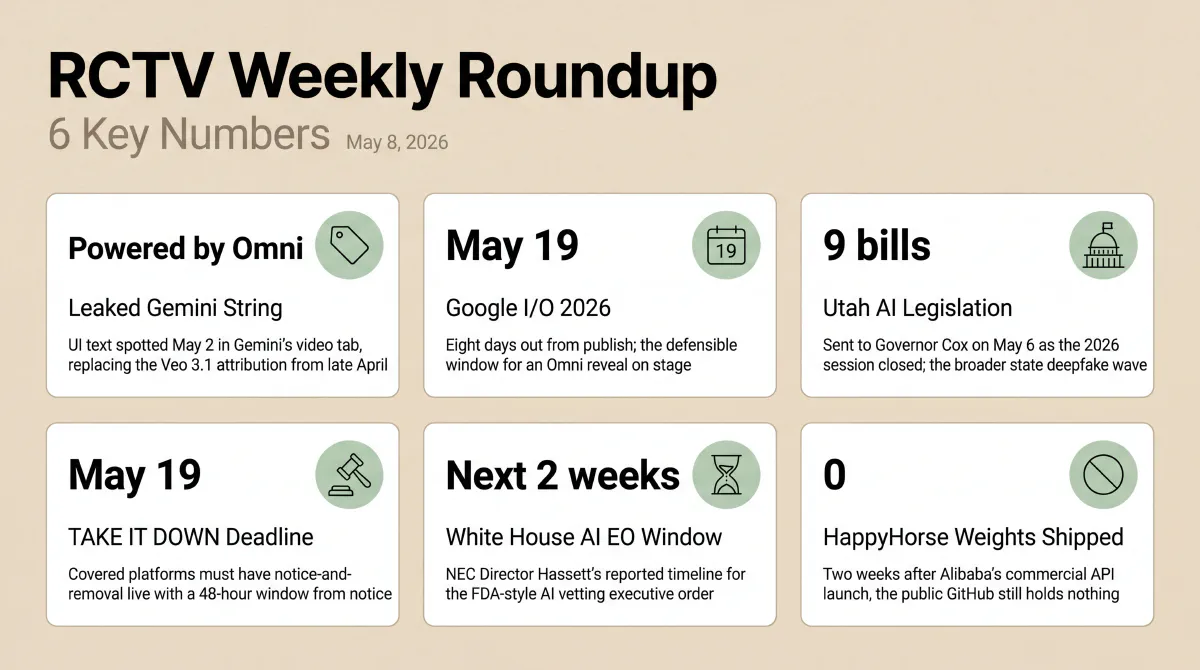
- “Powered by Omni” — the leaked Gemini UI string captured May 2, replacing the Veo 3.1 attribution the same surface carried in late April
- May 19 — Google I/O 2026 opens; the most defensible announcement window for whatever Omni turns out to be
- 9 bills — Utah’s 2026 legislative session closed May 6 with nine AI bills sent to Governor Cox; part of the broader state-level deepfake and chatbot-safety wave
- May 19 — TAKE IT DOWN Act covered-platform compliance deadline, eight days from this roundup
- Next 2 weeks — reported window for the White House AI vetting executive order, per NEC Director Hassett (May 6); CNBC names Google, Microsoft, and xAI as in-scope
- 0 — HappyHorse-1.0 weights shipped two weeks after the commercial API launch; public GitHub and Hugging Face still read “coming soon”
🔮 What to Watch Next Week
- Google I/O Day 1 — May 19. Whether Omni is a Veo rebrand, a parallel new model, or a unified image-video system reveals itself on stage. We’re tracking; the May 25 roundup carries whatever ships.
- TAKE IT DOWN Act takes effect — May 19. Civil enforcement begins May 20. We’re watching for compliance pages from YouTube, TikTok, Meta, X, and the AI video labs themselves; we’ll cover the disclosure pattern once it lands.
- White House AI vetting EO text. Hassett’s “next two weeks” window opened May 6. The actual document, the scope threshold, and whether it lands before or after I/O are the open questions; we’re tracking.
- HappyHorse weights. Ship before I/O or “coming soon” is the operational posture through summer. No new framing from Alibaba in the past week.
For full specs, pricing, and access details on every model covered this week, see the AI Video Stack 2026 reference page — updated every Monday.