Artificial Analysis rebuilt the benchmark everyone cites for image-to-video. With audio, the top is a tie. Without audio, the one clear leader is a model you cannot call by API. Kling’s own developer page stopped saying “not yet” and started selling its 4.0 API by the unit. And “open-sourced” turned out to describe the code, not the weights.
Models covered: Seedance 2.5 · Utopai X · Kling 4.0 · MiniMax H3 · HyperFlow · Runway · Genie 4
📊 Artificial Analysis rebuilt its image-to-video board. Its one clear leader has no API.
Artificial Analysis now labels its image-to-video boards AA-Video-I2V v2.1 and AA-Video-I2V-Silent v2.1. The scores moved to a new, lower scale, so last week’s Elo figures are void rather than “down.” Bach 1.0 Pro read 1362 on the old scale and reads 1120 on the no-audio board now. Compare ranks across the rebuild. Never compare the numbers.
Read the rank range AA prints beside each row, not the rank. On the with-audio board (read Nov 1), Dreamina Seedance 2.5 is first at 1153 ±17 with a range of 1–2, and Utopai X second at 1146 ±16 with 1–3: a two-way tie. Seedance 2.0 (1136, ranked 2–5) and MiniMax H3 (768p) (1128, 3–7) follow. The no-audio board has a clear leader. Utopai X sits at 1155 ±19 with a range of 1–1, the only such row on either toggle. Seedance 2.5 (1128), H3 Max (1122), Bach 1.0 Pro (1120) and Hyperflow H3 (1118) all rank somewhere between second and eighth behind it.
Utopai X is the new name, and it comes with an access footnote. Artificial Analysis announced it on Oct 29 as a post-train on MiniMax H3 from Utopai Studios, available only inside Utopai’s PAI platform, with no public API. Utopai’s price list charges 93 credits a second of 1080p video, on plans from $15 a month for 1,000 credits to $379 for 35,000. By our arithmetic that is roughly $60 to $84 a minute depending on the plan, against $34.12 for Seedance 2.5 on AA’s cost column. The one model that clearly leads a board is the one its readers cannot call.
Now the cost column. AA lists Seedance 2.5 at $34.12 a minute and MiniMax H3 (768p), fourth and 25 points behind, at $4.80: about seven times cheaper. Hyperflow H3, fifth, is $9.00. AA’s footnote says these are the cost to generate a minute on the model creator’s API. If you build for a living, the question is whether 25 points is worth seven times the price.
Bach’s campaign page still says “Now #2 on Image-to-Video.” It names no board, toggle or date. Today Bach is fourth without audio, with a rank range of 2 to 8, and has no row on the with-audio board. Treat any vendor “#2” as unproven until it names the board, the toggle and the date.
Why it matters: A rebuild that reshuffles the top is the benchmark working as designed, and the reader’s job changes with it. Read the rank range, not the rank. Then ask what the leaders cost and whether you can call them.
🔌 Kling’s own page now says the 4.0 API is live
As of Thursday, Oct 29, and unchanged on our Sunday re-read, kling.ai/dev carries the banner “Kling 4.0 API Is Live!” A week earlier the pricing page listed Kling 4.0 as coming soon, with API access “not yet available.” We can’t date the change. Kling’s X account has no API-launch post since Oct 24; its Oct 27 article on Kling 4.0 in production never mentions the API. So we print what the page says and when we read it.
The pricing page sells prepaid packages: $500 for 3,250 units, $2,000 for 13,135 and $8,000 for 53,640. Each lasts 180 days, with no rollover and 20 concurrent jobs. Kling 4.0 without video input costs 1.0 unit a second at 720p and 1.5 at 1080p, with 4K left blank. With video input the rate is 0.6 and 0.9 units, billed on a duration formula: output doubled when the input is no longer than the output, otherwise input plus output. A banner limits the packages to Kling 4.0 and Kling 4.0 Flash, but no Flash row appears on the page. A trial-package tab sits beside them.
Kling prints a unit price, not a price per second. Derived from the unit prices on the page ($0.14915 to $0.15386), Kling 4.0 works out to roughly $0.149 to $0.154 a second at 720p and $0.224 to $0.231 at 1080p without input video. Those dollars are our arithmetic. Runway Dev, a reseller, lists 15.7 credits a second at 720p, 20% off through Nov 30.
The 180-day packages are a commitment, not a rate. Prepay $500, lose what you don’t use in 180 days, and the real cost per second is whatever you manage to burn.
Why it matters: For a week, every host claimed an API the vendor said didn’t exist. Now the vendor’s page says it does, and it sells it in a form that rewards committed volume.
⚖️ HyperFlow Infinity is Apache-2.0 code on weights that exclude the US
Video Rebirth open-sourced HyperFlow Infinity on Oct 25: an agent harness that generates a shot, watches it, updates a memory and directs the next. The vendor’s demo is a 60-minute film generated in a single pass. The repository licenses the code under Apache-2.0. It needs at least four NVIDIA GPUs, and the README says only H200 141 GB has been tested. Its own timing table puts a five-second segment at 49.2 seconds on eight H200s with SGLang, vendor-reported.
The model is a different matter. The harness adds none. It runs MiniMax H3 plus a HyperFlow LoRA, and the README says the LoRA’s weights fall under the MiniMax H3 Community License, not the repo’s. The licence defines the excluded territories as the EU, the UK, South Korea and the United States. It requires written authorization above $20 million in yearly revenue, and it bars use of the works or their outputs outside the permitted territory. Governing law is Hong Kong.
So the code is open and the weights are conditional. The news is the Oct 25 release and what it requires. The LoRA itself dates to Sep 17, 46 days before this issue. The benchmark rows came later. Video Rebirth said on Oct 27 that Hyperflow H3 had “just landed” at #3 on AA’s video-editing board, and AA announced it at #5 on image-to-video on Oct 30, describing it as Video Rebirth’s 8-step LoRA for H3. Video Rebirth also says the model was trained on its own outputs with no external data, which is the vendor’s claim.
The H3 shelf keeps producing derivatives, and the licence travels with each. Six of the with-audio image-to-video top ten are H3 itself or, by AA’s own label, built on it. We’re reporting a mismatch between a headline and a licence. Whether anyone has permission is not something these pages tell us.
Why it matters: “Open source” is carrying more weight in launch posts than in licences. Read the weights’ licence, not the repo’s.
📣 Runway moves up the stack: ads and apps
Runway’s changelog lists Runway Ads on Oct 27 and App Studio on Oct 26. Runway Ads connects to Meta, Google and TikTok accounts, generates video and image variants from a brand kit, and publishes the ones a team approves. It is included in every paid plan and runs on credits. The page names no models. The rest of the week pointed the same way: Runway Dev shipped a Codex plugin on Oct 28, and on Oct 30 Runway Agent gained the ability to open files, run code and build a brand’s launch kit.
The numbers come from Runway’s page about Runway’s own program. It claims “$100M+” in additional annual recurring revenue attributable to its performance marketing. That is ads-program revenue, not Runway’s total. It also claims about 900 ads a week, up from 77, twice the return on ad spend, 34% higher conversion and a 41% lower cost per subscriber since July, with no baseline given. App Studio builds a plain-language app from Runway’s models, on paid plans, using existing credits.
Why it matters: Runway is selling the loop around generation. The figures are Runway’s about Runway.
🌍 Genie 4: a world model, with no price and no date
Google DeepMind’s Genie 4, announced Oct 27, is a real-time interactive world model with natively generated audio. It builds on the Gemini family, with Gemini Omni anchoring how scenes look and behave. It’s a research preview for trusted testers, with Google AI Ultra subscribers in Project Genie and early-access API partners “coming soon.” The page gives a few minutes of continuous interaction, admits drift and object-permanence limits, puts SynthID on outputs, and offers no price, API date or benchmark.
Why it matters: It’s a world model, not a clip generator, so it sits off every board above. The absence of a price is the reader-service fact.
📈 By the Numbers
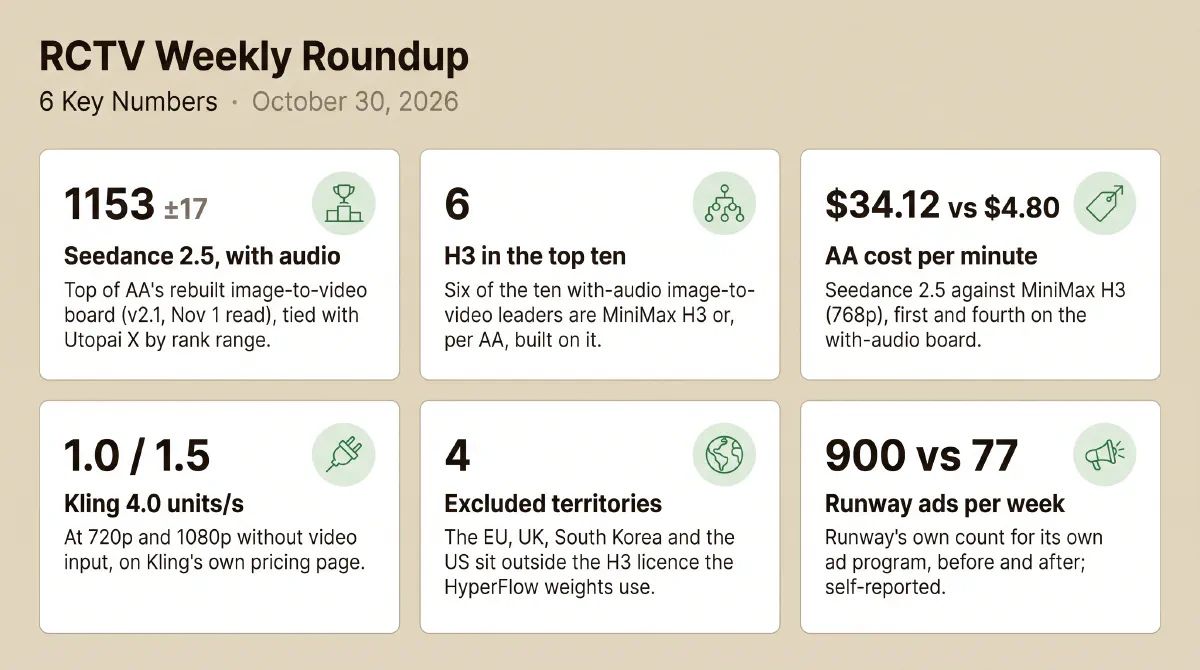
- 1153 ±17 — Dreamina Seedance 2.5 atop Artificial Analysis’s image-to-video board with audio (v2.1, Nov 1 read), tied with Utopai X by AA’s rank ranges.
- 6 — of the ten with-audio image-to-video leaders that are MiniMax H3 or, by AA’s label, built on it: Utopai X, H3 (768p), Hyperflow H3, HeyGen Video 1, P-Video-2-Pro and H3 Max.
- $34.12 vs $4.80 — AA’s cost per minute for Seedance 2.5 and MiniMax H3 (768p), first and fourth on the same with-audio board.
- 1.0 / 1.5 — units a second for Kling 4.0 at 720p and 1080p without video input, sold in prepaid packages from $500 for 3,250 units.
- 4 — territories the MiniMax H3 licence excludes: the EU, UK, South Korea and the US.
- 900 vs 77 — Runway’s own count of weekly ads after and before its ad program, from Runway’s page. Self-reported.
🔮 What to Watch Next Week
- Kling 4.0: a Kling-authored launch post or date, a Flash row, and any Artificial Analysis entry.
- Artificial Analysis: whether Utopai X, the no-audio board’s one clear leader, ever gets an API.
- FLUX 3 Max: fal’s 75%-off rate ends Nov 7, per fal’s page, after which 720p is $0.17 a second.
- Genie 4: an Ultra rollout date, a Gemini API price or a model card.
- EU AI Act: the Dec 2 dates for Article 50(2) marking and the Article 5 intimate-imagery ban are 30 days out.
For full specs, pricing, and access details on every model covered this week, see the AI Video Stack 2026 reference page — updated every Monday.