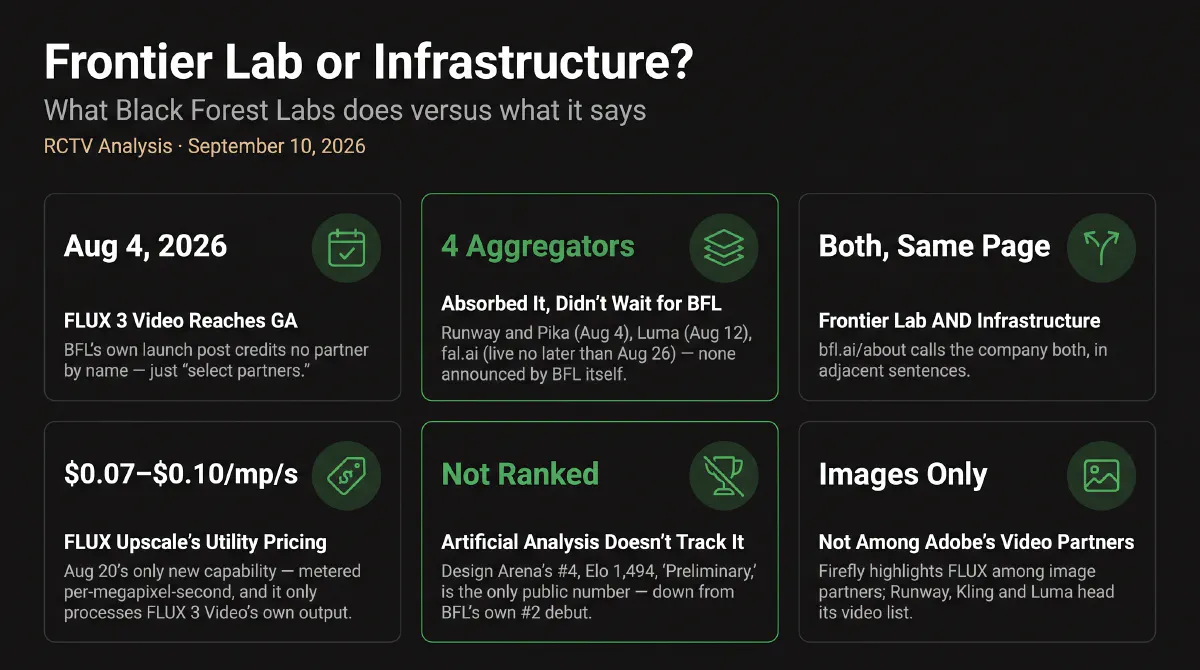
Black Forest Labs’ own About page holds both answers at once, one sentence apart. “We’re the frontier AI research lab for visual intelligence,” it says. Then: “we’re building the foundational infrastructure for visual intelligence.” Nobody at the company seems confused about which one it is. It’s running both plays at the same time — and for its video model, only one of them currently shows up in what the company actually does.
Absorbed, not announced
FLUX 3 Video — the video capability inside BFL’s broader FLUX 3 multimodal model, itself launched July 23 — reached general availability on August 4, 2026. Black Forest Labs’ own launch post doesn’t name a single aggregator; it credits only “select partners,” unnamed. It didn’t need to name them. They named themselves. Runway posted its own integration that same day. Pika, within hours, folded FLUX 3 into “the Pika API Club,” a 100-plus-model marketplace, without mentioning Black Forest Labs anywhere in the announcement copy — FLUX 3 now sits quietly on Pika’s live model catalog instead. Eight days after GA, Luma gave FLUX 3 Video the closest thing to a proper introduction it got from anyone that wasn’t BFL itself: “FLUX 3 is now live in Luma,” describing it as BFL’s first general model spanning image, video, audio, and action-prediction. By August 26 — three weeks in — fal.ai was serving it too, at $0.17 a second for 720p, a rate that reconciles exactly with the $2.55-per-15-seconds line on fal’s own pricing-comparison page that day. Four aggregators picked up the model inside a month, and the relationships kept deepening on their own initiative: Luma had folded in FLUX Upscale as well by September 1, a second BFL tool absorbed without a second BFL announcement. Black Forest Labs didn’t announce any of it.
The infrastructure case
Sixteen days after GA, BFL shipped FLUX 3 Video’s first and, so far, only new capability: FLUX Upscale, a 2K/4K upscaler priced at $0.07 to $0.10 per megapixel-second that processes nothing but FLUX 3 Video’s own output. Worked out per second, that’s roughly $0.14 at 1080p and close to $0.60 at 4K in precise mode — a metered rate card, not a product price. That’s a pipeline utility, priced like one, for a product that already exists — not a new capability aimed at a new audience. It’s also the last thing @bfl_ai has posted. By this piece’s publish date, that’s 21 straight days of silence from the account that carried the entire FLUX 3 Video story.
None of this is a new BFL habit — it’s just running faster than the last time. FLUX, the image model, has quietly run the same playbook for well over a year, embedded inside Adobe Firefly’s Generative Fill. But check Adobe’s own current partner-models page and FLUX sits specifically under “Image Partner Models.” The video section next to it headlines Runway, Kling AI, Luma AI and Topaz Astra — three of them the very companies that just integrated BFL’s video model elsewhere. Black Forest Labs isn’t among them.
The frontier-lab case
The marketing tells a different story. At the G7 in June, CEO Robin Rombach was introduced urging world leaders toward open AI development as the head of “a 90-person frontier AI lab, built on both sides of the Atlantic.” BFL’s own FLUX 3 page promises an open-weight FLUX 3 Dev backbone coming soon and a robotics arm already rolling out with mimic robotics. That roadmap item cuts against its own frame a little: giving weights away is usually how a company argues it’s infrastructure everyone should build on, not how a frontier lab defends a technical lead it’s still selling. And there’s a leaderboard number — sort of. FLUX 3 Video currently sits #4 on Design Arena’s text-to-video board, Elo 1,494, still marked “Preliminary” by the board itself — down from the #2 debut BFL announced on its own account back on August 11. Artificial Analysis, the board every other Big Ten commercial model gets measured against, doesn’t list FLUX 3 Video at all. The only public head-to-head evaluation anywhere comes from a competitor’s launch chart: World Labs’ Atlas post, published September 1, found raters preferred Atlas over FLUX 3 in 93% of camera-controlled trials — a comparison World Labs itself flags as uneven, since rivals “do not accept cameras as a native input format” and had to work from a text description instead. Nobody outside BFL, or a rival trying to beat it, has independently graded this model yet.
The take
BFL hasn’t chosen, and there’s no reason to expect it will resolve the tension for a reader’s convenience. But the marketing and the money are pointing in different directions, and only one of them costs anything to maintain. Silence on X, utility pricing on the one feature it shipped, and absence from the video half of its own oldest enterprise relationship all read like infrastructure economics. The G7 remarks, the open-weight roadmap, and the Design Arena placement read like a lab still selling itself as one. If the image-model precedent is the tell, BFL already made this decision once, on images, over about a year. What’s happening with video looks less like a new decision than the same one, compressed from twelve months down to under one.
What to watch
A fifth aggregator, on top of the four already counted. An enterprise or funding signal that would put revenue behind the frontier-lab language. Artificial Analysis actually adding FLUX 3 Video to a board. Or @bfl_ai posting again.