Sora’s autopsy had one number that did all the work: $15 million a day in peak inference cost against $2.1 million in total app revenue over six months. No pricing tier, no in-app-purchase layer, no $1 billion Disney deal closed that gap, and 30-day retention topped out at 1% — nobody stuck around long enough to find out if it ever could have. The finding wasn’t “AI video doesn’t work.” It was narrower: consumer-subscription video generation didn’t cover its own compute cost, full stop.
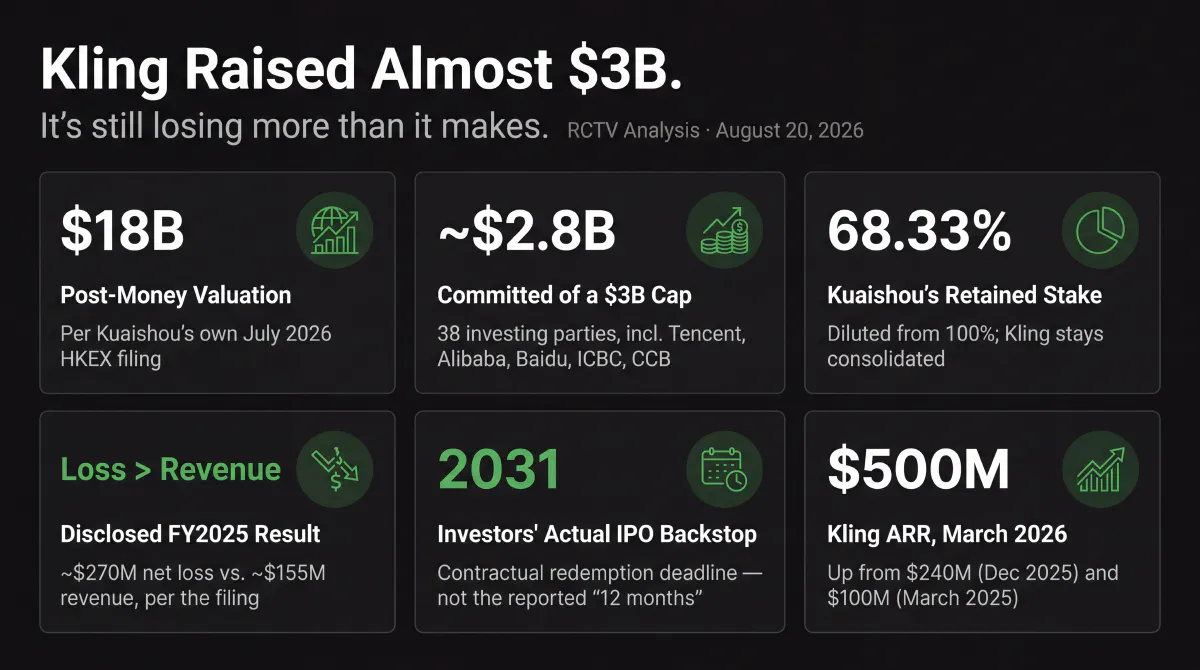
Kling bet the opposite way — enterprise and API access first, broadcast-grade 4K, a capital structure built for years rather than app-store cycles. In July, Kuaishou closed what several outlets called the largest financing round in AI video’s short history for its Kling AI subsidiary: nearly $2.8 billion committed against a $3 billion cap, an $18 billion post-money valuation, Tencent and Alibaba and Baidu among the investors. If Sora proved the consumer bet doesn’t work, Kling’s own disclosure is where the enterprise bet gets checked. Revenue growth and a marquee cap table aren’t the test. The unit economics are — and Kuaishou’s own paperwork has more to say about those than the headlines did.
The Numbers, As Kuaishou Filed Them
On July 2, 2026, Kuaishou filed a discloseable-transaction announcement with the Hong Kong Stock Exchange — a legal disclosure under HKEX Listing Rules, not a press release. The filing itself is the primary source underneath every “$3 billion / $18 billion” headline that followed, and it’s more precise than most of them.
The structure: 21 “Initial Investors” — including two of Kuaishou’s own independent directors, investing through personal vehicles and recusing themselves from the board vote — committed RMB13.82 billion (US$2.03 billion). Fifteen more joined the same day for another RMB5.22 billion (US$766 million): roughly US$2.79 billion signed as of the filing date, with room for more investors to join within 60 days, up to a hard cap of RMB20.45 billion, or US$3 billion. “Nearly $3 billion” is accurate. “$3 billion,” flat, is the ceiling, not yet the number.
The valuation: Kuaishou’s board set Beijing Kling’s — the new entity created to hold the business — pre-money value at US$15.00 billion, benchmarked against comparable publicly traded AI companies in the US and Hong Kong. At the full $3 billion cap (16.67% of the enlarged company), that implies the roughly $18 billion post-money figure every outlet led with. It landed below the roughly $20 billion target Kuaishou had floated in May.
Kuaishou keeps control: its stake dilutes from 100% to precisely 68.33%, and Beijing Kling’s results stay consolidated onto Kuaishou’s own books. The roster of 38 investing parties reads less like momentum money and more like a cross-section of Chinese institutional capital that ran its own diligence: Tencent, Alibaba Cloud, and Baidu, alongside vehicles tied to ICBC and China Construction Bank, three separate CITIC Securities entities, two Beijing municipal government investment funds, state capital out of Shanghai and Shenzhen, Primavera Capital, Qiming Venture Partners, and one clearly foreign check — Abu Dhabi-based BlueFive Investments. That’s a genuinely different signal than Sora’s situation, where the money was OpenAI’s own and retention data was the only real market feedback available.
None of that, on its own, tells you whether the business underneath it works.
What the Filing Doesn’t Answer
Sora’s failure was specific and falsifiable: the marginal cost of generating a clip exceeded what any subscription price the market would bear could cover. Kling’s public disclosure never gives that number — cost per generation, revenue per generation — for the simple reason that no video-generation company publishes it. What Kuaishou did disclose, in the same July filing, is a company-wide accounting result, and the two aren’t interchangeable.
On a pro forma basis — Kuaishou’s own estimate of what the numbers would look like once the restructuring that formally moves Kling’s assets into this entity is complete, which it isn’t yet — Beijing Kling’s unaudited net loss was approximately RMB0.5 billion (roughly $70 million, at ~¥7 to the dollar) in 2024 and approximately RMB1.9 billion (roughly $270 million) in 2025, against 2025 revenue of about RMB1.1 billion (roughly $155 million). Net assets at year-end: negative RMB9 million. Put plainly: on Kuaishou’s own numbers, Kling lost more in 2025 than it made.
That sits oddly next to the record-round headline, and it deserves equal billing. But it doesn’t resolve the Sora comparison either way. The generous read: a net loss on a frontier-model business scaling headcount, R&D, and data-center capacity isn’t automatically a unit-economics failure the way Sora’s was. Sora’s marginal cost got worse with every additional user; a loss driven by fixed investment can shrink as revenue scales past it, the way capital-intensive infrastructure businesses are supposed to work eventually. Nothing in the filing says which pattern Kling is on.
The less generous read: Kuaishou’s own Q2 2026 consolidated gross margin fell to 51.6%, down from 55.7% a year earlier, on rising revenue-sharing and bandwidth costs — RMB18.3 billion of gross profit against RMB19.5 billion the year before. Kling is too small a share of Kuaishou’s quarterly revenue for that move to be pinned on Kling specifically, and Kuaishou’s own results release files Kling’s revenue under “other services,” lumped in with e-commerce.
Kuaishou does now put one Kling number on the record: revenue of over RMB850 million in the second quarter, growing more than 200% year over year. That is the most specific figure the company has ever published about this business, and it is a revenue figure. Search the same release for a margin and there are five mentions, all of them consolidated and company-wide — gross margin and adjusted net margin for Kuaishou entire. “Other services” gets a revenue line and a growth driver (“primarily due to the growth of our Kling AI business”); it never gets a margin. Operating profit is broken out by geography, not by product.
So the disclosure moved, and the gap did not. That’s the actual, honest finding here: the specific number that would settle this — Kling’s own gross margin, or a per-generation cost figure, or anything isolating the AI-video business’s marginal economics — still isn’t public. Not hedged, not implied. It doesn’t exist outside Kuaishou’s internal reporting.
The same gap shows up on revenue quality. The filing states that Kling “offers paid subscription memberships for prosumers and API services for enterprise clients” — confirming the enterprise motion is real, which is more than Sora ever had. What it doesn’t say is the split. Is $500 million in annualized revenue mostly enterprise contracts, or still mostly consumer subscriptions with an API surface layered on top? RCTV’s own tracking of Kling’s pricing can’t answer it either: Kuaishou has never published official per-second API rates for its current models, so even the rough compute-cost sanity check the Sora piece used isn’t available here — third parties resell Kling’s API; Kuaishou doesn’t publish what it charges or how that revenue splits by channel.
Kling’s disclosure confirms half of the pro-infrastructure thesis and leaves the other half genuinely open. The enterprise motion is real. The capital behind it did its homework. What isn’t confirmed is the actual test the April piece proposed: whether the unit economics hold, or whether Kling is doing a version of what Sora did — buying growth at a loss a subscription-and-API blend hasn’t yet covered — just with a balance sheet large enough to run the experiment for years instead of months.
Updated 2026-09-01: the margin figures in this piece originally cited Kuaishou’s Q1 2026 results. Q2 was released on August 19, a day before this piece published, and the Q2 figures (51.6%, down from 55.7%) now stand in their place, along with the RMB850 million Kling revenue line Q2 disclosed for the first time. The piece’s argument is unchanged — Kuaishou discloses Kling revenue and still discloses no Kling margin, which is the gap this piece is about.
The IPO Timeline Everyone Reported, and the One the Contract Says
Every outlet that covered this financing repeated a version of the same detail: Kuaishou plans to start Kling’s Hong Kong listing process within 12 months. South China Morning Post’s sourcing, citing people familiar with the plans, is the origin point most English-language coverage traces to — solid Tier-1 China-beat reporting, but sourced to “people familiar,” not to Kuaishou on the record, and it isn’t written into the July 2 filing itself.
What is written into the filing is a different number. Each investor’s Redemption Right — Beijing Kling’s contractual obligation to buy back their stake, plus an 8% annual return, if the IPO doesn’t happen — only becomes exercisable if the company fails to list before what the filing calls the “Latest Listing Date”: the fifth anniversary of the deal’s “Latest Payment Date,” or October 30, 2031, whichever comes first. That’s roughly five years, not twelve months.
This isn’t a contradiction so much as two different kinds of promise. “Within 12 months” is a stated ambition, relayed through press briefings — nobody signed it. The five-year window is what 34 independent investors, Tencent, and several of China’s largest banks actually negotiated as their downside protection, and sophisticated pre-IPO investors routinely take the longest reasonable backstop regardless of how fast management says it plans to move — a five-year clause isn’t evidence the near-term plan is fake. But it is evidence that “investors are voting on this thesis with a fast, forced deadline” overstates what the money is actually locked into. The restructuring that formally moves Kling’s assets into the listing entity isn’t even due to finish until roughly nine months after payment closes — sometime around mid-2027 — which makes an early-2027 filing target tight on the mechanics alone, whatever management is telling reporters.
If a listing application does land inside the next year, it’s the event that could actually resolve the unit-economics question above: prospectus-stage disclosure is where segment financials, per-business margins, and revenue-mix breakdowns become mandatory rather than optional. Until then, the IPO plan is real evidence of institutional confidence in Kling’s trajectory — it just isn’t the fast, forced test the “12 months” headlines implied.
The Verdict
Call it not falsified, not confirmed. Kling clears a bar Sora never approached: a genuine enterprise/API revenue channel, a cap table built by investors who ran their own comparable-company analysis rather than chasing a headline, and revenue tripling year over year rather than cratering. If the test were “does professional-infrastructure-first video generation attract real capital and real enterprise demand,” Kling passes it, on numbers Kuaishou itself signed.
That was never the whole test, though. The April piece’s actual finding was narrower: that the marginal economics of AI video generation didn’t work at the price consumers would pay. Kling’s own disclosure shows a business losing more than it earns, with that loss growing faster than revenue in the one year Kuaishou is willing to show — without ever isolating whether the underlying unit economics are the problem, or just the ordinary cost of building infrastructure ahead of scale. Nobody currently has the number that would settle it — not Kuaishou, not the 38 investors who diligenced this exact question, not RCTV. That’s not evasion on Kuaishou’s part; segment-level unit economics for a two-year-old product line inside a much larger public company aren’t something most companies volunteer, and Kling isn’t required to disclose them until it files to list on its own.
What to Watch
The prospectus, if one gets filed, is the actual test — Hong Kong listing documents require segment financials that would show Kling’s own margin and, potentially, its revenue split. Watch whether Kuaishou starts breaking Kling out of “other services” in its own quarterly disclosures before that; a company confident in the number usually shows it early. And watch the loss trajectory specifically: a 2026 net loss that narrows relative to revenue is a scale story working as advertised. One that keeps outrunning the top line is Sora’s problem, wearing a bigger balance sheet.
For current specs, pricing, and benchmark rankings across all active AI video models, see the AI Video Stack 2026 reference page — updated every Monday.