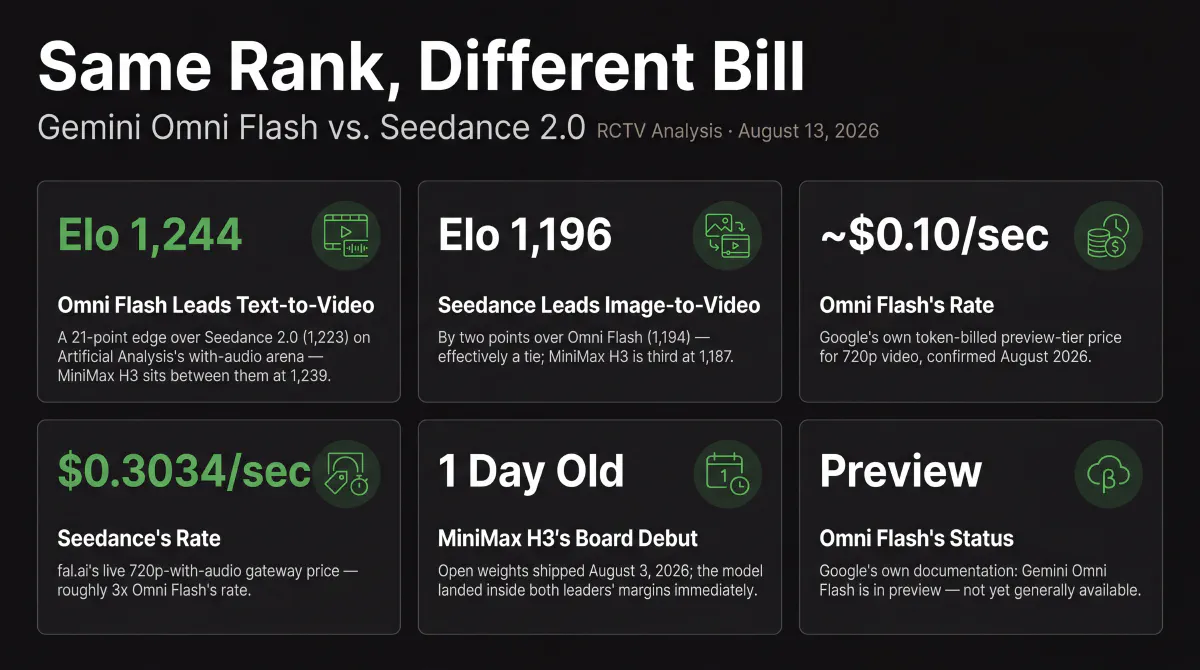
Gemini Omni Flash beats Seedance 2.0 by 21 Elo points on one Artificial Analysis board. Seedance beats Omni Flash by two points on the other. MiniMax H3 — a model that didn’t have open weights a week ago — sits inside both margins. If the question is “which model wins,” the honest answer this week is: none of them, clearly. If the question is which one you actually want for a specific job, the leaderboards aren’t the instrument that answers it. The spec sheets and the price tags are.
The scores
As of August 4, 2026, on Artificial Analysis’s text-to-video and image-to-video arenas — both defaulted to the with-audio board, the only one where these two audio-native models are directly comparable — the picture is close enough to call a wash.
| Gemini Omni Flash (Google) | Seedance 2.0 (ByteDance) | |
|---|---|---|
| Text-to-video, with audio | #1, Elo 1,244 | #3, Elo 1,223 |
| Image-to-video, with audio | #2, Elo 1,194 | #1, Elo 1,196 |
| Votes logged (T2V / I2V) | 10,644 / 5,763 | 17,330 / 11,367 |
Omni Flash’s text-to-video lead is real but not commanding — 21 points, with MiniMax H3 sitting a hair behind at 1,239. The image-to-video “lead” for Seedance is two points, inside the range that flips on the next few hundred votes; Seedance has logged nearly double Omni’s I2V sample size, so its position is the more settled of the two.
The structural fact that matters more than either number: this stopped being a two-model race the moment MiniMax shipped H3’s open weights on August 3, with Day-0 support landing simultaneously across ComfyUI, vLLM, and SGLang. A model with no track record a week ago is already inside the margin separating the two incumbents on both boards. Any comparison that treats this as a clean two-horse contest is already out of date.
The bill
Where the boards blur, the invoice doesn’t. Google’s pricing page bills Omni Flash by output tokens — 5,792 tokens per second of 720p video under standard pricing — which works out to an effective rate near $0.10 per second. fal.ai’s live gateway prices Seedance 2.0’s standard 720p-with-audio tier at $0.3034 per second, with a faster tier at $0.2419 and 1080p at $0.682. That’s roughly three times Omni’s rate for the comparable 720p tier — the cleanest, least ambiguous number in this whole comparison.
One reconciliation worth stating plainly: Artificial Analysis’s own attributed figure for Seedance’s standard tier runs lower, around $0.151/sec — a number RCTV’s own Stack page already flagged and resolved in favor of the live gateway rate, since it’s what a developer’s card actually gets charged. Use fal.ai’s number, not the aggregator’s estimate, when the two disagree.
And a caveat that belongs next to any Omni Flash price: Google’s documentation states plainly, “Gemini Omni Flash is in preview” — not generally available. The $0.10 rate is a preview-tier number attached to a model Google hasn’t finished shipping. (This is the paid developer API, separate from the free consumer experience inside YouTube Shorts — different product, different economics.)
What each one is actually built to do
The “cheap and simple vs. expensive and complex” framing gets the price half right and oversimplifies the rest. Omni Flash’s differentiator isn’t that it does less — it’s the interface. Google positions it as built for “multi-turn conversational editing,” with character consistency carried across successive edits inside one session: generate a clip, then talk your way through changing a camera angle or swapping an element, without restarting from a fresh prompt. That’s a genuinely different production loop from a single render call — the practical value of staying in one session isn’t just convenience, it’s the model holding a character’s voice and look steady across several iterative passes.
ByteDance’s own description of Seedance 2.0 points the other direction: “full control over performance, lighting, shadow, and camera movement,” specified up front from combined image, audio, and video references in a single generation. fal.ai’s listing is specific about what that control is for — “more realistic rendering of complex interactions like sports, dancing, fighting, object collisions.” That’s a director-brief model: you choreograph the shot before you generate it, rather than talking your way there afterward.
So the real axis isn’t simple-vs-complex. It’s iterative-and-conversational versus single-pass-and-precise. A talking-head explainer, a quick product edit, anything that benefits from three rounds of “now make the lighting warmer” plays to Omni Flash. A stunt sequence, a dance number, anything where two things need to physically collide correctly on the first take plays to Seedance.
The take
Rank isn’t the question that matters here, and the boards make the case for us: a 21-point spread on one arena, a 2-point spread on the other, and a model that debuted six days ago sitting inside both. When a launch announcement claims “#1,” the useful follow-ups are which board, by how much, and against how many votes — on this pair, this week, the honest answer is “barely, and it depends which board.” The number that actually separates these two products is the invoice: roughly three times the per-second cost, buying a model built around single-pass precision instead of conversational iteration. That’s a real choice. It’s just not the one the scoreboard is making for you.
What to watch
MiniMax H3 didn’t stop at shipping open weights — it’s contesting both Artificial Analysis boards from a standing start, and a credible third model with no accumulated baggage changes what “winning” this arena is even worth. Watch whether Seedance 2.5’s 30-second single-pass mode reaches a public price before this comparison needs another pass, and whether Omni Flash’s preview tag comes off — a GA release usually arrives with a pricing change, not just a status change.