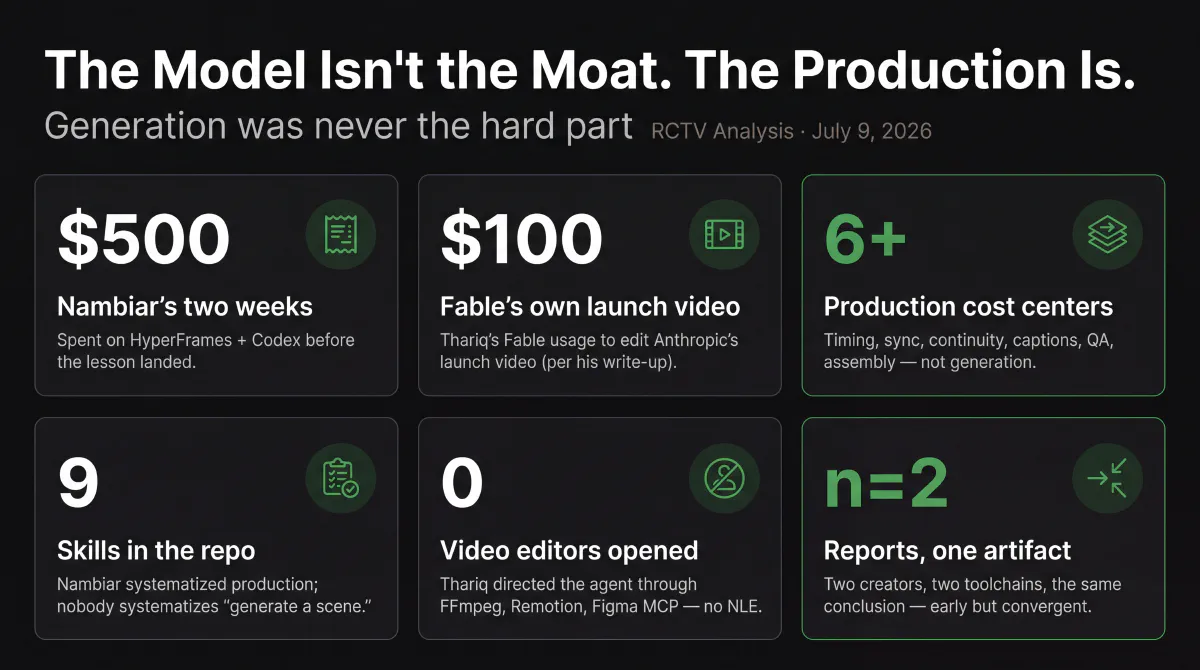
Sara Nambiar spent close to $500 in two weeks and walked away with a conclusion that has almost nothing to do with the tool she paid for.
She had been making videos with HyperFrames — HeyGen’s open-source framework for building scenes as code — driven by the Codex coding agent. Going in, she figured the hard part would be generating the scenes. It wasn’t. HyperFrames generated scenes fine. The money and the hours went somewhere else: lining animations up with narration, fixing captions that landed half a second late, holding continuity from one scene to the next, re-rendering a section three times to make one small change stick. Her verdict, posted June 14: the work is “much closer to a production workflow problem” than a generation one.
That sentence is the whole argument. And she is not the only person who reached it this month.
The model stopped being the hard part
For two years the AI-video story was a model story. Whose clip is longest, whose motion is cleanest, whose price per second is lowest. That contest is still running, and somebody still has to build the best engine. But the engine is getting cheap, fast, and everyone can rent one.
Look at the last few weeks of shipping. Seedance 2.0’s native 4K reached three platforms inside a 24-hour distribution wave; HappyHorse-1.1 posted the strongest leaderboard debut since Grok Imagine. When a frontier model lands on four aggregators in an afternoon and the top of the leaderboard reshuffles by a handful of Elo points, “which model” stops being a durable question. We said in May the prompt was no longer the moat. We said in June the orchestration layer — who picks the model — was becoming the product. This is the next floor down. Even for one creator with one model and no aggregator in sight, the generation step is not where the work is.
Nambiar’s field report is the cleanest statement of it. HyperFrames, she found, is genuinely good at scenes — charts, glassmorphism, animated diagrams, camera moves. What it does not do is hand you a finished video. A chart fixed in one scene is still wrong in the next. A caption lands late. A transition technically works and still feels off. None of it is hard on its own. It adds up fast, and it is exactly the stuff a viewer notices.
What the hard part actually is
Enumerate the layer and it looks unglamorous: narration timing, audio sync, continuity between scenes, caption styling, music ducking, final QA, assembly. None of that is a model capability. All of it is production.
But the enumerated list is the shallow version of the point. The deeper one is about iteration. Nambiar’s most useful finding was that the first render is rarely the final one, and often it isn’t close — so the projects that turned out best were the ones she could iterate through quickly. The goal, she writes, is not the perfect first render. It is lowering the cost of getting to the next version.
That reframe changes what “good at prompting” means. Her example, from a B2B launch video: telling the agent to “make the graph appear more gradually” got inconsistent results; specifying that the line should reach each data point on a named second, and that points appear only once the line arrives, got the shot. One prompt describes an outcome. The other describes a behavior — the exact relationship between what’s spoken and what’s on screen. The winning prompts weren’t longer. They were more precise about state over time.
Everyone markets the generation step. The value is in everything after it.
Two more of her highest-impact lessons matter because they are about protecting iteration, not producing pixels. The first: a target beats a description. Before a major scene she’d generate a concept image of the exact final frame — not a moodboard, an actual target state — and hand it to the agent alongside the requirements. The conversation shifted from “make this better” to “make it look like this,” and the iteration count dropped, because the agent was converging on something concrete instead of guessing. The second: telling the agent to leave finished work alone (“do not modify Scene 01; treat it as approved”) prevented it from quietly re-breaking things that already worked. A surprising amount of iteration time gets burned when an agent tries to improve output that was already signed off.
Sit with that. Two of the highest-payoff moves in an AI-video workflow are giving the system a fixed target and telling it what not to touch. Neither is a generation problem. Both are production discipline.
A second chair, a different toolchain, the same conclusion
Now move to the opposite end of the market. In June, Anthropic engineer Thariq Shihipar used the company’s Fable model, driven through Claude Code, to edit Anthropic’s own product launch video — and wrote up how. Whisper for transcription. FFmpeg for cutting and assembly. LUT files for color grading. Remotion for motion graphics rendered as code. The Figma MCP to pull design in and push it back. His summary line: “I didn’t touch a video editor.”
Read that precisely. He directed the agent; he didn’t open a timeline. The autonomy is in the assembly, not the judgment — a human decided what the cut should be, and the model executed the transcribe-cut-grade-render loop that a person would otherwise do by hand in an NLE. By his own account the job ran to roughly $100 in Fable usage, most of it spent iterating on the UI graphics rather than generating any footage.
One disclosure the reader is owed, in one sentence: this is Anthropic-internal — an Anthropic engineer used Anthropic’s model on Anthropic’s own video, written up here by an operation that itself runs on Claude. It doesn’t invalidate the evidence; it does mean you should weight it as a dogfooding demo, not a disinterested one.
With that caveat sitting in plain view, the shape still holds. Two people, in different chairs — an independent creator doing paid client work on Codex plus HyperFrames, and a lab engineer editing a corporate launch on Claude Code plus Fable — arrived in the same month at the same conclusion from opposite directions. The scene was the easy part. The production loop around it was the work. That is two data points, not a law. But they don’t share a toolchain, a budget, or a reason to agree, and they agree.
The tell is what got systematized
Here is the structural evidence, the part that outlasts any single field report. Nambiar didn’t just conclude the production layer was hard. She turned it into a public repository of nine reusable skills — scene continuity, audio-sync assembly, captions and music, render QA and surgical edits, FFmpeg utilities, storyboard and intake templates. Its stated goal is to “capture production patterns that agents repeatedly need.” Not a prompt library. A production codex.
Notice what is not in it: a skill for generating a good scene. Nobody builds a reusable system for that, because with a competent model it isn’t the repeatable problem. What repeats — what pays to systematize — is everything that happens after the scene renders. The repo is a personal project, not an official HeyGen artifact, and it is two weeks old. But it is the clearest possible signal of where the durable value sits: you build reusable machinery around the part of the job that is genuinely, repeatedly hard.
So what
If the production layer is the moat, three things follow.
The vendors racing to own the workflow rather than the model — the orchestration and editing agents from HeyGen, Higgsfield, Runway, and the rest — are betting correctly, whatever you think of any specific product. This week’s roundup caught all three pushing on that layer at once — HeyGen’s agentic routing, Higgsfield zeroing its price, Runway signing an enterprise conglomerate. The value is migrating to whoever owns assembly, iteration, and context, and they can see it as clearly as Nambiar can.
The durable advantage for a creator is a production system, not prompt-craft. Anyone can type a good prompt into a model that keeps getting better at forgiving bad ones. Far fewer people have a repeatable process that carries continuity, timing, and approved work through twenty renders without regressing. That process is the asset. The prompt is table stakes.
And the demo to distrust is “look what I generated.” A single stunning first render tells you the model is good, which we already knew, and which is becoming true of every model. It tells you nothing about whether the person can ship a finished, revised, on-brand two-minute video without burning $500 in re-renders. The impressive thing was never the scene. It was getting to the next version cheaply.
The obvious objection is that this is temporary — that the next generation of models simply absorbs the production layer, the way each generation has absorbed the last hard thing. Maybe. But notice what the production layer actually is: continuity across a whole timeline, timing tied to a specific script, a target the creator holds in their head, and a running memory of what has already been approved. Those are not scene-quality problems that a better renderer solves. They are context and judgment problems — which is exactly why the tooling that’s emerging around them looks like agents and skills and repos, not like bigger models. The layer might get automated. It won’t get automated by making scenes prettier.
The honest limit: this is two field reports and one repository, all from a single month, one of them internal to a model lab. It is a strong signal, not a settled result — the kind of convergence that is worth naming early precisely because it hasn’t been priced in yet. If the pattern holds, the question that decides who wins in AI video stops being “whose model is best” and becomes “whose production loop is cheapest to iterate.” Two people spent June learning that the expensive way. The rest of the field can read it for the price of a GitHub star.