No major video model launched in the June 6–12 window. What moved instead: the surfaces where existing models now live, a new legal theory applied to AI-generated likenesses, and the first open-weight video model from a government-backed program in India. The release calendar went quiet. The distribution war and the regulation race didn’t.
Models covered: Grok Imagine 1.5 · Varya
🔁 Higgsfield’s Routing Bet, in Product Form
The week’s two most significant Higgsfield moves both landed June 8: the launch of a DaVinci Resolve plugin — putting AI video generation inside Blackmagic Design’s professional editing suite — and the integration of Grok Imagine 1.5 into Higgsfield’s own platform. Those two closed a 12-day distribution sprint that began May 28.
The arc: Claude MCP integration (May 28), Adobe Premiere and After Effects bundle (May 29), Higgsfield Reframe on the web app (June 1), Figma plugin for design-to-video workflows (June 4, 297K impressions at launch), Minecraft mod embedding text-to-video inside the game engine (June 5, 422K impressions), and then DaVinci Resolve plus the xAI model integration on June 8. Five external platform integrations in 12 days.
The Grok Imagine 1.5 integration is the more pointed move. A competitor’s model, running inside Higgsfield’s surface, generating video that counts as a Higgsfield session. Higgsfield takes the customer relationship; xAI takes the compute cost. That’s the agentic-orchestration thesis expressed as a product decision rather than a competitive presentation. The underlying model becomes a routing choice. Higgsfield is betting it can be the surface users reach first across enough contexts that the model question stops mattering.
DaVinci Resolve extends the bet upmarket. Blackmagic’s editor is the professional NLE of record for feature film and broadcast post-production. That’s a different buyer conversation than Figma or Minecraft — editorial supervisors and colorists who have strong opinions about tools that don’t hold up. Getting Higgsfield onto that desktop is either a signal that the quality threshold is there, or an aggressive bet that it will be before the professional audience tests it seriously.
Why it matters: Distribution compounds differently than capability. Higgsfield is not the top model on Artificial Analysis. It is the company with AI video generation embedded in the most creative environments right now. If the routing-bet thesis holds, that gap is harder to close than a leaderboard position.
⚖️ Washington’s Deepfake Law Took Effect. The Legal Theory Matters.
SSB 5886 took effect June 11, and the framing in most headlines — “deepfake law” — undersells what actually changed. This is not a nonconsensual intimate imagery statute. It is a personality-rights expansion, and personality rights reach places the NCII framework never did.
Washington’s Personality Rights Act (RCW 63.60) already protected name, voice, signature, photograph, and likeness from unauthorized commercial use. SSB 5886 adds “forged digital likeness” to that list: any AI-generated or AI-altered visual or audio representation that is indistinguishable from the real person and likely to deceive a reasonable viewer. The civil penalty rises from $1,500 to $3,000 per violation. Courts can now award noneconomic damages — pain and suffering, reputational injury — in addition to actual economic loss.
The noneconomic damages provision is the structural shift. NCII statutes generally require proof of economic harm to clear the damages threshold; noneconomic damages don’t. Personality rights also attach to both living individuals and certain deceased persons, which means the law covers historical likenesses used in commercial AI-video contexts — archive footage reimagined, historical figures voiced, post-mortem appearances generated. The NCII statutes were not designed to reach any of that territory.
The vote was 47-0 in the Senate and 85-9 in the House. This is not contested terrain in Washington.
RCTV has tracked this regulatory arc through Connecticut, Arizona, Hawaii, and California. Washington is the first to deploy personality rights rather than NCII or election-integrity theory. The state stack isn’t just growing; it’s testing different legal instruments. Any commercial AI-video product that generates recognizable likenesses now needs to reason across at least three distinct legal frameworks simultaneously, and those frameworks don’t cover the same fact patterns.
Why it matters: Personality rights reach commercial AI-video use cases the NCII statutes were not built to touch. The per-violation floor doubling plus noneconomic damages raises the cost of non-compliance before a single dollar of economic loss is proven.
🌏 India’s Varya Enters the Market at $0.005 per Second
Avataar.ai launched Varya on June 11 — an open-weight video generation model distilled from Alibaba’s Wan 2.2. Four distillation steps where Wan 2.2 uses 50. The result: 5-second, 720p clips on an H200 GPU in 45 seconds, at ₹0.48 per second — roughly $0.005, about 20× below what Veo, Kling, Luma, and Runway charge.
The weights are available on AI Kosh, India’s government model repository. The model was trained on Indian cultural contexts — festivals, food, clothing, architecture — and is one of 12 projects selected under the $1.2 billion IndiaAI Mission program. Peak XV Partners (formerly Sequoia India/SEA) also invested. The launch took place in the presence of India’s Ministry of Electronics and Information Technology secretary.
Multiple Indian outlets including Outlook Business report 14B parameters; TechCrunch does not confirm the figure independently, and Artificial Analysis has not benchmarked the model. The 20× cost claim is vendor-reported. Avataar.ai’s primary web presence returned a 404 at draft time, so the company’s own published specs weren’t accessible for direct verification.
What is verifiable: Varya is open-weight, government-backed, and priced well outside the range where the current global market leaders operate. That combination is new to this beat.
This is the second consecutive roundup with a sub-market price data point — Agnes-Video’s $0.30 per minute appeared last week. The pattern is consistent even if each individual figure carries uncertainty: the global price floor for AI video generation is falling, and the pressure is coming from directions the major leaderboard vendors did not build their pricing around.
Why it matters: Government-backed open-weight video models from large economies are a category the global pricing structure wasn’t designed for. Varya isn’t competing on Artificial Analysis this month. It’s competing for a market of 1.4 billion people who were never the target customer for $0.10-per-second cloud generation.
📈 By the Numbers
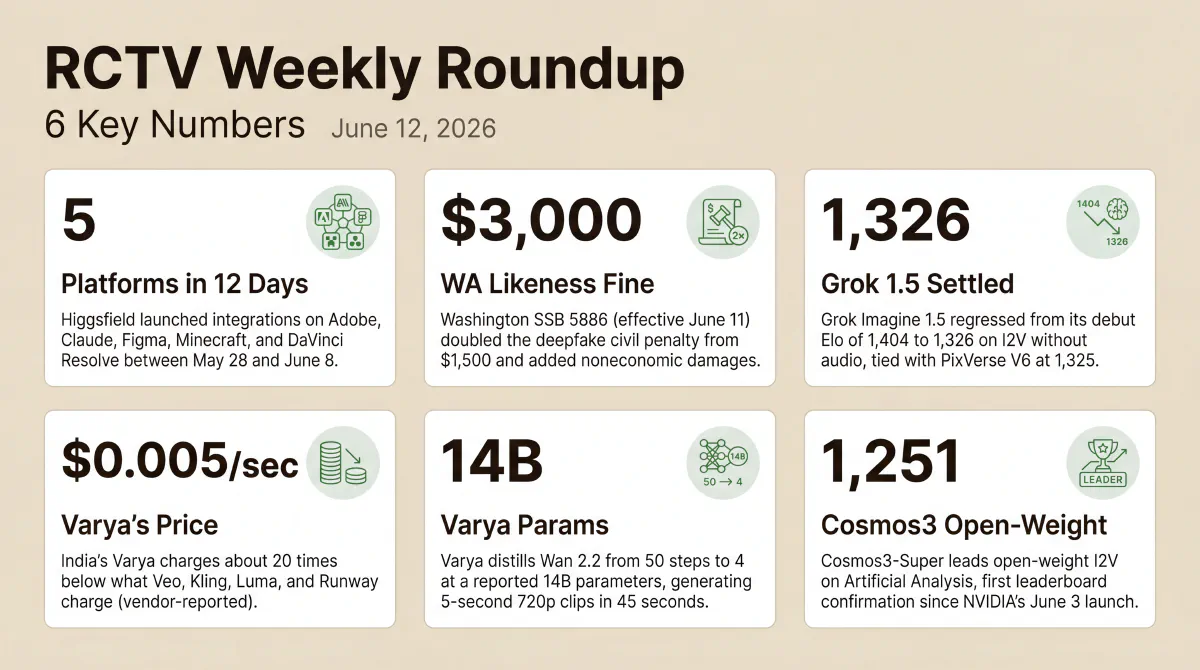
- 5 — Higgsfield external platform integrations launched in 12 days: Adobe Premiere and After Effects (May 29, counted as one bundle), the Claude MCP integration (May 28), a Figma plugin (June 4), a Minecraft mod (June 5), and the DaVinci Resolve plugin (June 8)
- $3,000 — Washington’s new civil penalty floor per deepfake violation under SSB 5886, doubled from $1,500 and effective June 11; noneconomic damages are now also recoverable
- 1,326 — where Grok Imagine 1.5’s debut-week Elo of 1,404 settled on I2V without audio — effectively tied with PixVerse V6 at 1,325, both 19 Elo behind Seedance 2.0’s #1 at 1,344; T2V rankings unchanged (HappyHorse #1 without audio, Seedance #1 with audio)
- $0.005/sec — Varya’s cloud-hosted price per second of generated video (₹0.48), vs. $0.10-plus for Veo, Kling, Luma, and Runway; vendor-reported and not yet Artificial Analysis validated
- 14B — Varya parameter count per Indian outlet corroboration (Outlook Business, IndianWeb2, others); not confirmed by TechCrunch and not independently benchmarked
- 1,251 — Cosmos3-Super’s Elo on Artificial Analysis’s open-weight I2V leaderboard — the first board data point confirming the model’s competitive position since NVIDIA’s June 3 launch announcement
🔮 What to Watch Next Week
- Idaho HB 727 — effective July 1 (16 days out). Idaho becomes the first US state to explicitly define AI-generated synthetic media within video voyeurism statutes. After Washington’s personality-rights move this week, the regulatory filing pressure on AI-video applications accumulates from both directions — NCII/voyeurism theory and personality rights — without federal preemption.
- EU AI Act Article 50 — disclosure August 2, watermarking December 2 for systems already in market; California’s AI Transparency Act (SB 942, as amended by AB 853) — August 2. The May 2026 AI Omnibus agreement keeps August 2 for the disclosure and deepfake-labeling obligations but grants a four-month grace period — to December 2 — on the harder machine-readable watermarking requirement (Art. 50(2)) for generative systems placed on the market before August 2; the Code of Practice defining the technical standard is still in draft. So the EU date is a staircase, not the single cliff we and others framed it as. California’s AI content detection-tool mandate holds at August 2. Both regimes cover AI-generated video.
- OpenAI’s confidential S-1 (filed June 8). Off-beat today. On-beat when the document surfaces and shows what consumer video actually cost them — and the Sora API sunsets September 24.
For full specs, pricing, and access details on every model covered this week, see the AI Video Stack 2026 reference page — updated every Monday.