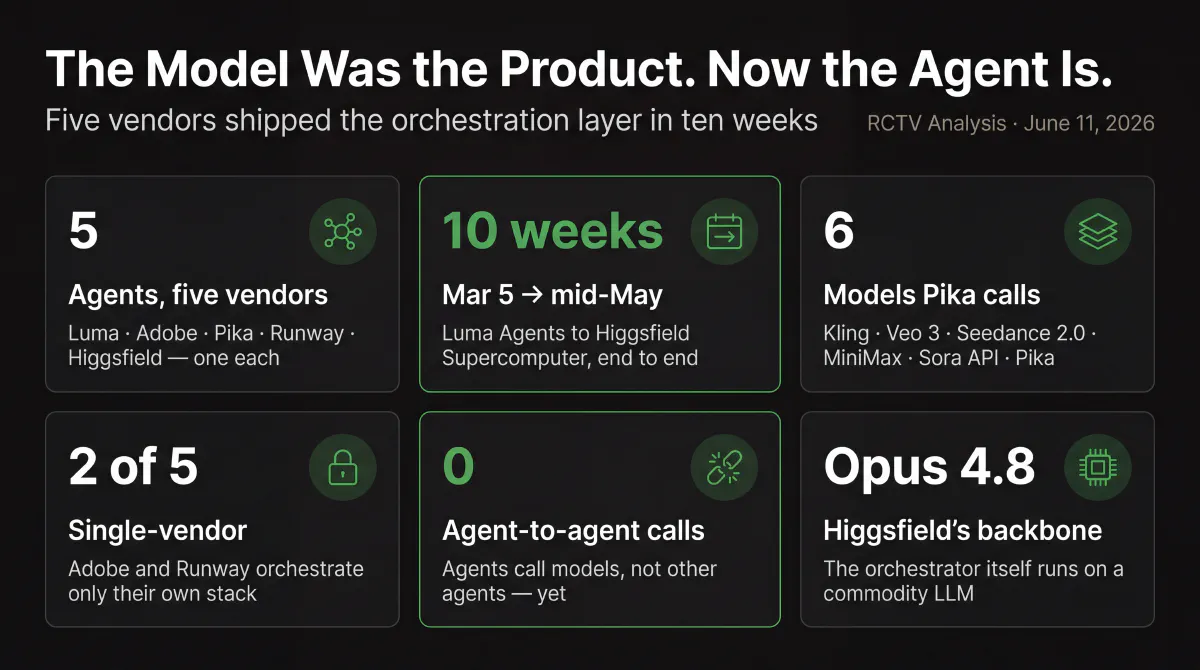
For two years the AI-video story was a model story. Sora versus Runway versus Kling versus Veo. Longest clip, best motion, highest resolution, lowest price per second. That story is still live — somebody still has to build the best engine. But starting in March, five companies decided the engine is no longer the thing they sell. They sell the steering wheel.
Luma Agents shipped March 5. Adobe’s Firefly AI Assistant hit public beta April 27. Pika Agents launched April 28. Runway Agent on May 13. Higgsfield Supercomputer around the same week. Five conversational agents, five different vendors, ten weeks. None of them generates video. Each of them decides which model generates video, on what schedule, across which surfaces, carrying what context forward. The operator question moved up a layer, and the whole industry moved up with it inside a single quarter.
That kind of convergence is not coincidence. It is a bet — placed simultaneously by competitors who do not coordinate — that the model layer is commoditizing and the value is migrating to whoever owns the conversation on top of it. The bet might be wrong. But five companies do not place the same wrong bet in ten weeks by accident.
The ten-week pattern
Lay the five launches on a calendar and the shape is unmistakable.
Luma Agents came first, on March 5. Luma did not soft-launch it — by March 10, deployments were live at Publicis Groupe and Serviceplan, with Adidas, Mazda, and the Saudi firm Humain named as brand customers. The agent runs on Luma’s Uni-1 reasoning model, which plans across video, image, audio, and text before generating anything, then calls Luma’s own Ray 3.14, Google’s Veo 3, ByteDance’s Seedance 2.0, and ElevenLabs for voice. The Mazda commercial that Johannesburg agency Boundless produced in under two weeks using Luma Agents remains the most credible production-deployment signal any agent in this set has shown.
Then the cluster. Adobe’s Firefly AI Assistant — previewed as Project Moonlight, public beta April 27 — orchestrates the Creative Cloud stack from a chat box: Premiere Pro with full project-metadata access, Photoshop, Lightroom, Illustrator. Pika Agents launched April 28 and became the moment the pattern stopped being one lab’s experiment and became industry news; we led that week’s roundup with it because the positioning was explicit — the prompt is no longer the product. Runway shipped its agent May 13, single-vendor, end to end across its own stack. Higgsfield’s Supercomputer landed the same week, the most enterprise-positioned of the set.
Five launches. Ten weeks from the first to the last. Here is the discipline the calendar demands: the pattern is real, and the agents are not therefore good. A convergence of launch dates is evidence that five companies read the market the same way. It is not evidence that any one of these agents reliably composes a finished piece of video work. Adobe’s multi-app handoff “without context loss” is a claim still forming in public beta. Higgsfield says its agents now “catch their own mistakes earlier, so the human in the loop drops even further” — that is a vendor’s sentence, not a measured result, and the day a benchmark exists for “human in the loop drops” is the day we can grade it. We have adjudicated the “world model” claim twice this spring. The “agent” claim earns the same skepticism: take the shipping product as real, take the autonomy promise as a promise.
What is not in dispute is the structural fact. Twelve months ago the operator-relevant question was “which model is best?” Today, for an increasing share of professional work, the question is “which agent puts the right model on the right shot, in the right workflow, with the right context carried forward?” Five companies have shipped an answer, and the Stack’s Agentic Layer now tracks all five as a category in its own right.
Two shapes of bet
The five agents split cleanly on one axis, and it is the axis that matters: how many vendors’ models the agent can call.
Adobe and Runway are single-vendor. Adobe’s assistant orchestrates the Creative Cloud suite Adobe already owns. Runway Agent runs ideation, generation, sound, and editing — all on Runway’s own Gen-4 Turbo, Aleph 2.0, and Edit Studio, and never leaves. Luma, Pika, and Higgsfield are multi-vendor. Pika Agents calls the broadest roster anyone has shipped: Kling, Veo 3, Seedance 2.0, MiniMax, Sora’s API, and Pika’s own model on the video side, with ElevenLabs and Whisper underneath for audio — all from inside Slack, Telegram, Discord, Notion, Figma, and a dozen more surfaces where creators already are. Higgsfield routes across Claude, GPT-5.5, and Gemini alongside its own video stack. Luma blends its own Ray with third-party Veo and Seedance.
These are two different theories of where the moat lives, and they are not both right.
The single-vendor bet is a control bet. Adobe and Runway are wagering that owning the full stack — generation, editing, the file format, the customer’s existing project — is worth more than offering the best model on any given shot. Adobe’s advantage is real and specific: Premiere Pro is the professional NLE, the assistant reads live project metadata, and the operator already lives there. Runway’s advantage is a coherent, owned pipeline that never has to hand off. The risk is equally specific. If the agent picks the model, a single-vendor agent can only ever pick your model — and the moment your model is not the best one for the shot, the operator notices. Runway’s own framing concedes this: single-vendor is a product posture, not a technical limit. They can open the roster the day the math changes.
The multi-vendor bet is a routing bet. Pika, Higgsfield, and Luma are wagering that the operator does not want to own the model decision at all — that the value is in a layer that always picks the best available model and the operator never has to care which one it is. This is the stronger position, and it is worth saying so plainly rather than both-sidesing it. Here is why: the multi-vendor agent’s value rises as the model field gets more competitive and more fragmented, because picking well among many options is exactly the labor it removes. The single-vendor agent’s value falls under the same conditions, because its one model is, by arithmetic, less and less likely to be the best one for any given shot. The model field in 2026 is getting more competitive and more fragmented by the month. The wind is at the router’s back.
The single-vendor incumbents are not naive about this. Adobe’s bet is that workflow lock-in beats model quality — that an operator with ten years of Premiere muscle memory and a project full of Adobe-native assets will tolerate a second-best generation to stay in one tool. That is a defensible bet, and for a large installed base it may even be the right one. But it is a bet on switching costs, not on capability, and switching costs erode. The multi-vendor router is betting on capability staying fragmented, which is the way the model layer has actually moved for two years and shows no sign of consolidating.
What to watch
Three things will tell you how this layer develops, and the first one threads straight back to a flagship we ran in May.
Model commodification. If the agent picks the model, the model loses pricing power. This is the same argument we made in The Prompt Is No Longer the Moat — that the value was migrating upstack, off the prompt and onto orchestration — now arriving at the layer above. When a Pika or a Higgsfield routes a job to whichever model wins on quality-per-dollar for that specific shot, the models are competing in a blind auction the operator never sees. The model that wins the shot gets the spend; the model that loses gets nothing, and has no relationship with the customer to fall back on. That is what commoditization looks like from the model’s side: you are a line item in someone else’s routing table. The tell is already visible in the orchestrators themselves — Higgsfield swapped its agent backbone to Claude Opus 4.8 at the end of May, treating the LLM that runs the orchestration as itself a hot-swappable commodity. The router commoditizes the models it calls, and then shops for its own brain the same way.
Distribution, not features. The agentic layer’s next competitive front is not capability — it is where the agent runs. Higgsfield spent late May and early June shipping itself into other people’s surfaces: a Reframe tool and MCP server that put four distinct AI-video capabilities inside Claude within five days, a Figma plugin on June 4, and a Minecraft mod on June 5 that embeds AI-video generation inside a 140-million-player game engine — with the video generated by Kling 3, so even inside Higgsfield’s own mod, the model doing the work is a competitor’s. By June 8 there was a DaVinci Resolve plugin too, generating footage directly in the editor’s timeline. Pika moved the other direction, deepening the surface it owns: Pika Group Chat launched June 4, turning the single-user agent into a collaborative one where the Pika Agent joins a shared chat. Both are distribution plays. When the orchestration is good enough to be a commodity itself, the agents compete on being everywhere the work already happens — which is the same logic that made the models commodities one layer down.
Agent-to-agent calls. None of the five agents calls another vendor’s agent. They call models. Pika Agents does not invoke Runway Agent; it invokes Runway’s models, when it invokes Runway at all. That boundary is the current ceiling of the category, and the day it breaks — the day one agent delegates a subtask to a competitor’s agent rather than to a model — the competitive dynamics change entirely, because the unit of orchestration stops being the model and becomes the agent. There is no public sign of it yet. ByteDance’s Dreamina Octo, teased since late May under “Vibe Create” language that gestures at the agentic frame, has not shipped, so it does not count. Watch this line. It is where the next layer starts.
For now the shape is settled enough to name. The model is the engine. The agent is the steering wheel. And the company that owns the steering wheel is, increasingly, the company that decides which engine you never had to think about.