Three weeks ago, RCTV argued the model isn’t the moat anymore — the production loop around it is. This week, the argument stopped being ours to make. Google DeepMind reconstructed a 67-year-old goal nobody filmed, and told everyone it did. Runway’s enterprise customers put real invoices behind the thesis instead of a keynote slide. Higgsfield’s revenue is now big enough to make its own headlines. And a new benchmark started scoring exactly what that piece said mattered: not the clip, the direction.
Models covered: Veo · Runway · Higgsfield
⚽ Google DeepMind Reconstructs Pelé’s Lost Goal — and Says So
On August 2, 1959, Pelé scored what he called the most beautiful goal of his career — the “Gol da Rua Javari,” in a street match in Santos. It exists on film nowhere. This week, Google DeepMind published a mini-documentary that puts it back together anyway: roughly 2,000 historical records, 3,600 archival images, and eyewitness interviews with the Mooca community, combined with a live-action shoot and three separate AI passes.
The technical center of the project is Performance Control, a new Veo technique that extracts precise 3D geometry and motion from a real stunt player and uses it to drive generation, with editable layers that let DeepMind change the player and the environment independently. A second pass restyles the environment for 1959 — period architecture, period weather. A third recreates the ambiance fans experienced, both inside the stadium and over the radio. Gemini Omni and Nano Banana Pro handle editing and refinement; traditional VFX — ball compositing, grain, color — finishes the shot through a filmout machine. The result is now on permanent display at the Pelé Museum in Santos.
The more interesting move is what DeepMind says about its own work. “The moment was never captured on film,” the post states plainly, before describing the footage as something the team built to “reconstruct this piece of football history” rather than letting it pass as archival. Pelé’s daughter, Flávia Kurtz, on seeing it: “being able to relive it, with all this technology, is amazing.” Google drew that disclosure line on July 14 — six days before the European Commission finished writing the final guidance for the rule that will require exactly this kind of labeling, and nineteen days before the EU AI Act’s Article 50 disclosure rule and California’s AI Transparency Act make it mandatory on August 2. For what it’s worth: the original goal was scored on that same calendar date, 67 years earlier. Coincidence, not cause.
Ten days later, Google made the posture official. On July 24 — inside this week’s window — Google signed the EU’s Code of Practice on Transparency of AI-Generated Content, the voluntary rulebook that operationalizes Article 50, naming Apple, NVIDIA, OpenAI, ElevenLabs, and Kakao as partners in an interoperable-watermarking push built on SynthID. It signed with a hedge in the same breath: adding regulatory complexity “as technical solutions are still evolving,” Google wrote, “could contradict Europe’s goals for competitiveness and simplification.” Getting ahead of the rule and objecting to it in one move.
Why it matters: This is a production application from the world’s most-watched AI lab, not a developer demo — and Google drew its own disclosure line, then signed the rulebook that will force everyone else’s, days before Article 50 takes effect.
🏭 Runway’s Customers Put a Price on the Production Thesis
Runway co-founder and co-CEO Cristóbal Valenzuela published “Content Factories Don’t Have Factories,” a longitudinal study of hundreds of Runway’s enterprise customers, anonymized and self-reported. His framing, verbatim: “Your $500K campaign costs $5K now.” A national financial-services brand’s $5M broadcast commercial became a $3–4K AI-generated ad that aired on NFL Sundays. A home-goods retailer replicates $800K visual projects for under $10K and now makes 75% of its visual media with AI. A Fortune 50 tech company saves $97K a month on photoshoots. A UK broadcaster’s five-person AI team produces 800 to 1,000 ads a year across more than 50 sub-labels.
Two caveats, and they’re not the same one. Runway discloses its own: figures are self-reported by customers against their prior-year spend, and examples are anonymized at customers’ request — no independent verification of any single number. RCTV’s, layered on top: only 15 to 20 cases surfaced out of the “hundreds of enterprises” the study claims to have analyzed, and the piece doesn’t explain how those cases were chosen. Curated, not sampled.
It’s the densest evidence yet for the July 9 flagship’s argument that the moat moved from generation to the production loop around it — that piece worked from two solo operators’ field reports; this is dozens of enterprise case studies with real dollar figures behind them. Runway kept extending the point mid-week, shipping Media Router on July 23 — a system that lets a team define what “best” means once, for cost, quality, or latency, and routes each request to a model automatically. Luma made a parallel move two days earlier, linking Luma Agents to a client’s Google Ads account to read ad-performance data, generate new variations from the winners, and push them back to run — a data-in, distribution-out loop, though not yet the agent-to-agent handshake the June 11 flagship flagged as the next threshold.
Why it matters: Self-reported doesn’t mean fabricated. It means the receipts still need a second look — but there are receipts now, not just a keynote claim.
💰 Higgsfield’s Reported $300–500M Raise Is Still Not Closed
Higgsfield is reportedly in talks to raise $300–500M at a $5B valuation — four times its January 2026 mark of roughly $1.3B — after crossing a $500M annualized revenue run rate this month, up from $200M at the end of 2025, about 70% of it enterprise. DST Global is reportedly among the investors in talks. The round hasn’t closed: MasterNodeAI’s status check puts it bluntly — “the round has not closed, and terms could shift” — and no source dated after mid-July suggests otherwise as of this week.
It’s the financial capstone to six weeks of Higgsfield production-layer coverage — NLE plugins, MCP price-floor moves, the absorption-speed thesis we’ve tracked since June. Hard revenue numbers now substantiate what had been a string of feature ships.
Why it matters: A $200M-to-$500M run-rate jump in about six months is the kind of number that gets built into rival board decks whether or not this specific round ever closes.
🏆 A New Benchmark Scores Direction, Not Generation
Physion Labs launched Physion-Arc 1.0, a benchmark built to score AI video agents rather than base models — testing complete, multi-scene videos across three pillars: Narrative Coherence, Cinematic Language, Production Quality. Per the company’s own launch post: 100 screenplays, 600 generated videos, six agents tested — Runway, Luma, MiniMax, Kling, Utopai Studios, and TapNow. Runway Agent 2.0 ranked #1 overall and led every dimension the benchmark measured. Physion Labs, in its own words: “Its advantage was especially clear across subjective metrics, where cinematic taste matters most.”
The two primaries don’t agree on the benchmark’s own scale. Physion Labs’ launch post cites 100 screenplays and 600 videos; Runway’s amplifying post instead cites “30 cinematic prompts and 16 metrics.” The methodology page 404s on every URL we tried, so there’s no way to adjudicate between the two — this piece uses Physion Labs’ own internally consistent figures, not Runway’s.
Worth a light hedge: Physion Labs is real and VC-backed (500 Global, E14 Fund, xNova VC), with legitimate academic footing — it co-published “Physion-Eval” with Stanford, MIT, and Harvard. No disclosed commercial relationship with Runway turned up in any search. Still, a brand-new third-party benchmark crowning the vendor amplifying it loudest #1 in every category, with an unreachable methodology page, earns a caveat: no independent replication yet. This is exactly the axis the July 9 flagship argued matters — assembly and direction, not clip quality — and it directly extends the June 11 agentic flagship, which named Runway as one of five vendors racing to ship orchestration agents.
Why it matters: A benchmark built around the exact axis we’ve been arguing matters is itself evidence the argument is catching on. Who’s amplifying it doesn’t erase that — it just means checking twice.
📈 By the Numbers
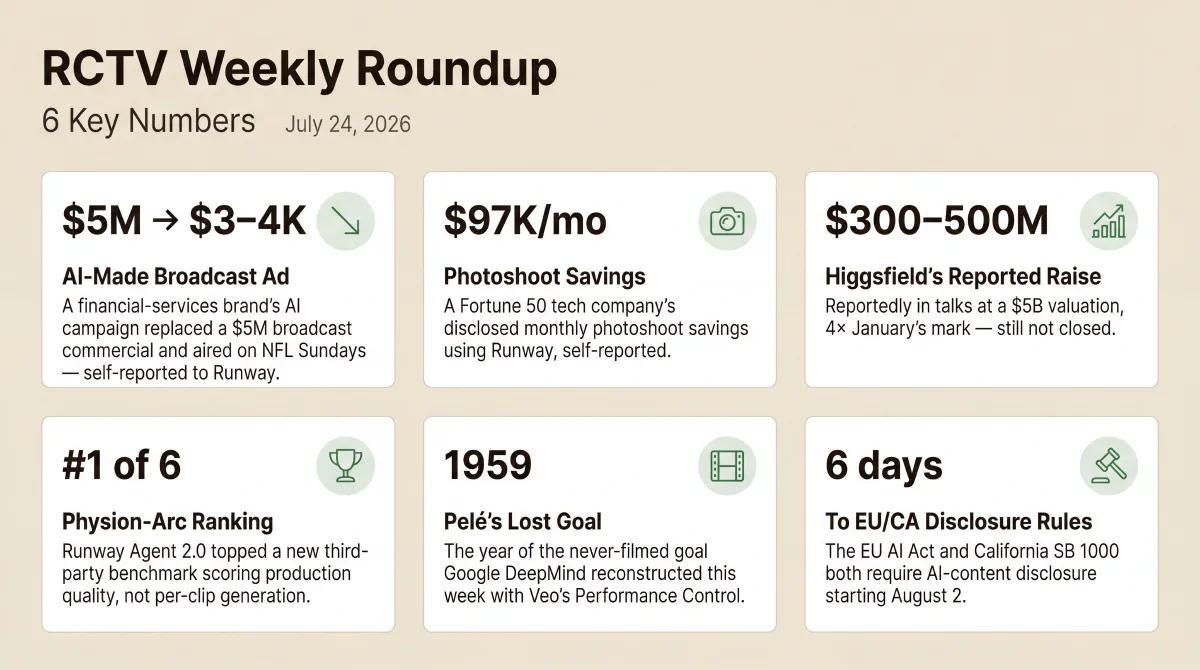
- $5M → $3–4K — a national financial-services brand’s broadcast commercial, replaced by an AI-generated campaign that aired on NFL Sundays (Runway, self-reported).
- $97K/month — a Fortune 50 tech company’s disclosed photoshoot savings using Runway (self-reported, not independently verified).
- $300–500M — Higgsfield’s reported raise, at a $5B valuation; still in talks, not closed.
- #1 of 6 — Runway Agent 2.0’s rank on Physion-Arc 1.0, a new third-party benchmark scoring AI video agents on production quality, not per-clip generation.
- 1959 — the year of Pelé’s never-filmed goal, reconstructed this week by Google DeepMind using Veo’s new Performance Control.
- 6 days — until the EU AI Act’s Article 50 disclosure rule and California’s AI Transparency Act (SB 942, as amended by AB 853) both take effect on August 2; the EU’s final guidance for the rule landed July 20.
🔮 What to Watch Next Week
- EU AI Act Article 50 and California’s AI Transparency Act (SB 942, as amended by AB 853) — both due August 2, six days out. The European Commission adopted its final Article 50 guidance July 20; the rule itself is now inside a week. Google signed the EU’s voluntary transparency Code on July 24 — watch the initial signatory list (publishes before August 2) for whether the other major video labs, ByteDance, Kuaishou, Alibaba, and Meta, follow, or meet August 2 without the presumption-of-compliance shield.
- Higgsfield’s raise — still reportedly in talks; watch for a close.
- Physion-Arc’s own numbers — the 100-screenplays-vs-30-prompts discrepancy is unresolved; watch for either company to clarify before this benchmark gets cited again.
For full specs, pricing, and access details on every model covered this week, see the AI Video Stack 2026 reference page — updated every Monday.