Black Forest Labs spent June and July as an image-only lab with a famous new adviser. This week it shipped video, audio, and a robotics pilot in one release — and two aggregator platforms picked it up before the lab itself said a word about it. Meanwhile Higgsfield, Runway, and Pika spent the week racing a ByteDance model none of them controlled, until Friday morning, when all three shipped it within about two hours of each other.
Models covered: FLUX 3 · Runway · Higgsfield · Seedance · Grok Imagine · MiniMax
🎨 Black Forest Labs Was an Image Lab. Now It Ships Video, Audio, and Robotics.
Black Forest Labs — the FLUX image-model maker Martin Scorsese joined as an adviser back in June — shipped FLUX 3 on July 23: a model that “jointly learns from images, videos, and audio within a unified architecture,” per BFL’s own framing. Video mode generates up to 20 seconds per clip with native synced audio — text-to-video, image-to-video, video-to-video with character consistency, multilingual dialogue, and agentic chaining of individual clips into multi-shot sequences running several minutes. It’s Early Access only for now, via API and private weights; an open-weight “FLUX 3 Dev” is named but carries no announced ship date beyond “the next few weeks and months.” A robotics variant, FLUX-mimic, is already being tested on Audi production lines — a real move into physical AI, not a headline feature.
None of that made news on its own. Runway integrated FLUX 3 on August 4 — “Generate and edit up to 20 seconds of video with audio” — and Pika followed the next day: “Flux 3 is now available through the Pika API Club.” That’s the actual news peg: a previously image-only lab’s pivot got two aggregator platforms’ distribution within 48 hours, the same absorption pattern we’ve tracked all summer on Seedance 2.5, Grok Imagine, and MiniMax H3.
One number is worth naming plainly: thirteen days passed between FLUX 3’s launch and the Runway integration that put it in front of anyone. @bfl_ml, the lab’s own X handle, posted nothing about it in that window — a frontier lab shipped a model that generates 20 seconds of video with native audio, and let an aggregator do the announcing. That is its own comment on where distribution now sits.
BFL’s own comparison numbers — 77% preferred over Runway Gen-4.5, 93% over Luma Ray 3.2 — come from the company’s “preliminary evaluation,” not an independent benchmark. Treat them as marketing until someone else runs the test.
Why it matters: We’ve covered Black Forest Labs since Scorsese’s advisory deal in June as a company to watch, not a company that ships. FLUX 3 is the video model that advisory role implied was coming — and the platforms integrated it faster than the lab promoted it.
🌊 Three Platforms Raced a Model None of Them Controlled. Friday Morning, All Three Won.
Pika, Runway, and Higgsfield spent the first week of August chasing the same ByteDance model. As of Thursday, none of them had it. By Friday morning, all three did — within about two hours of each other.
Runway shipped first, 06:11 UTC: “Seedance 2.5 is live on Runway.” Higgsfield followed at 07:46 UTC: “The most capable video model is globally LIVE on Higgsfield” — a 33-day zero-credit-cost window replacing the 7-day offer it had floated a day earlier. Pika landed at 07:59 UTC through its new API Club, a $10/month subscription launched August 4 that bundles more than 100 gen-media models across video, image, audio, and text — up to 88% cheaper than other API aggregators, by Pika’s own calculator (Pika says three Seedance 2.0 generations alone cover the $10 membership fee). Pika’s Seedance 2.5 post that morning: “The only thing better than Seedance 2.5 is Seedance 2.5 up to 88% off. Now on the Pika API Club” — a price the company later called permanent, not promotional.
ByteDance’s own consumer surface got there first on paper: Dreamina’s US rollout completed a day earlier, Thursday at 15:00 UTC — “Seedance 2.5 is officially live in the US,” following Southeast Asia, the Middle East, Africa, Europe, and South America — but the third-party aggregator layer had already been racing to integrate the model for days by then.
The same pattern repeated on a second model this week: Luma Agents added MiniMax H3 Thursday — “Generate up to 15 seconds of 2K video with native stereo sound” — a fourth platform racing to integrate a hot frontier model rather than build its own. (HyperFrames, the HeyGen production-tooling series we’ve tracked since July, closed its own 30-day run this same week — pushing its component catalog from 113 to 132 blocks — a footnote next to three platforms racing one model, not a story of its own.)
Why it matters: We’ve tracked the aggregator-strategy thread since Pika Agents in May. This week is the cleanest version of the thesis yet: three competitors, one unshipped model, a two-hour window between “coming soon” and “live” on all three at once.
🎙️ Grok Imagine Closes a Gap It Opened in April. MiniMax Closes One HappyHorse Hasn’t.
Grok Imagine Video 1.5 shipped native 1080p, text-to-video, and voice references July 31 — “Create characters with their own voices, make videos in native 1080p, and more!” It closes a gap we’ve tracked since June 22 (“720p-capped, 1080p Pro still unshipped”) and named again in July. Per earlier vendor commentary, native 1080p reportedly steps back down to 720p when a reference-character feature is active — a caveat worth naming, though we couldn’t independently re-locate the specific thread this week, so treat it as unconfirmed rather than a settled spec.
MiniMax offered a sharper contrast this week, not with Grok but with itself against a rival’s promise. Having flagged its intent to open-source H3’s weights “within days” on July 31, MiniMax shipped them roughly 60 hours later with simultaneous Day-0 support across ComfyUI, vLLM-Omni, SGLang, and fal.ai. The delivery has real fine print, direct from MiniMax’s own license: the Community License defines its “Applicable Territory” as worldwide excluding the United States, the European Union, the United Kingdom, and South Korea — using, modifying, or deploying the weights in any of those four markets isn’t licensed at all. The self-hosted build has a resolution ceiling too: MiniMax’s own model card confirms local generation tops out at 768p, since the 2K upscaling module “is not yet open-sourced” and still routes through MiniMax’s hosted infrastructure. HappyHorse-1.0’s own open-weights promise remains unfulfilled — Hugging Face still returns a gated 401 on the model card, 105 days after its April 27 launch.
On the leaderboard, MiniMax H3 sits #2 on Artificial Analysis’s text-to-video board (Elo 1,240, behind Gemini Omni Flash’s 1,244, ahead of Seedance 2.0’s 1,224) and debuted #4 on Design Arena’s separate text-to-video board (Elo 1,455) — a second, independently run board corroborating the same strong-debut pattern.
Why it matters: A promise kept in 60 hours beats a promise unkept past 100 days — but MiniMax’s own version of “open weights” excludes four of the world’s biggest video markets and caps out below its own headline resolution. The gap between “open-weights” as a marketing line and “open-weights” as a fact keeps being the story on this beat, and this week it isn’t only HappyHorse on the wrong side of it.
🏆 A Pixar Co-Founder Judges an AI Film Festival. The Company Behind It Open-Sources Its Own Feature.
Higgsfield opened its Global Film Festival — a $1,000,000 prize pool — with Edwin Catmull on the jury. Every credential in the announcement checks out independently: Pixar co-founder, five Academy Awards including the Gordon E. Sawyer lifetime-achievement Oscar, former president of Walt Disney Animation Studios and Pixar, Toy Story executive producer, and a 2019 ACM A.M. Turing Award laureate alongside Pat Hanrahan. In Higgsfield’s own framing: “The man who invented 3D graphics will judge the first generation of AI filmmakers.”
The same day, Higgsfield fully open-sourced Hell Grind — its own $500,000, 95-minute AI feature that screened in the Cannes Market and drew Wall Street Journal, Variety, and BBC coverage when it premiered, covered here in the June 1 roundup. “All the prompts and assets are public,” released as contest reference material for entrants.
Two moves, one day, one theme: an A-list juror lending credibility to an AI-film contest, and a company opening its own flagship production as proof-of-work instead of marketing copy.
Why it matters: Higgsfield spent this same week racing a ByteDance model it doesn’t control (above). The festival and the open-sourced feature are the opposite move — betting on craft legitimacy it does control.
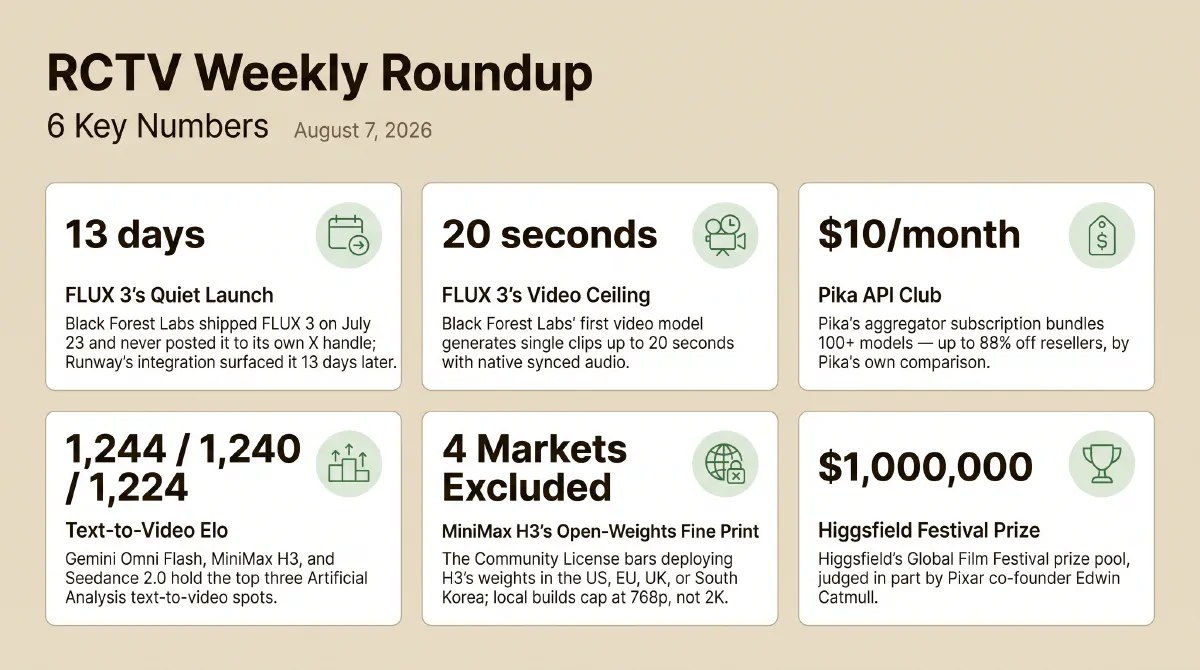
📈 By the Numbers
- 13 days — the gap between Black Forest Labs’ FLUX 3 launch and the Runway integration that surfaced it; the lab’s own
@bfl_mlhandle posted nothing about it in between. - 20 seconds — FLUX 3’s max single-generation video length with native synced audio, Black Forest Labs’ first video model.
- $10/month — Pika API Club’s membership price, bundling 100+ models, up to 88% off other API aggregators by Pika’s own comparison.
- 1,244 / 1,240 / 1,224 — Gemini Omni Flash, MiniMax H3, and Seedance 2.0’s current Artificial Analysis text-to-video Elo standings.
- 4 markets — the US, EU, UK, and South Korea, all excluded from MiniMax H3’s Community License; the weights shipped in ~60 hours, faster than HappyHorse-1.0’s own open-weights promise has gone unfulfilled (105 days), but they’re not legally usable in four of the world’s biggest video markets.
- $1,000,000 — Higgsfield’s Global Film Festival prize pool, judged in part by Pixar co-founder Edwin Catmull.
🔮 What to Watch Next Week
- Whether Black Forest Labs’ pivot earns a longer look. An image-only lab shipping video, audio, and robotics in one release, with two-platform distribution inside 48 hours, is the same absorption shape we’ve tracked all summer — and it raises a real question about whether BFL is becoming a Big Nine commercial lab or the infrastructure underneath the aggregators that just absorbed it.
- Higgsfield’s reported raise. Still “in talks” at $300–500M on a $5B valuation, not closed — treat any headline claiming otherwise skeptically.
- Whether the Seedance 2.5 pattern repeats. MiniMax H3 just landed on a fourth platform (Luma Agents) using the same integrate-first playbook — watch whether more aggregators pattern-match on it the way three just did on Seedance 2.5.
For full specs, pricing, and access details on every model covered this week, see the AI Video Stack 2026 reference page — updated every Monday.
Correction (August 18, 2026): This piece originally dated Grok Imagine Video 1.5’s native 1080p release to August 1, 2026. The correct date is July 31, 2026.
The error came from anchoring the date to an amplification post on the @imagine sub-account, published August 1 at 20:32 UTC, rather than to SpaceXAI’s own release page — which carries a July 31 publication date in UTC — or to the primary @grok announcement, posted August 1 at 00:46 UTC, which is July 31 in both US Eastern and the company’s home Pacific time. Two independent primary sources agree on July 31; the post we cited was the one that happened to get linked.
Everything else in this item stands. Native 1080p is generally available, the accompanying text-to-video and voice-reference features are as reported, and the $0.08/sec rate carries no resolution-tiered pricing. Only the date was wrong.