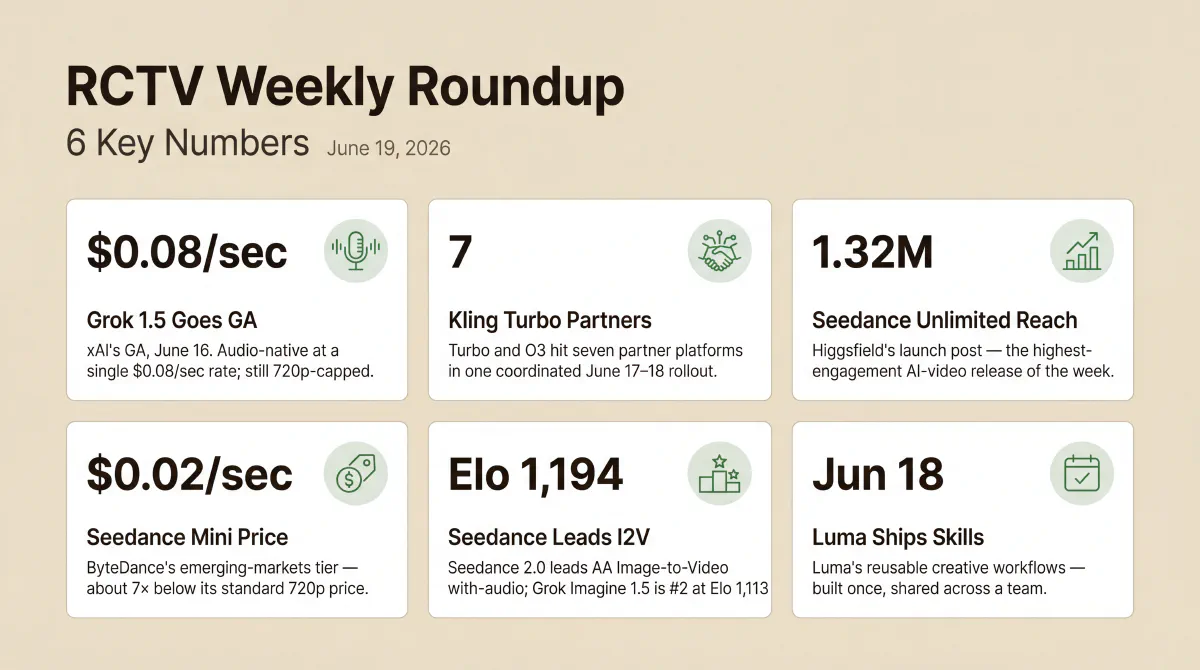
No new model launched in the week of June 13–19 — but the one everyone was tracking finally shipped. xAI moved Grok Imagine Video 1.5 out of preview into general availability, audio-native and aggressively cheap, while the 1080p tier it promised first stayed vapor. Around it, the competition kept moving one layer up from the models themselves: Kling pushed a cost tier to seven platforms in a single day, Higgsfield closed an exclusive unlimited-Seedance deal through ByteDance’s own cloud, and Luma made its agentic workflows portable. A quiet week for new models. A loud one for price, distribution, and workflow.
Models covered: Grok Imagine · Kling · Seedance · Luma
🎬 Grok Imagine 1.5 Lands at GA — Audio-Native, Cheap, Still 720p
The model that drew a 2.25-million-impression teaser in preview went fully live on June 16. xAI released Grok Imagine Video 1.5 to general availability across the Imagine API, grok.com, iOS, and Android at once, with a faster Video 1.5 Fast variant that renders a 6-second 720p clip in about 25 seconds — down from 40-plus in preview. Every generation includes synchronized audio in the same pass.
The price is the headline. xAI’s docs price the model by resolution: $0.08/sec at 480p and $0.14/sec at 720p, or $4.80 to $8.40 a minute. At 720p, the top of what the model produces today, that undercuts the premium audio tiers it competes with: Sora 2 Pro runs $0.30/sec at 720p and sunsets September 24; Veo 3.1’s Quality tier is $0.40/sec. It does not undercut Google’s cheaper Veo 3.1 Fast at $0.10/sec; only the 480p rate does. The “$4.20/min” figure circulating misses — it’s the original Grok Imagine’s old rate. The “$0.14/sec at 720p” figure is right; it’s the 720p row on xAI’s own table. At $0.14/sec with audio included, Grok 1.5 is cheaper than the premium tier, dearer than Veo’s budget tier — and it sits #2 on the Artificial Analysis image-to-video with-audio board, behind Seedance 2.0. xAI’s “#1” claim attaches to that audio board only; the live board doesn’t bear it out.
What still hasn’t shipped is what xAI promised first. Both Grok video models top out at 720p, and the 1080p “Pro” tier Musk floated for “later this month” back in April is now more than two months past with no date. The ceiling keeps Grok out of broadcast and large-format work — it’s a wedge into social, prototyping, and high-volume short-form, where 720p rarely binds and price does.
Why it matters: A capable, audio-native image-to-video model at $0.14/sec for 720p puts pressure on the tier above it — Sora 2 Pro and Veo’s Quality tier charge two to three times that for comparable audio output. Veo’s budget tier still undercuts it at 720p; Grok wins that comparison only at 480p. The 720p ceiling and still-vapor 1080p Pro keep it out of high-end work, but for the volume tier — social, ads, prototyping — Grok 1.5 is a value option, with Veo 3.1 Fast the number to beat at 720p. The model everyone was waiting on finally shipped; the resolution everyone was promised did not.
⚡ Kling 3.0 Turbo and O3 Hit Seven Platforms at Once
Kuaishou rolled Kling 3.0 Turbo and Kling 3.0 Omni (O3) to seven partner platforms — fal, SeaArt, Clipfly, Fotor, GlamAI, Runware, and Morphic — in a single coordinated push on June 17–18. Kuaishou made no direct announcement; the launch surfaced simultaneously across the partner ecosystem.
The two variants split on purpose. Turbo targets speed and cost: faster generation, lower price, improved lip-sync, and more stable motion. O3 targets production quality: up to 15-second clips at full 4K with stronger prompt-and-reference consistency. One tier for iteration; one for delivery. Kuaishou has not published official pricing for either variant; capability claims come from partner-platform announcements, which agree across all seven independently.
What is worth noting is the rollout shape itself. Kuaishou did not post on klingai.com and wait for platforms to find the new tiers. Seven partners confirmed simultaneously, with no head-start for any single distributor. When the model itself is not the headline, the distribution architecture carries the weight — and a same-day coordinated push across seven platforms is a deliberate architectural choice.
Why it matters: Kling 3.0 Turbo’s speed-and-cost positioning puts it in direct competition with Dreamina Seedance 2.0 mini, which launched June 16 at $0.02/sec for emerging markets. Two of the strongest models in the leaderboard top five are converging on the same price-floor axis at the same moment.
♾️ Higgsfield Closes Exclusive Unlimited-Seedance Deal via ByteDance’s Cloud
Higgsfield launched “Seedance Unlimited” on June 17 through an official partnership with BytePlus — ByteDance’s global business-to-business cloud platform. The offer: 30-day unlimited video generation on an “Enhanced Seedance 2.0 Fast” model, available in 1-day, 7-day, or 30-day add-on tiers for existing Higgsfield subscribers. Higgsfield’s stated position: “the only place with real unlimited Seedance.”
The structure is worth examining. Dreamina’s own subscription plans are metered. ByteDance has designated Higgsfield — a California-based platform — as the exclusive non-ByteDance surface for unlimited Seedance globally. BytePlus handles the commercial infrastructure; Higgsfield handles the creator-facing product and the subscriber relationship.
The distribution problem this solves is one the June 4 Grok vs. Seedance analysis named directly: Seedance’s generation quality was never in question, but Western access was. Dreamina’s original global rollout was US-excluded under copyright pressure. BytePlus as a B2B intermediary lets ByteDance route commercial revenue from Western markets without operating a direct consumer product there. Higgsfield gets the model on exclusive unlimited terms; ByteDance gets the revenue channel it can’t safely run itself.
One week after ByteDance’s own platform launched Seedance 2.0 mini at $0.02/sec for Southeast Asia, the Middle East, Africa, Europe, and South America, the Western unlimited-access gap is closed through a separate partner, on a separate commercial tier, via the same underlying model. Two channels, one product, very different regulatory profiles.
The launch post drew 1.32 million impressions on June 17 — the highest engagement of any single release in this coverage window, by a wide margin.
Why it matters: If this structure holds, it is a replicable template: a Chinese-origin lab generates revenue from Western creators through a B2B intermediary while maintaining distance from direct consumer-app regulatory exposure. Other labs navigating similar constraints will take note.
🔄 Luma Makes Agentic Workflows Portable
Luma launched Skills for Luma Agents on June 18 — the ability to build a repeatable creative workflow once and run it on any asset. You build a Skill in plain language, or let the agent generate it automatically. Once built, it runs consistently across projects and can be shared by link, bundled, or exported as a standalone file.
The platform framing is explicit in Luma’s launch language: “one person’s workflow becomes something the whole team can run.” That is not a feature description. It is a collaboration layer — the kind that makes switching platforms expensive once a creative team has adopted and shared a library of Skills.
The competitive logic follows directly from where model quality stands today. Kling, Seedance, Veo, and Grok Imagine 1.5 trade top spots on the Artificial Analysis leaderboards by margins too small to feel in production. A creative director’s four-step Style+Motion Skill is worth more to a working team than a 10-Elo quality gap. Generation capability has largely commoditized; the durable advantage now is whether the platform is the one the team has built their process around.
This is the pattern the June 11 agentic-orchestration flagship called explicitly: five vendors shipped agentic layers on top of AI video models in ten weeks, but the deeper competition is distribution — who makes their platform indispensable at the workflow level, not just the generation level. Skills is Luma’s concrete move on that thesis. Build the workflow once; the platform becomes the substrate.
Why it matters: Portable, team-shareable workflows convert adoption into retention. Every Skill a team builds on Luma assets compounds the switching cost without requiring Luma to win every model benchmark — and at today’s quality-compression levels, that is the more defensible position.
📈 By the Numbers
- $0.08/sec at 480p, $0.14 at 720p — Grok Imagine Video 1.5 reached general availability June 16 priced by resolution ($4.80 to $8.40 a minute), audio included — cheaper than Sora 2 Pro and Veo’s Quality tier at 720p, dearer than Veo 3.1 Fast, and #2 on the I2V with-audio board. The “$4.20/min” figure circulating is the original model’s old rate; the “$0.14/sec” figure is xAI’s 720p rate.
- 7 platforms — Kling 3.0 Turbo and O3 launched simultaneously across fal, SeaArt, Clipfly, Fotor, GlamAI, Runware, and Morphic on June 17–18 in a coordinated same-day rollout.
- 1.32M impressions — Higgsfield’s Seedance Unlimited launch post drew the highest single-release engagement in this coverage window; 380 retweets and 1,882 bookmarks alongside.
- Elo 1,194 — Dreamina Seedance 2.0 holds #1 on Artificial Analysis Image-to-Video with-audio, stable through the full coverage week.
- Elo 1,113 — Grok Imagine Video 1.5 holds #2 in the same arena — settled from its June 8 debut score of 1,404 after vote accumulation; all leaderboard data is with-audio.
- Elo 1,092 — Wan 2.7 entered I2V with-audio at #3 globally on 2,310 accumulated samples (an April launch accruing votes, not a fresh debut), displacing HappyHorse-1.0 from the podium.
- $0.02/sec — ByteDance launched Seedance 2.0 mini for emerging markets on June 16, priced at roughly 7× below the standard 720p tier ($0.151/sec per Artificial Analysis). US-excluded. A separate move from Higgsfield’s deal — same model, different channel.
🔮 What to Watch Next Week
- Idaho HB 727 — effective July 1 (9 days). The first US state to explicitly include AI-generated synthetic media within video-voyeurism statutes goes live. Platforms handling user-generated video in Idaho should have reviewed their content-moderation scope before the deadline.
- EU Art. 50 Code of Practice — now published. The technical implementation guidance for the EU’s AI-content disclosure mandate is out as of June 10. The August 2 AI-content labeling requirement and the December 2 machine-readable watermarking obligation are now fixed requirements, not estimates. A Compliance scorecard covering the global disclosure and labeling landscape — EU, US states, and India — is in progress for a separate piece.
- EU Art. 50 Aug 2 / CA AI Transparency Act (SB 942, as amended by AB 853) Aug 2 (44 days). EU AI-content disclosure and California’s AI detection-tool mandate land simultaneously. AI video platforms serving either jurisdiction should be tracking both.
For full specs, pricing, and access details on every model covered this week, see the AI Video Stack 2026 reference page — updated every Monday.
Correction (October 11, 2026): This piece said xAI listed a single $0.08/sec rate for Grok Imagine Video 1.5 regardless of resolution, and called the $0.14/sec 720p figure unconfirmed. Both were wrong. xAI’s model page prices the model by resolution: $0.08/sec at 480p, $0.14 at 720p and $0.25 at 1080p. The $0.08 headline is the 480p rate, so a 720p minute costs $8.40, not $4.80. The 480p and 720p rows were already on xAI’s preview page before this piece ran. The “among the cheapest” and “reprices the tier above it” lines are revised: at 720p Grok undercuts Sora 2 Pro and Veo 3.1 Quality, but not Veo 3.1 Fast, which Google lists at $0.10/sec. The text above is corrected; the infographic’s first card still carries the original wording.