Two competing theories of how AI video wins played out in the same week. The Hollywood route — Runway declaring the uncanny valley crossed, Higgsfield putting a 95-minute feature into theaters — orbited the AI on the Lot event in Culver City and a Film Market slot at Cannes. Both were real. Neither was the week’s most consequential development. That was quieter: Runway, Pika, and Higgsfield all shipped MCP integrations within 24 hours, and Higgsfield dropped five Adobe Premiere Pro and After Effects plugins the same day. AI video is wiring itself into the tools people already use.
The Hollywood route mostly shipped claims and screenings. The plumbing route shipped products. RCTV covers the gap.
Models covered: Runway · Higgsfield · Pika · Dreamina
🎬 Runway’s “Uncanny Valley” Claim Has One Film Behind It
On May 26, Runway launched Project Luxo — a series of short films and a spec ad screened for an audience Runway describes as “Hollywood executives, producers, directors, actors, guild members, press, studios.” The announcement carried a specific claim: AI video has “crossed the uncanny valley.” Runway points to improvements in character consistency, lip sync, face-drift reduction, and temporal stability as evidence.
What the page actually names: one director, one film. Felipe Orozco made The Rogue, a 9:57 maritime short, in three weeks, solo. Two other shorts are listed — Last Night (5:28, made in 7 hours) and Pigeons in Time (0:46, made in 4 hours) — along with a spec watch ad that Runway says accumulated over 100 million Instagram views in 48 hours. No studios, no named directors, no guild members, no aggregate reaction data. Runway says the response was “unanimous.” That’s self-reported.
This is not a reason to dismiss the work. The Rogue is a reviewable artifact, and the claim that a single person built a coherent short film in three weeks on AI tools is itself meaningful. The spec ad metric — 100M Instagram views, if accurate — is a distribution data point no competitor has matched publicly. The technical improvements Runway cites are real categories of progress.
But “crossed the uncanny valley” is the most loaded claim in AI video. Whoever gets to declare it means something. Runway is declaring it with an anonymous audience and a handful of shorts. The claim is auditable; the evidence offered is not yet. A second Project Luxo film, Last Night, dropped May 28 — follow-on content, not a new announcement.
Why it matters: The quality-threshold debate Runway reopened here threads directly to Sora’s shutdown in April — the question of whether AI video had gotten good enough to retain paying users. Project Luxo does not settle that debate. It advances Runway’s position in it.
🎞️ Hell Grind Is a Real Feature Film With a Hype Problem
The more concrete of the week’s Hollywood stories is Higgsfield’s Hell Grind. Directed by Aitore Zholdaskali and produced by a 15-person team in 14 days for under $500K ($400K of that in compute costs), Hell Grind screened at an AI film event adjacent to the Cannes Film Market in May and made its North American theatrical premiere May 29 at the Culver Theater as part of AI on the Lot. Higgsfield says a traditionally produced equivalent would cost $50M.
The production data is specific: 16,181 AI generations to produce 253 shots in the first 25 minutes alone. That ratio — generations per retained shot — is a concrete process metric the space has been missing. Whether it holds for the full runtime is an open question; the first-25-minute figure is what Higgsfield published.
Two things to hold clearly. First, the model stack: Hell Grind is itself a multi-model orchestration artifact. Higgsfield’s own tools — Soul Cinema, Soul Cast, Cinema Studio 3.5 — handled the orchestration layer. ByteDance’s Seedance 2.0 was the video backbone, with Google Veo 3 reportedly also in the mix. The “single platform” billing in Higgsfield’s marketing doesn’t survive scrutiny; it’s three tools doing different jobs.
Second, the Cannes framing: the festival explicitly distanced itself — Cannes confirmed the film was not part of the official program, and festival leadership stated a curatorial exclusion of films primarily driven by generative AI from competition. The screening was at an industry event organized by third parties running alongside the Market, not within it. Reception was rough even from sympathetic critics; one reviewer said it made him “less convinced about AI features than before.” The episodic release format — roughly 22–25-minute installments as well as a 95-minute cut — coexists uneasily with the “95-minute theatrical feature” marketing frame. The claim is running ahead of the evidence here, which is the same pattern as Runway’s anonymous audience.
What’s real and worth crediting: this production cleared the distribution pipeline. It got theatrical dates. That is an objective milestone no amount of mixed reviews changes. The production-metric ambition — 14 days, 15 people, under $500K — is a legitimate data point for anyone modeling AI video production economics.
Why it matters: Hell Grind’s “single-platform 95-minute theatrical feature” billing is the week’s clearest hype-asymmetry case — same structure as Luxo’s anonymous audience. The actual story, the multi-model orchestration that produced something with real theatrical distribution on a five-figure budget, is genuinely interesting without the superlatives. It threads back to Higgsfield Supercomputer, launched two weeks earlier.
🔌 AI Video Becomes a Plugin: Three Labs, 24 Hours
The Hollywood stories were what people talked about. This story is what will matter six months from now.
Between May 27 and May 28, three Tier-1 AI video labs shipped integrations that move video generation out of standalone apps and into the tools professionals already have open. The sequence: Runway MCP on May 27, then Pika Founder Starter Kit and Higgsfield MCP both on May 28.
Runway MCP connects Runway’s model roster — Gen-4.5, Seedance 2.0, GPT Images 2.0, and Kling — directly into Claude, ChatGPT, Cursor, Replit, and any other MCP-compatible client. You generate a video without leaving the agent or coding tool where you’re already working. No tab switch, no separate app. The launch pulled 375K impressions on X the day it dropped.
Pika’s Founder Starter Kit shipped as four MCP skills for Claude: Build-a-Brand, App Screens, Product Sizzle, Founder Video. 741K impressions. Higgsfield’s MCP deploys its Supercomputer as a Claude skill — “Higgsfield Supercomputer Skill is now inside Claude” — at 54K impressions.
That’s three separate companies, three separate model rosters, converging on one integration convention in one 24-hour window. Runway and Pika don’t share ownership, investors, or architecture. Higgsfield is a different company still. The convergence on MCP is a pattern, not a coincidence — and it means AI video capability is becoming callable rather than destination.
Separate but concurrent: Higgsfield launched five Adobe Premiere Pro and After Effects plugins on May 27 — Reframe, Remove Background, Upscale, Draw to Edit, and Edit Video. All five run inside the editing timeline without exporting or switching applications. The Adobe NLE path is a different target than the developer/chat path, but the logic is the same: meet the user where the work already is. The launch pulled approximately 1M impressions.
The distinction is worth stating plainly. The MCP cluster and the Adobe plugins are not about “agents built on top of video” — the agentic-orchestration story we tracked through Pika Agents, Runway Agent, and Higgsfield Supercomputer. They are about video embedded into the agent and editing layers. If AI video is becoming a callable tool inside Claude and Premiere rather than a place you visit, the competitive surface moves. Reach and integration become the moat. Destination traffic matters less.
Why it matters: The distribution channel for AI video capability is shifting from consumer apps to protocol integrations. Runway + Pika + Higgsfield converging on MCP in 24 hours is the strongest signal yet that MCP is becoming the standard. For operators and developers, the question is no longer “which platform do I use” — it’s “which tool do I call from here.”
💰 Reactor Exits Stealth: Real-Time World Models as a Different Bet
While the week’s Hollywood theater was unfolding, the funding market made a more pointed statement. Reactor exited stealth on May 28 with a $59M Series A led by Lightspeed Venture Partners. WndrCo participated — and Jeffrey Katzenberg, who co-founded DreamWorks, joins as a board observer. He called the technology “a bridge between the model world and real-world applications.”
The company was co-founded by Alberto Taiuti (CEO, ex-Luma AI co-founder and Apple Vision Pro technical lead) and Bryce Schmidtchen (CTO, also ex-Apple Vision Pro). What they’re building is not another text-to-clip model. Reactor’s platform provides SDK and API infrastructure for real-time interactive scenes — world models that perceive and respond in real time rather than rendering a clip on a ten-minute queue. Per Taiuti, time to first frame is “basically nil.” Current customers include film studios, television companies, and robotics firms.
This is a different economic structure than anything in the MCP cluster. The MCP labs (Runway, Pika, Higgsfield) are billing per clip, per generation. Reactor bets on per-session economics — you call a world model and it runs continuously, like a game engine, not a video export. If that bet is right, the multi-model routing layer the MCP integrations are building becomes a streaming-session layer. The product isn’t the clip; it’s the world.
Why it matters: Real-time world models are a distinct category from text-to-clip generation, and Reactor is the first company to raise serious capital exclusively for the infrastructure layer that makes them callable. Katzenberg’s participation is the Hollywood-validation signal that the theatrical route this week mostly failed to deliver. This is the frontier/business bet of the week, and it came from a company nobody was tracking.
📋 California SB 1000, the TAKE IT DOWN Indictments, and Aug 2
The regulatory story this week ran on two tracks.
The criminal track moved first. The Eastern District of New York unsealed criminal complaints on May 20 charging Cornelius Shannon and Arturo Hernandez with violations of the TAKE IT DOWN Act — the first federal criminal charges under the statute since President Trump signed it into law in May 2025. Shannon is accused of publishing approximately 360 albums of AI-generated deepfake pornography depicting roughly 90 identified female victims; Hernandez is accused of publishing approximately 113 albums depicting around 50 identified victims, including non-public figures. Both face up to two years’ imprisonment if convicted. The charges are allegations, and both defendants are presumed innocent unless and until proven guilty. The DOJ’s posture is now clearly criminal-track, not only FTC civil.
The state and civil track is converging on August 2. SB 1000 — California’s 2026 AI Transparency Act amendment — passed the Senate 33-1 and is now in Assembly committee. The August 2 compliance deadline is already embedded in the underlying law, extended from January 1 by AB 853. SB 1000’s urgency clause would add a new detection-tool mandate on signature; the August 2 date does not wait for SB 1000 to pass. Separately, EU AI Act Article 50 watermarking enforcement also begins August 2.
The tooling side arrived in scale context. SynthID’s expansion announced May 19 puts Google’s watermarking footprint at 100 billion-plus images and videos, with 20-plus new partners including NVIDIA Cosmos video models. C2PA Content Credentials are now in the Gemini app, expanding to Google Search and Chrome. A new AI Content Detection API is live on Google Cloud Gemini Enterprise.
What Google shipped is the detection infrastructure both tracks are demanding. The state-level wave — Connecticut SB 5, Arizona SB 1786, Hawaii HB 2137, and now California SB 1000 — has spent six weeks building a provenance mandate. Google spent the same six weeks building the provenance tooling. That’s not coordination. It’s the same market pressure from two directions.
Why it matters: The FTC opened civil enforcement in May; EDNY filed criminal charges before June. The regulatory clock is running faster than the “it’s early days” framing most labs are still using.
👁️ What to Watch: Dreamina Octo and the MCP Pattern
Dreamina Octo did not ship this week. ByteDance’s AI on the Lot panel (May 27) revealed the product philosophy — “Vibe Create,” with three principles: Stay in Sync (shared attention), Creative Resonance (parallel execution while talking), Stories That Emerge (narrative structuring from concepts) — and the line that carries: “when the prompt isn’t the point.” An early-access survey is live. The product is “arriving soon.” This echoes the prompt-commoditization argument we ran in May and it’s a clean watch: when Octo ships, we’ll see whether the philosophy is a product.
The MCP pattern spreading is the other forward-look. Runway + Pika + Higgsfield is three labs. If Luma, Kling, or ByteDance ships MCP integrations in the next two weeks, the 24-hour cluster becomes a trend with a named direction. Watch for it.
August 2 is 62 days out. The EU and California compliance windows are live. No lab has published a public compliance page for either.
📈 By the Numbers
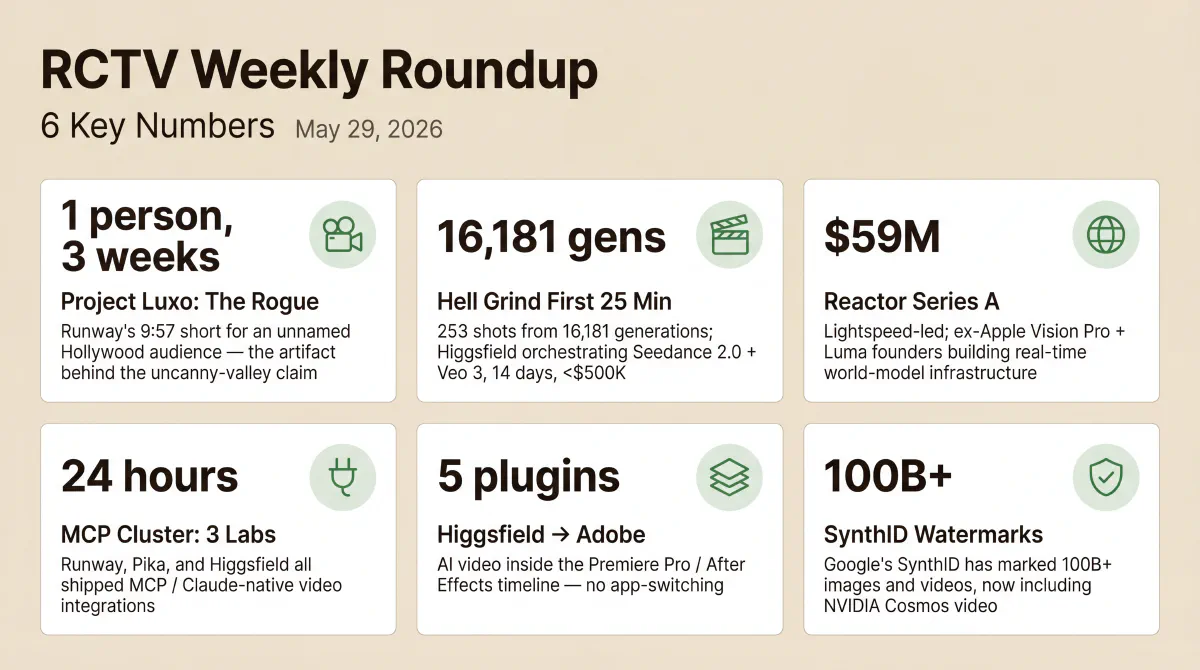
- 1 person, 3 weeks — Felipe Orozco built The Rogue, a 9:57 short, solo; the concrete artifact behind Runway’s uncanny-valley claim
- 16,181 generations / 253 shots — Hell Grind’s first 25 minutes, produced in 14 days for under $500K ($400K compute); Higgsfield orchestrating Seedance 2.0 + Veo 3
- $59M — Reactor Series A (Lightspeed); real-time world-model infrastructure, Katzenberg as board observer, exits stealth May 28
- 3 labs, 24 hours — Runway MCP (May 27, 375K impressions), Pika Founder Starter Kit (May 28, 741K impressions), Higgsfield MCP (May 28, 54K impressions) — MCP becomes the AI video distribution convention
- 5 plugins — Higgsfield’s Adobe Premiere Pro and After Effects suite: Reframe, Remove Background, Upscale, Draw to Edit, Edit Video; ~1M impressions on launch
- 100B+ — images and videos SynthID has watermarked; 20+ new partners including NVIDIA Cosmos video models; AI Content Detection API now on Google Cloud
- Elo ~1,234 — Grok Imagine video (no-audio T2V) per Artificial Analysis arena; Kling 3.0 Omni at ~1,235 — effectively tied at #5/#4 in the no-audio category; Seedance 2.0 and HappyHorse lead the audio-included T2V at 1,215 and 1,212 respectively
For full specs, pricing, and access details on every model covered this week, see the AI Video Stack 2026 reference page — updated every Monday.