fal Research fine-tuned MiniMax’s own open-weight model until it generated video faster than a person can watch it — proof, not promise, that continuous and live generated video is buildable now. Google shipped a capability update the same week that didn’t touch its leaderboard rank at all, adding scene extension, frame control, and reference conditioning instead. Neither vendor moved a score. Both moved the axis the industry actually competes on.
Models covered: MiniMax H3 Max · Gemini Omni 1.1 Flash
⚡ Video Generation Got Faster Than Video Playback
fal Research — the inference provider already serving MiniMax H3 traffic — shipped H3 Max on August 25: a post-trained fine-tune of MiniMax’s own open weights, tuned for prompt adherence and aesthetics with the serving stack co-designed around the model instead of bolted on after. fal’s announcement post, published August 26, claims the model ranks first for overall quality, prompt understanding, and aesthetics against the field it was tested against. The number worth sitting with is the generation time: a 5-second, 768p clip with synced audio, rendered in under 3 seconds — what fal calls, in its own words, “faster than real-time is still possible.”
Someone tested what that’s actually good for before the week was out. Early Saturday, developer @rehan_shei wired H3 Max to a Twitch livestream — continuously generated video with no end, “infinite interdimensional cable.” Indie developer @levelsio quote-amplified it hours later: “you can now generate AI video faster than you can watch it.” The post had drawn 1.4 million impressions and more than 12,000 likes by Saturday night. Worth naming the size of that reaction without adopting its temperature: nobody has shown H3 Max holding up at length, at higher resolution, or under sustained load, and a livestream that never stops is exactly the thing that would expose all three.
The benchmark is why the demo isn’t vapor. On this week’s Artificial Analysis board, H3 Max sits #1 on image-to-video at Elo 1,202 (fal’s own citation: 1,201 ± 11), displacing Dreamina Seedance 2.0 720p’s incumbent lead, and #3 on text-to-video at Elo 1,235 — ahead of the unmodified base MiniMax H3, which drops to #4 on the same board. fal also cites a Design Arena image-to-video Elo of 1,341; that board runs on a different scale entirely, and the two numbers shouldn’t be read against each other. fal’s own page still labels the image-to-video result “first… with audio” — Artificial Analysis retired its separate with-audio boards on August 11, so the rank is real and the label is stale.
Three speed multipliers are circulating, each against a different comparator, worth keeping apart. fal counts 35x the throughput of the official H3 endpoint. Design Arena’s own benchmarking, cited on fal’s blog, put it at “more than 50x the speed.” fal’s broader claim, measured against a quality-matched comparison group rather than H3 itself, is 15x. The genuinely interesting fact is that the independent number is the largest of the three — that gap usually runs the other way.
On pricing, fal’s model page — the pricing surface of record — is clear on two things and silent on a third. Free: five 5-second, 768p generations a day with no sign-up; signing in for fal’s sandbox adds five more a day at up to 15 seconds. Paid: half price for the first 14 days (fal’s blog says “first week” elsewhere; the model page’s 14-day figure governs). What the page doesn’t carry anywhere readable is a per-second dollar rate, so this piece isn’t printing one.
MiniMax’s own account endorsed the result rather than downplaying it: “this is exactly why we build with open weights.” The same week, ComfyUI announced it’s now “the first and only commercial license distributor for MiniMax’s generative media models” — full commercial rights to outputs, LoRA training and fine-tuning, client and agency work covered, across MiniMax’s video, audio and music models — on an open-weight base ComfyUI says has been downloaded close to 20 million times. fal is capturing the value on performance; ComfyUI is capturing it on licensing. Both are the same movement: the layer beneath the lab keeps the surface that monetizes what the lab released for free.
Threads directly to the assembly-layer thesis tracked since June: infrastructure graduating from distribution to authorship, not just routing someone else’s model faster.
Why it matters: A leaderboard rank is a comparison anyone can report. A speed threshold is a category change — once generation outpaces playback, continuous and live generated video stops being a projection and becomes a working demo. That demo is running on Twitch right now, un-stress-tested.
🎛️ Google Shipped Controls, Not a Bigger Number
Google shipped Gemini Omni 1.1 Flash on August 27 — a capability update to a model that has held a top-3 spot on every Artificial Analysis video board RCTV tracks this month. Five additions, per Google’s own launch post: scene extension (continue a clip from where it left off), first/last-frame specification, up to three video input references, upscale to 4K, and a fast 360p mode for iteration.
Get the availability split right, because the two primaries scope it differently. Google’s post frames the whole set as “for developers,” and its own launch card reads “Available via APIs.” A second post from @GeminiApp, published the same evening, narrows the consumer release to one feature: scene extension is “available to all Google AI Plus, Pro and Ultra subscribers globally.” Five capabilities reached developers. One of them reached the app.
Third-party adoption followed within hours. ComfyUI shipped Partner Node support the next morning — one node, five task types (text-to-video, image-to-video, reference-to-video, edit, extend), “up to 4K, audio generated with every clip.” Pika opened API Club access the same day. It’s the fourth model this month to reach third-party platforms within 24 hours of shipping, after Seedance 2.5, FLUX 3, and Wan 3.0.
Omni Flash’s board position didn’t move this week — #2 on text-to-video at Elo 1,237, #4 on image-to-video at Elo 1,179 — but read that carefully, because it isn’t a score for what shipped. Artificial Analysis lists the entry as “Gemini Omni Flash,” with none of the version markers it attaches elsewhere (“Wan2.7-260612,” “Minimax H3 Max (post-trained by fal)”), and it read 1,237 on August 24 and again on August 26, both before 1.1 existed. The arena hasn’t scored 1.1. Anyone routing on that number is routing on the previous model. What moved is the axis. Frame control, reference conditioning, and scene extension are what make a model usable inside an actual edit rather than impressive in a demo — shipped the same week a third party out-benchmarked a lab on its own weights. Resist reading intent into the timing: no primary connects the two launches, and a week’s coincidence is the most that’s supportable. The analysis that measured this model against Seedance 2.0 on price ran three weeks ago; this week the same model is competing on an entirely different axis.
Why it matters: The score stopped being the interesting number the moment a third party proved anyone could chase it on someone else’s weights. Google’s answer wasn’t a higher rank — it was giving the model more to do once it’s already inside an edit. That’s the axis both of this week’s stories actually compete on.
📈 By the Numbers
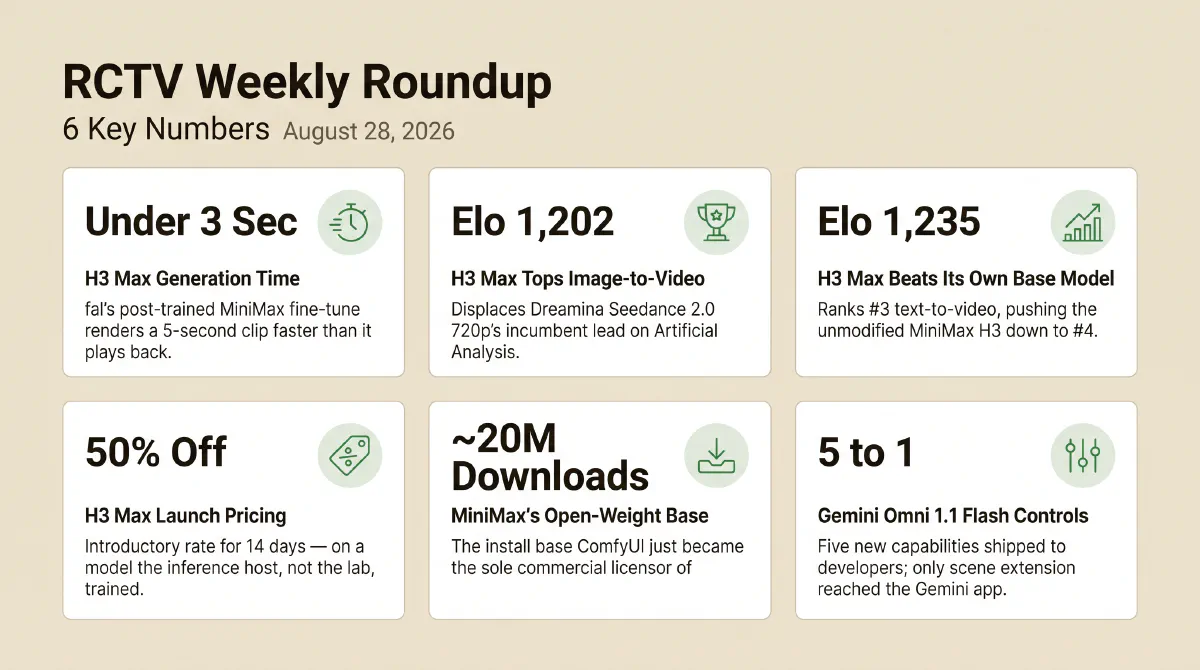
- Under 3 seconds — fal’s H3 Max generates a 5-second, 768p clip faster than it plays back, in fal’s own words: “faster than real-time is still possible.”
- Elo 1,202 — H3 Max’s #1 image-to-video score, displacing Dreamina Seedance 2.0 720p’s incumbent lead on Artificial Analysis.
- Elo 1,235 — H3 Max’s #3 text-to-video score, pushing the unmodified base MiniMax H3 down to #4 on the same board.
- 50% off, 14 days — fal’s launch pricing on a model the inference host, not the lab, trained.
- ~20 million downloads — MiniMax’s open-weight base through ComfyUI, which just became its sole commercial licensor.
- 5 controls, 1 consumer feature — Gemini Omni 1.1 Flash ships scene extension, frame control, video references, 4K upscale and a fast mode to developers; only scene extension reached Google AI subscribers in the app.
🔮 What to Watch Next Week
- California’s legislative session adjourns August 31 — the same day this roundup publishes. SB 1050, which would require disclosure when an advertisement uses a synthetic performer, sits on the Assembly’s third-reading floor file for August 30; no floor vote was recorded as of August 30.
- Whether the gap closes between Gemini Omni 1.1 Flash’s developer suite and what reaches consumers. Scene extension is the only piece of it in the Gemini app right now; if the rest follows before Google’s next update, that’s the story.
- Whether H3 Max holds up past a demo. The Twitch livestream running on it hasn’t stopped — but length, resolution, and sustained load are all still untested by anyone independent of fal.
For full specs, pricing, and access details on every model covered this week, see the AI Video Stack 2026 reference page — updated every Monday.