fal shipped on top of MiniMax’s open weights for the fourth time in nine days this week, launching a real-time continuous video model even as its month-old livestream recovered from an unexplained outage in the same window. Runway answered with two research previews three days apart — one builds worlds out of video, the other out of interfaces — and World Labs slipped a third world model in between them, one that takes the camera as an input. Neither of California’s two AI-disclosure bills that moved through the legislature this week is law yet, and the more consequential one is sitting on the Governor’s desk.
Models covered: H3 Max Turbo · H3 Max Director · Runway Solaris · GWM Worlds 2 · Atlas
⚡ fal Shipped a Fourth Time on Someone Else’s Weights
Two weeks ago fal Research post-trained MiniMax’s open-weight H3 into a model that generated video faster than a person could watch it. This week fal shipped on those weights three more times, and a research team built on them without asking either company.
On September 2, fal shipped H3 Max Turbo: twice the speed of the original H3 Max at half the cost, fal says, aimed at what it calls the 97th percentile of the base model’s quality — a target fal set for itself, not one any benchmark has scored. The promotional pricing is concrete where the quality claim isn’t: $0.00625 a second at 480p, $0.01 a second at 768p, both confirmed live on fal’s pricing page. Both prices quadruple after September 7 — the day this roundup publishes — reverting to $0.025 and $0.04. Turbo hasn’t been added to any Artificial Analysis board as of this writing; treat it as an unranked preview, not a leaderboard entry.
The next day, fal answered its own question about what a continuous H3-based stream is actually for. H3 Max Director, launched September 3, is fal’s description “the first natively continuous real-time frontier video model for action-controlled long-form generation” — a single generated stream that holds context over time instead of chaining discrete clips together. It’s also, per fal, the technology behind fal.live, the infinite AI livestream fal opened August 31, paused about three hours later citing quality work, and has been bringing back piecemeal since. Director is now a paid API product: $0.02 a second, 75% off an $0.08 list price, through September 14, with a 60-second minimum per session. As of this writing, fal.live has recovered further than it had three days ago — six of nine channels running, versus two of seven on September 3 — and picked up two new channels (Magical Girl Mishaps, Popcorn) in the process. fal has still posted nothing explaining what went wrong or what fixed it; the closest thing to an explanation is that the underlying model just became a real product. The same day Director shipped, Runway put H3 Max on Runway Dev at 5 to 8 credits a second — a second company now sells fal’s post-train of MiniMax’s weights.
fal isn’t the only outside party building on those weights. On September 2, a research team unaffiliated with either company — Xingyi Yang, working across PolyU, NUS and Oxford — turned the open-weight H3 itself into a world model on 8,000 training samples, no independent benchmark, no shipped product, describing it as “the first to turn MiniMax-H3 itself into world model.” That’s five things built on one open release in the five weeks since the weights shipped, none of them by the lab that trained it.
Why it matters: MiniMax shipped H3’s weights on August 3. In the five weeks since, the inference host serving them has put four products on top, and a research team has turned the base model into something MiniMax never announced. Open weights were supposed to be a distribution strategy. They’re turning into someone else’s product roadmap. And the shelf those weights sit on changed hands this week: NVIDIA agreed to acquire Hugging Face on September 3 for $12.93 billion, with a written promise that NVIDIA’s compute will not be required to build on or deploy through it. Every open video checkpoint that matters, H3 included, is distributed from there.
🌍 Three World Models in Four Days. Two of Them Are Video.
Start with the caveat, because it matters: Solaris, which Runway shipped August 31, generates interactive software interfaces, not video. It sits on Runway’s Gen-4.5 video-diffusion stack and shares its research framing, but the product itself renders UI, not footage. That would put it off-beat entirely, except that three days later Runway shipped the video-generating counterpart from the same research lineage — which is the actual reason this reads as one story and not a UI-tooling item that wandered onto an AI-video site.
Solaris — Runway’s “Interface World Model” — generates interactive interfaces frame by frame in real time: 720p target, sub-500ms per-frame latency, early access via request form only. Runway’s own user study (250 participants, roughly 7,500 pairwise comparisons) found Solaris preferred over a Claude-Opus-5-coded interface 61% of the time on instruction-following and 71% of the time on “natural behavior.”
The video-generating half arrived September 3: GWM Worlds 2, built on Runway’s own audio-visual generation model, generates continuous 720p video at 24 frames per second with 48,000Hz audio, steered by text actions addressed to any subject or to the scene itself, with no preset session length — “the world continues from each new input” rather than following a fixed clip or script. It’s the second version of a research line Runway first showed in December; this one adds generated audio and finer subject-and-scene control. Unlike Solaris, there’s no scope question here: this generates actual video, continuously, in response to input, which is precisely the capability the industry has spent the last three months calling a “world model” without anyone quite settling what that means.
Between the two Runway posts, on September 1, World Labs shipped Atlas: a model pretrained from scratch on text, images, video and 3D that takes camera poses as a native input and generates up to a minute of video at 1440p along a path you hand it as geometry rather than describe in a prompt. World Labs’ own chart has human raters preferring Atlas’s camera-following over MiniMax H3 75% of the time, over Gemini Omni Flash 81%, over Seedance 2.5 94% — and World Labs says in the same section that the rivals received the camera path as text, because none of them accept anything else. Read those numbers as a measure of how badly prompt-described camera control works, not as a quality ranking. Atlas is in early access with select partners, no price, no API date, and it will power future versions of World Labs’ Marble.
RCTV has been here before. The June 8 roundup caught NVIDIA, Runway and Luma all reaching for “world model” language in the same week with wildly different amounts of evidence behind it, and the May 21 flagship built the adjudication framework this beat still uses: what a lab claims a model does versus what it’s actually shown doing. Runway’s evidence this time is a demo reel and a self-run preference study; World Labs’ is a self-run preference study with the deck stacked by its own admission. Real, vendor-graded, and none of the three is available outside a request form.
Why it matters: A vendor claiming a world model and a vendor shipping one aren’t the same claim, and Runway is making both this week — Solaris on interfaces, GWM Worlds 2 on video, with a single research lineage underneath. Only one of them is a story about AI video on its own; the other earns its place by sitting next to it. Atlas is the more interesting bet of the three: it competes on camera control, an axis no blind A/B measures, which makes it either the next thing the leaderboards have to answer for or a research post that never becomes a product. Nothing here changes a routing decision today.
⚖️ Two Bills Cleared California’s Legislature. Neither Is Law.
California’s AI Transparency Act rewrite, SB 1000, hasn’t moved since it was enrolled and presented to Governor Newsom on September 2 — confirmed directly against the bill’s own status page, not a tracker. Because the bill carries an urgency clause, a signature any day between now and next week makes its changes effective immediately rather than waiting for January 1: it would remove the covered-provider user-count threshold, rename “AI detection tool” to “disclosure verification tool,” and require latent disclosure stating content is AI-generated or modified. None of that is in force yet.
SB 1050, which would require disclosure when an advertisement uses a synthetic performer, moved further this week: the Assembly concurred in Senate amendments 40–0 on August 31, and the bill shows as enrolled as of September 4. Like SB 1000, it is not law until Newsom signs it. Two AI-disclosure bills, same legislature, same week, zero enactments.
Why it matters: A bill that passes unanimously and a bill that’s been fully drafted for months both still do exactly nothing until a governor’s signature lands. California’s legislative session is procedurally finished; whether either of these takes effect this year now depends on one person’s desk, not the process that got them there.
📈 By the Numbers
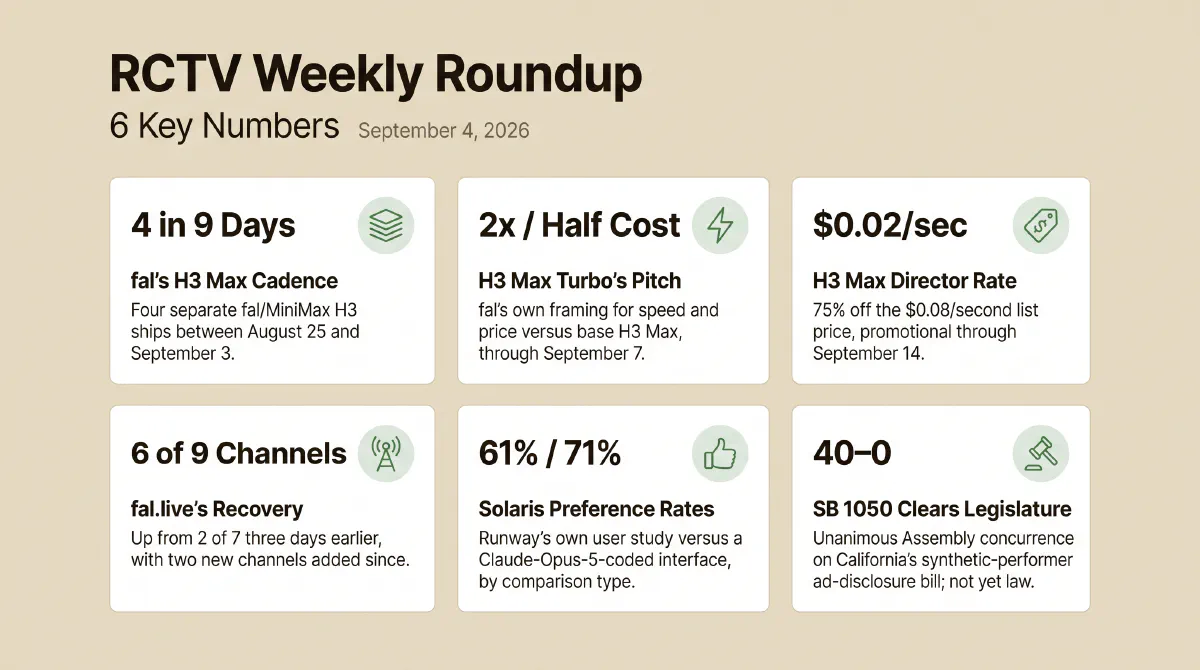
- 4 ships in 9 days — fal shipped H3 Max Turbo and H3 Max Director on top of MiniMax’s open-weight H3, following the August 25 H3 Max fine-tune and the August 31 fal.live launch.
- 2x the speed, half the cost — H3 Max Turbo’s own framing versus base H3 Max, promotional through September 7.
- $0.02 a second — H3 Max Director’s promotional rate, 75% off an $0.08 list price, through September 14.
- 6 of 9 channels — fal.live’s live channel count as of this writing, up from 2 of 7 three days earlier, with two new channels added.
- 61% / 71% — Runway’s own preference rates for Solaris over a Claude-Opus-5-coded interface, instruction-following versus “natural behavior.”
- 40–0 — SB 1050’s unanimous Assembly concurrence vote; still not law.
🔮 What to Watch Next Week
- Whether Governor Newsom signs SB 1000 — the urgency clause means any signature this month makes it effective immediately, not January 1.
- Whether fal.live’s three paused channels come back, or whether fal ever explains what took the stream down in the first place.
- Whether Runway or World Labs opens Solaris, GWM Worlds 2 or Atlas to anyone beyond a request form.
For full specs, pricing, and access details on every model covered this week, see the AI Video Stack 2026 reference page — updated every Monday.