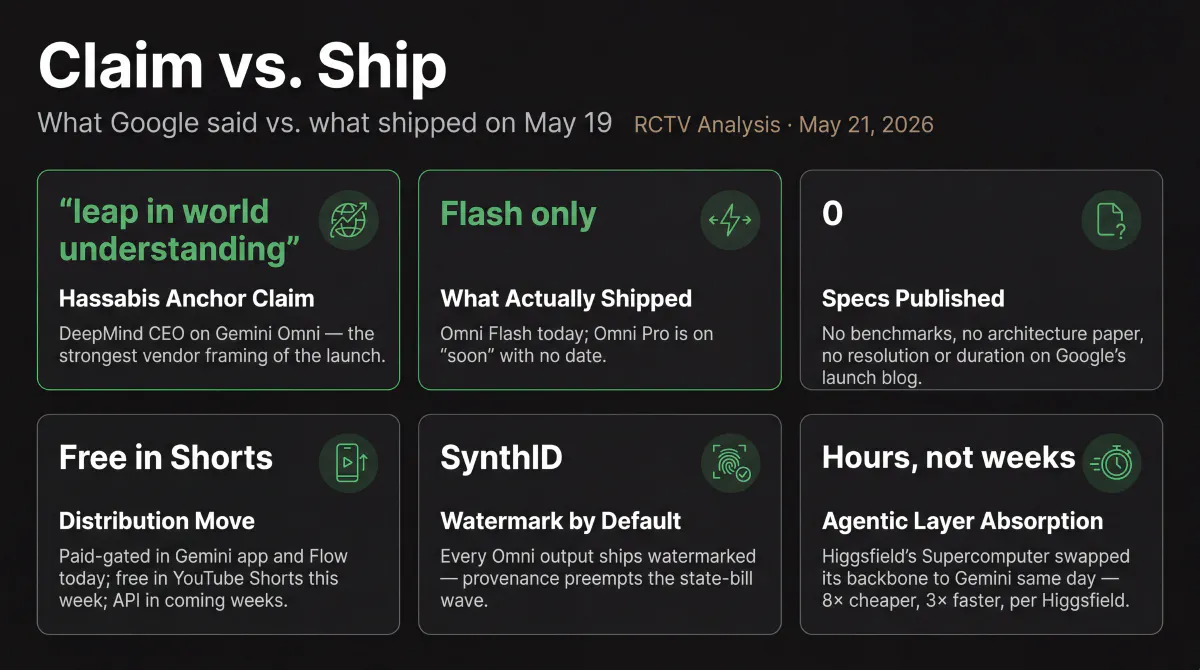
DeepMind’s own announcement called Gemini Omni a “first step towards a model that can create anything from anything — starting with video.” Demis Hassabis posted that it was “a major leap in world understanding & multimodal editing.” Sundar Pichai went further: Omni, in his words, “doesn’t just build scenes that look real, it reasons about what should happen next.” Read those three sentences in order. They get more confident the further you climb the org chart. The model is the same model.
Then the official launch blog — Google DeepMind CTO Koray Kavukcuoglu’s byline, May 19 — describes Omni’s “improved intuitive understanding of forces like gravity, kinetic energy and fluid dynamics,” shows the demos, and lists exactly zero benchmarks, no architecture paper, no resolution or duration specs. That gap, between the vendor’s strongest claim and the vendor’s published evidence, is the piece.
What did Google actually ship on May 19? A distribution move. The world model is still a promise.
01 — The claim is bigger than the announcement
Hold the three Google sentences side by side. The org account is hedged (“first step towards”). The CEO of DeepMind is firmer (“leap in world understanding”). The CEO of Alphabet is firmest (“reasons about what should happen next”). The further you climb, the more confident the language gets — and the further you get from the team that would have to ship the benchmarks. That is the amplification gap, in one company, across one keynote, in one afternoon.
We’ve covered this shape before. OpenAI announced Sora’s shutdown by reframing its compute toward “world simulation research.” Calling Sora a world simulator was the framing then; the numbers behind the shutdown said Sora was a very good video model with very bad unit economics. “World simulator” was the marketing skin on a product the company was retiring. The two claims aren’t the same claim. The voice we use for the world-model framing on Omni has to be the same voice — call the claim, name the evidence, hold the line on what the vendor has actually shown.
What Pichai claims is testable. “Reasons about what should happen next” implies a model that maintains and queries a causal scene representation across edits — not just renders one frame after another. Two questions resolve that. Did the physics demos shown on stage run on the tier that shipped today (Omni Flash), or on a tier that hasn’t shipped (anything implied by “Flash”)? And do those demos hold up to an independent physics-consistency hands-on, not Google’s reel? Neither question has a primary answer yet. Until they do, “reasons about what should happen next” is what Google says about Gemini Omni. Not what Gemini Omni has demonstrated.
“Gemini Omni doesn’t just build scenes that look real, it reasons about what should happen next.” — Sundar Pichai, May 19, 2026
The claim is testable. The test hasn’t run.
02 — What actually shipped
Omni Flash is what’s available today. The launch blog is precise on the rollout: Google AI Plus, Pro, and Ultra subscribers globally can use Omni inside the Gemini app and Google Flow starting May 19; YouTube Shorts and the YouTube Create app get free Omni-powered video this week; developer and enterprise APIs land “in the coming weeks.” Every output ships with an embedded SynthID watermark. None of that requires a world model. All of it requires Google’s distribution.
Notice what the blog does and doesn’t name. It names “Gemini Omni Flash.” It does not name Omni Pro. The “Flash” naming is industry shorthand — every modern Gemini line has had a Flash tier and a heavier sibling — but Google did not announce a Pro tier on May 19. Whatever is on the heavier side of Flash is on “soon,” with no date attached. This isn’t a small omission. The physics demos that drew the keynote’s biggest reactions were not labeled by tier. If those demos ran on the heavier model, then the model that did the most to support the world-understanding claim is not the model that shipped to subscribers today.
We’ve kept a scorecard on “coming soon” on this beat. Alibaba’s HappyHorse-1.0 has now been three weeks past its “fully open-sourced” marketing language with no public weights, no inference code, no license. The product is real; the artifact behind the headline claim isn’t. That is not a comparison to Omni’s safety — Google ships products, Google’s distribution is real, Omni Flash is in the Gemini app right now. It is a comparison to the promise structure. A vendor promise without a date is the same shape of object whether the vendor is ATH or Google. The shape doesn’t get more reliable because the logo got bigger.
The distribution side, by contrast, is the cleanest data point of the launch. Free Omni inside YouTube Shorts is the most consequential AI-video distribution event since Veo 3.1 landed inside Google Vids — and probably since Sora launched on Plus a year and a half ago. Two billion-plus monthly logged-in Shorts users get conversational video generation inside a surface they already open. No new download. No new account. No new bill. That’s not a world model. It is the most powerful distribution move in AI video since Sora launched, and it is what Google actually shipped today.
03 — SynthID by default, and the regime it preempts
One detail in the blog is worth pulling out: every video Gemini Omni produces carries a SynthID watermark by default, verifiable through the Gemini app, Chrome, and Search. Google framed this as a content-transparency feature. It is also a regulatory hedge, and the hedge is precisely tuned to a regime that doesn’t exist yet at federal level but is moving fast at the state level.
Connecticut’s SB 5 and Arizona’s SB 1786 would require providers above a user threshold to embed C2PA-aligned, tamper-resistant provenance data in any AI-generated or materially altered audio, image, or video. Connecticut’s provenance obligation takes effect October 1, 2026; Arizona’s, on a separate timeline, would be February 1, 2027. The EU AI Act’s Article 50 transparency-marking regime begins enforcement August 2, 2026. None of those regimes are federal. All of them reach Google.
Shipping with SynthID baked into every output isn’t a stunt. It is what compliance looks like when you write the model rather than retrofit the platform. A generator that needs to add provenance after the fact, vendor by vendor, has to engineer two products — the model and the compliance layer. A generator that ships the compliance layer as a default property of the model has one product. Google chose one product on May 19. That matters more for incumbents trying to retrofit than for Google itself, and it is the part of the launch that will compound longest.
It is also the part that lets Google’s claim survive scrutiny on a different axis. “Grounded in real-world knowledge” is a marketing line on the blog. “Every output is watermarked and verifiable through three Google surfaces” is a property that holds. Asymmetric: the world-model claim hasn’t been tested. The provenance claim has been engineered to be unconditionally true. Notice which side of that pair Google made unfalsifiable, and which side they left as a forward promise.
04 — The agentic layer absorbed it inside hours
We argued last week that the agentic video layer had stopped being one company’s bet — Luma, Pika, Runway, and Higgsfield all shipped conversational end-to-end agents inside roughly nine weeks. The thesis in our prompt-convergence flagship was that the moat had moved upstack: the model was no longer the product, the orchestration around it was. Omni’s launch day was the cleanest validation of that thesis to date.
Within hours of the I/O keynote, Higgsfield posted that its Supercomputer agent had swapped its backbone over to Gemini. Higgsfield’s own numbers, vendor-attributed: “8× cheaper, 3× faster.” That isn’t independent verification — it is Higgsfield’s claim about its own pipeline economics — but the speed of the swap is the story, not the multiplier. Luma’s announcement the same day was Seedance 2.0 added to Luma Agents’ model roster — different model, same pattern. The agentic layer treated Omni and Seedance interchangeably, as engines plugged into orchestration, within one news cycle.
This is what the post-Sora aggregator thesis looks like when it is no longer a thesis. The model leaderboard still decides who has the best engine. The agentic layer decides who owns the customer relationship. Google’s distribution into YouTube Shorts gives Google the largest engine-side surface in the world — but the multi-model agents (Higgsfield, Pika) treat Gemini as one input among several, not as a destination. Both can be true. The money is in the model; the defensibility is in the orchestration; Google’s Shorts move bets on owning the input side because the output side is being aggregated away.
There is one further read. Higgsfield’s quoted economics — accurate or not — point to the part of the launch Google hasn’t talked about. Free in YouTube Shorts means Google is eating inference cost on a consumer surface at scale to seed the corpus. The “8× cheaper” number, if it survives third-party stress-testing, suggests Google priced Omni to win the orchestration layer too. Which is consistent with the rest of the launch architecture. Distribute everywhere. Price aggressively into every layer. Worry about the world-model claim later.
05 — What to call this launch, on the evidence
Three readings sit inside the same set of primaries. Pick the one the evidence supports.
Reading one — the world model is real. Omni does what Pichai claims; the physics demos hold up; the gap to Veo, Kling, and HappyHorse just widened structurally. This is the read the keynote argues for. It requires a benchmark or an architecture paper or an independent physics-consistency test to be defensible. None of those exist as of publication. Reserve judgment on this read until they do.
Reading two — the world model is the marketing for a very good video model. Omni Flash is materially better than Veo 3.1, the demos are real, the distribution is the actual story. The vendor sold the launch with the strongest framing the org chart could produce; the engineering shipped the most impressive consumer-video distribution move since Sora. This is the read the primaries support. It is the lean.
Reading three — Omni Pro is the world model, and Omni Pro is on “soon.” The physics demos used the unreleased tier; the model that shipped today is the smaller sibling; the headline claim and the headline product are not the same object. This is the most generous read for Google’s substance, and it is the most damning for Google’s framing. It would mean Google announced a model that didn’t ship to justify a model that did.
The piece’s verdict is reading two, calibrated. Omni Flash is real and is the largest distribution event in AI video this year. The world-model claim outruns the published evidence at every level — DeepMind’s own language is hedged, Hassabis’s is firmer, Pichai’s is firmer still, the blog has no numbers. The promise is on “soon.” We have a scorecard on “soon” on this beat, and it doesn’t move the calibration in Google’s favor — being the largest company in the conversation doesn’t make the date land sooner, it makes the promise more expensive to break.
What changes that verdict is one of three things. A model card with benchmarks. An architecture paper. An independent physics-consistency hands-on against Veo 3.1, Kling 3.0, and HappyHorse-1.0. When any of those land, we calibrate against them. Until they do, the story Google shipped on May 19 is the distribution story, not the world-model story.
06 — The take
Sora’s framing taught the industry that “world simulator” is the vocabulary you reach for when you want to relabel a video model as something more durable than a video model. Omni’s launch keeps that vocabulary alive at the largest company in the conversation, applied to a product whose distribution genuinely is durable and whose world-understanding evidence genuinely isn’t published.
Google announced a direction, shipped the Flash tier, put the headline model and the headline claim on “soon,” and put a video model into YouTube Shorts for free in a week. That last clause is the news. The rest is the framing. Hold them apart and the launch reads more cleanly than the keynote: an aggressive, well-executed distribution move sold inside a world-model claim the company has not yet shown evidence for.
The model leaderboard will eventually tell us how good Omni Flash is. The state-bill calendar will tell us how well Google’s SynthID-default play ages against incumbents who didn’t ship compliance as a model property. The agentic layer will tell us how much of the customer relationship Google actually owns versus how much it has just inputted into someone else’s planner. None of those answers landed on May 19. The distribution did.
That’s enough for one keynote. The world model can wait for its benchmark.