Runway has offered enterprises its closed model weights since September. This week it added a managed host to run them on. Around that, a leaderboard changed its methodology under a vendor’s feet, a price cut turned out to be tier-specific, and the open-weight thread kept fighting over licences.
Models covered: Gen-4.5 · Aleph 2.0 · FLUX 3 Video · Vidu Q4 · Kling 4.0 · MiniMax H3 · Agnes-Video-2.0
🏗️ Runway’s closed weights get a managed host
Baseten announced on Oct 14 that customers can run Runway’s Gen-4.5 and Aleph 2.0 in single-tenant deployments, with fine-tuning on their own data. Runway posted the same news three minutes after Baseten’s own post.
The structure is easy to misread. The licence runs from Runway to the customer: Baseten’s post says you can “license Runway model weights directly from Runway.” Baseten is the host, and its own access to the weights runs under a distribution agreement whose terms nobody has published. Fine-tuning runs under the customer’s direct licence with Runway. Runway is not licensing weights to Baseten in the sense that phrase suggests.
Nor is this new for Runway. A Sept 11 post told enterprises they could license its model weights, fine-tune them, self-host and sell what they make, 33 days before Baseten’s announcement. Runway’s licensing page describes it as one of very few companies licensing closed weights at its level of quality. That is Runway’s description of itself, and we found no competitor doing it, which is weaker than proof. What Baseten adds is a channel: a customer who wants the weights now has a host that already runs GPUs.
What is undisclosed is most of what a buyer needs: no price, and no exclusivity terms. The one term on record is the length. Runway’s licensing page sells an annual licence with renewal built in. The 99.99% uptime SLA is Baseten’s commitment, not Runway’s. For scale, on Artificial Analysis Gen-4.5 sits 26th (1265) on the no-audio image-to-video board and 23rd (913) on no-audio text-to-video. Aleph 2.0 is eighth (1014) on the with-audio editing board (boards read Oct 18; Elo does not compare across boards). Runway is also a reseller this week: its API now carries Kling models, below.
Why it matters: Open-weight labs publish their weights and fight over the licence terms. Runway licenses closed weights one enterprise contract at a time, and its licensing page says open weights “hand you a weaker model and a to-do list.” Whether that makes Runway a lab or a model vendor depends on terms nobody has shown.
📊 Artificial Analysis re-bases image-to-video, and Vidu Q4 Preview vanishes
A leaderboard position is a snapshot of a methodology. This week’s example: Artificial Analysis’s image-to-video with-audio board now reads AA-Video-I2V v1.1, and its banner says v2.1 is “coming soon.” The text-to-video board is on v2.1 and video editing on v1.1.
On the re-based board, read Oct 18, MiniMax H3 (768p) is first at 1140, then Seedance 2.5 (1138), Gemini Omni Flash 1.1 (1132), Wan 3.0 (1127) and H3 Max (1125). Those five sit within 15 points and every interval is ±16 or ±17, so the board has no clear leader. Elo values do not carry over from the earlier version, so the old top five with Vidu Q4 Preview at third (1179) cannot be compared with this one. FLUX 3 is seventh at 1086.
Vidu Q4 Preview is missing from every board and toggle we read, along with HiDream-O1-Video-1.0. The page has filters that hide research previews and derived models, so a default setting could explain it. AA has not said. Vidu’s own materials still say “Preview,” and its API docs list only viduq4-preview, priced in credits per second from 9 at 540p to 78 at 4K. The vendor’s marketing page, vidu.com/vidu-q4, drops the word.
The toggle matters as much as the version. Video Rebirth launched BACH 1.0 Pro commercially on Oct 15 as “Currently No. 2” on AA’s image-to-video leaderboard. That holds on the no-audio board, where it sits at 1362, level with Wan 3.0 and six points behind Gemini Omni Flash. It is not on the with-audio board at all. The X post doesn’t name the toggle; Video Rebirth’s own site does, and lists $0.12 a second at 1080p.
Why it matters: Cite a rank with the board version, the audio toggle and the date, or don’t cite it. A debut inside the top three can be gone within days of a re-base while the vendor’s own copy hasn’t changed.
💸 FLUX 3 Video gets cheaper, but “50% less” is a tier-specific claim
Black Forest Labs said on Oct 14 that FLUX 3 Video is “up to 2x faster and costs 50% less” for native 2K and 4K. BFL’s pricing page now marks the video row “NEW LOWER PRICE” and shows each old price struck through beside the new one.
| Mode | Tier | Old | New | Cut |
|---|---|---|---|---|
| Text/image-to-video | HD | $0.17 | $0.15 | 12% |
| Text/image-to-video | FHD | $0.29 | $0.24 | 17% |
| Text/image-to-video | QHD (2K) | $0.40 | $0.28 | 30% |
| Text/image-to-video | UHD (4K) | $0.80 | $0.41 | 49% |
| Video-to-video | HD to UHD | $0.41–$0.95 | $0.21–$0.45 | 49–53% |
The headline holds at 4K and for video-to-video. At 2K text and image-to-video the cut is 30%, and at HD about 12%. A separate Draft tier stays at $0.06 a second, HD only.
BFL’s reply claims 4K quality that “outperforms Kling o3, at comparable pricing and latency.” The price part checks out: Kling’s API page lists Kling 3.0 and Omni 4K at $0.42 a second, against FLUX’s $0.41. The quality part is BFL’s own claim, and we found no independent 4K comparison behind it. On AA, FLUX 3 is seventh on image-to-video with audio (1086) and sixth on text-to-video with audio (1146).
Why it matters: Resolution is where the money is. A vendor cutting 4K by half while HD moves 12% is pricing for the buyer who wants the biggest output, not the one iterating cheaply.
🔌 Kling 4.0 is on Kling’s site. The API has no row for it.
Kling’s X account said on Oct 15 that Kling 4.0 is “now fully available” through a refreshed kling.ai interface, MCP and CLI. The same post puts two things on its coming-soon list: 10-bit HDR output at 4K and 1080p, and API access for enterprise customers and developers. Kling’s API pricing page agrees. Its plans “currently don’t support Kling 4.0,” and there is no 4.0 row. The post states no price, plan gating or clip length, and Artificial Analysis has no Kling 4.0 entry on any board. This is a consumer launch with the developer side to follow, which is how Kling describes it too.
Meanwhile Kling’s older models are spreading. Runway’s API changelog added Kling on Oct 13: Kling 2.5 Turbo Pro at 12 credits per second, Kling 3.0 Standard at 9 or 13 and Pro at 12 or 17 (without and with audio), and 4K at 43. O3 runs 13, 17 and 43. Runway bills a credit at $0.01, which puts 4K at $0.43 a second against Kling’s own $0.42. There is no Kling 4.0 on that list either.
Higgsfield’s Katana skill, live since Oct 12, runs inside Claude: it rebuilds a reference edit from up to five of your photos through Higgsfield’s MCP connector, on Higgsfield models and existing plan credits. It generates shots, so it is generative video. Higgsfield also says a “Motion Design” variant is available in Claude; the post is the only source, so we leave the mechanics to Higgsfield. And Runway announced “Runway for web design” with Replit on Oct 13, with no terms stated.
Why it matters: The video vendors are building for the agent a customer already uses. The prices, though, live in the API tables, and those lag the launch posts.
🌐 H3 builds keep coming, now from NVIDIA Research. Agnes ships plainly open weights.
MiniMax’s H3 licence excludes four territories, defined in its text as the European Union, the United Kingdom, the Republic of Korea and the United States of America. It requires written authorisation above US$20 million in yearly revenue, requires products to display “MiniMax H3,” and is governed by Hong Kong law. Builders keep appearing under it.
StreamRender-H3, created Oct 11, is a streaming renderer on H3 of about 207GB, trained on racing-game footage. Its project page footer reads “NVIDIA Research,” and the code sits in NVIDIA’s NVlabs/Sana repository. The model card says the bundle is “not covered by a single blanket license”: H3 components follow the MiniMax licence, Qwen parts Apache-2.0, its TAE component MIT. A US lab is shipping a build under a licence that excludes the US. That is a mismatch worth knowing about, not an accusation. The card does not spell out how the territory terms apply, and we haven’t seen NVIDIA’s reading.
TaoMate-H3-FL2VA, created Oct 15, is a LoRA by the Alibaba TaoLive AIGC Team, tagged minimax-h3-community. Its card says “to our knowledge” it is the first real-time streaming first/last-frame-to-audio-video model. That is the developers’ claim.
FastH3-Omni is billed as open source and can’t be downloaded. Reactor’s post calls it the “open-source version of realtime H3,” post-trained by FastVideo with Nuvalab, and MiniMax reposted it. What exists is an exclusive preview on Reactor’s API until Oct 20. FastVideo’s earlier FastH3 checkpoints are on Hugging Face under the H3 licence; we found none for FastH3-Omni as of Oct 18.
The contrast is Agnes-Video-2.0-MoE, created Oct 11: Apache-2.0 with no territory clause, 28.7B parameters stored and 15.3B active across three experts, built on GAIR’s daVinci-MagiHuman. The caveats are real. The licence is “subject to applicable upstream license requirements,” the T5Gemma text encoder falls under Gemma terms and comes separately, and the pruned checkpoint is promised for later. Derivative counts live in the open-weights tracker.
Why it matters: The licence is the product. Builds from a US lab and an Alibaba team carry a licence that excludes the US and the EU. Agnes’s carries no territory clause at all.
🧾 Also this week
- Decart: The Wall Street Journal reported, as relayed by GeekWire, that Amazon is in talks to buy Decart for around $7 billion. We have not read the Journal piece, and neither company has confirmed. GeekWire frames it as an inference-software deal: Decart’s software helps models run faster on different chips, including Amazon’s Trainium.
- Kandinsky S2V 1.0: An arXiv paper (Oct 13) says the code and checkpoints for its 2B and 21B avatar-video models are released under the MIT license. We found no repository or checkpoint as of Oct 18, only two tiny test pipelines in the lab’s Hugging Face listing.
📈 By the Numbers
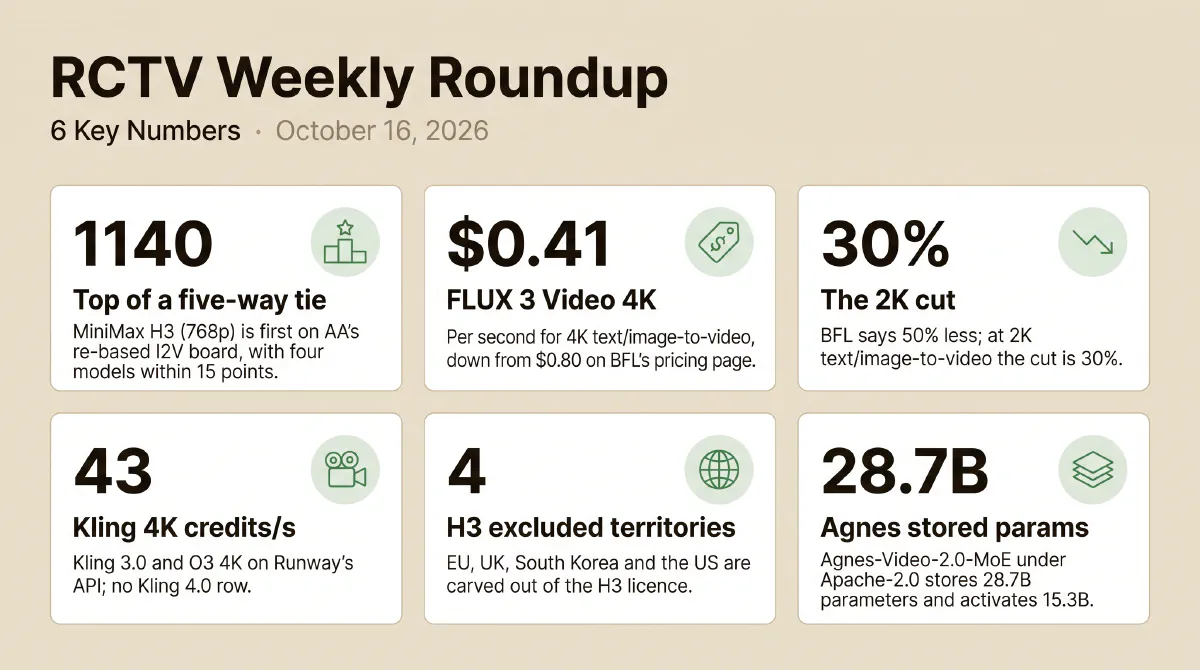
- 1140 — MiniMax H3 (768p), first of five models within 15 points on AA’s re-based image-to-video board, with audio, v1.1, read Oct 18. Vidu Q4 Preview is on no board.
- $0.41 vs $0.80 — FLUX 3 Video 4K text/image-to-video per second, new against old, on BFL’s pricing page.
- 30% — the 2K text/image-to-video cut, against BFL’s “50% less” headline.
- 43 credits per second — Kling 3.0 and O3 4K on Runway’s API, about $0.43 a second. No Kling 4.0 row.
- 4 — territories excluded by the H3 licence: EU, UK, South Korea, US. Apache-2.0 excludes none.
- 28.7B / 15.3B — Agnes-Video-2.0-MoE stored against active parameters, per its model card.
🔮 What to Watch Next Week
- Kling 4.0 on the API side. A 4.0 row on Kling’s pricing page and a price would turn a consumer launch into a developer one. Kling’s own post lists API access as coming soon.
- AA’s image-to-video v2.1. Announced as “coming soon.” Whether Vidu Q4 Preview and HiDream return on it is open.
- FastH3-Omni and Kandinsky S2V. Reactor’s exclusive preview ends Oct 20, which is when “open source” either means weights or doesn’t. The Kandinsky paper says its MIT code and checkpoints are released; we haven’t found them.
- GTC Berlin, Oct 21–22. NVIDIA’s keynote is Oct 21, and Black Forest Labs’ CEO is on the speaker list a week after the FLUX 3 Video price cut.
For full specs, pricing, and access details on every model covered this week, see the AI Video Stack 2026 reference page — updated every Monday.