Kling and Google both put a cheaper video tier on sale this week, at about 9 and 7 cents a second. fal, which sold both the same day they launched, says it raised $1.65 billion. And the benchmark top stayed a tie, which leaves price doing more of the choosing.
Models covered: Kling 4.0 Flash · Gemini Omni 1.2 Flash · FLUX 3 Max · Seedance 2.5 · Utopai X · HeyGen Video 1 · Pika H3 Flex · Runway
⚡ Kling 4.0 Flash goes on sale at 60% of the flagship’s rate
Kling said on Nov 4 that Kling 4.0 Flash is “Fully Available”, open to everyone on its website and through the API. The post names no price, resolution or duration, and says nothing about audio. The price is on Kling’s API pricing page, read Nov 7 and again Nov 8. Flash bills 0.6 units a second at 720p with no input video, and 0.4 with one. Its 1080p and 4K cells are blank. Kling 4.0 bills 1.0 units a second at 720p and 1.5 at 1080p, or 0.6 and 0.9 with input video. Kling sells units in 180-day prepaid packages with no rollover: $500 for 3,250, $2,000 for 13,135, $8,000 for 53,640.
Dollars are our arithmetic. The smallest package lists at $510, which makes a unit about 15.7 cents and Flash at 720p about 9.4 cents a second, against 15.7 cents for Kling 4.0. fal’s Kling listing prints $0.094 and $0.157, so the derivation holds. A package price is a commitment, not a rate, and the bigger packages come out a few percent cheaper per unit.
In late October the same page showed Kling 4.0 only as a coming-soon preview with Flash “TBA”. It then went live. Now it carries a second, cheaper tier, and the cheaper tier is the one most readers will actually run.
What Flash produces is mostly settled. Kling’s release note lists it at 3 to 20 seconds and 720p, and its spec table has no audio row. fal’s launch post, 17 minutes after Kling’s, says Flash generates “up to 20 seconds at 720p with native audio.” Runway’s developer changelog (Nov 5) agrees: 3 to 20 seconds at 720p, outputs include audio, 9.4 credits a second against 15.7 for Kling 4.0, whose 20% launch discount runs through Nov 30. Both are resellers. Kling’s post, pricing table and release note are silent on Flash audio, though the pricing table tags it on the 3.0 rows. Until Kling says it, audio is the resellers’ claim.
Quality has no independent read yet. Artificial Analysis shows no Kling 4.0 or Flash row on its image-to-video, text-to-video or editing boards. Kling’s own feed this week was creator showcases, and the 30-second single takes they praise are a Kling 4.0 claim, not a Flash one. On Design Arena’s own preference scale, which is not AA’s, Kling 4.0 read 1282 on Nov 7.
Why it matters: The price ladder is the story. Kling’s own note settles length and resolution; treat audio as unconfirmed until Kling says it.
💸 Google’s Gemini Omni 1.2 Flash goes generally available at about 7 cents a second
Google made Gemini Omni 1.2 Flash generally available on the paid tier of the Gemini API on Nov 5, for clips up to 15 seconds with native audio. Its pricing page bills output tokens at $12.00 per million and does the conversion itself: about $0.07 a second at 720p, $0.104 at 1080p and $0.209 at 4K, the last two upsampled. On the same page, the 1.1 model converts to about $0.10 a second, and from Dec 3 every request to 1.1 routes to 1.2 and bills at 1.2’s rates.
fal and Runway had it the same day. Artificial Analysis has no 1.2 row yet. Its predecessor, Gemini Omni Flash 1.1, shares first place on AA’s no-audio video-editing board. On Design Arena’s scale, 1.2 Flash sat first at 1367 on Nov 7.
Why it matters: At 720p, the week’s cheap options sit within three cents a second of each other: Google about 7, fal’s discounted FLUX 3 Max 8.5, Kling Flash 9.4. Google’s is the only one whose length and audio come from the vendor’s own page.
💰 fal says it raised $1.65 billion, and publishes no valuation
fal announced on Nov 3 that it raised its Series E and Series F “for a combined total of $1.65B.” Sequoia led the E and Bessemer led the F, with “continued investment” from NVIDIA. The figure is fal’s. Its blog post says the E closed earlier this year and the F is announced “today,” and states no amount, no valuation and no split between the rounds. We have seen one secondary report with numbers and could not trace it to a Tier-1 outlet, so we print none of them.
fal listed Kling 4.0 Flash 17 minutes after Kling’s post and Gemini Omni 1.2 Flash the same day as Google. It also ships its own model: FLUX 3 Max, post-trained with Black Forest Labs, turned up in October. The hosting layer is no longer neutral plumbing. It sets prices, runs promotions and trains models. FLUX 3 Max’s 75% discount ended on Nov 7 and a new one replaced it: 50% off, $0.085 a second at 720p against a $0.17 list, until Nov 21 on one fal page and through Nov 22 on another.
Why it matters: Capital is moving to the layer that sells everyone else’s models, and the only number we can print is the one fal chose to publish.
📊 With audio, AA’s image-to-video top is still a tie, and the price column does the work
Names, boards and dates, since they move: the figures below are from Artificial Analysis, AA-Video-I2V v2.1, read Nov 8. Ties follow AA’s rank ranges: two rows tie for first when both ranges include first place.
With audio, Seedance 2.5 leads at 1158 (range 1–2), and Utopai X sits at 1149 (range 1–3), so it’s a two-way tie. Then Seedance 2.0 at 1137, MiniMax H3 (768p) at 1133, and HeyGen Video 1 at 1123 (range 4–9). On cost, AA prices Seedance 2.5 at $34.12 a minute of generated video, H3 (768p) at $4.80 and HeyGen Video 1 at $2.40. HeyGen costs about a fourteenth of the leader and ranks fifth, with a range reaching ninth. AA’s banner counts 10 models added to the board in 30 days.
Without audio, Utopai X holds range 1–1 and leads outright, as it did a week ago. It still has no API. On text-to-video with audio (v2.1), Wan 3.0 (1172, range 1–3) and Utopai X (1167, range 1–4) tie for first. On video editing with audio (v1.1), Wan 3.0 at 1192 holds range 1–1 and leads outright.
Why it matters: Where the top is a tie, the cost column breaks it, and on this board a buyer gives up a few places for a fourteenth of the price.
🗞️ Also this week
- Pika H3 Flex arrives on Pika’s own platform. Pika said on Nov 4 that Creator and Fancy subscribers get 15 free generations a day through Nov 15. The model launched Oct 29, so the news is the platform.
- HeyGen Video 1 on mobile. HeyGen’s Nov 4 post says it’s in the HeyGen app. It sits fifth on AA’s image-to-video board above.
- Runway Dev reaches Cursor (Nov 2) and Claude Code (Nov 4) as plugins, after Codex on Oct 28.
- TaoMate-HD-preview. Alibaba’s TaoLive AIGC team released preview LoRA weights on Nov 3 for the MiniMax H3 base. The card names the MiniMax H3 Community License, says “the upstream license terms apply” and prints no territory text. Our Nov 2 piece covers what those terms say.
- Sand.ai, reportedly. TMTPost reported that the maker of MAGI-2 closed a $200 million Series A+. We found no company statement and no valuation, so it stays a report.
📈 By the Numbers
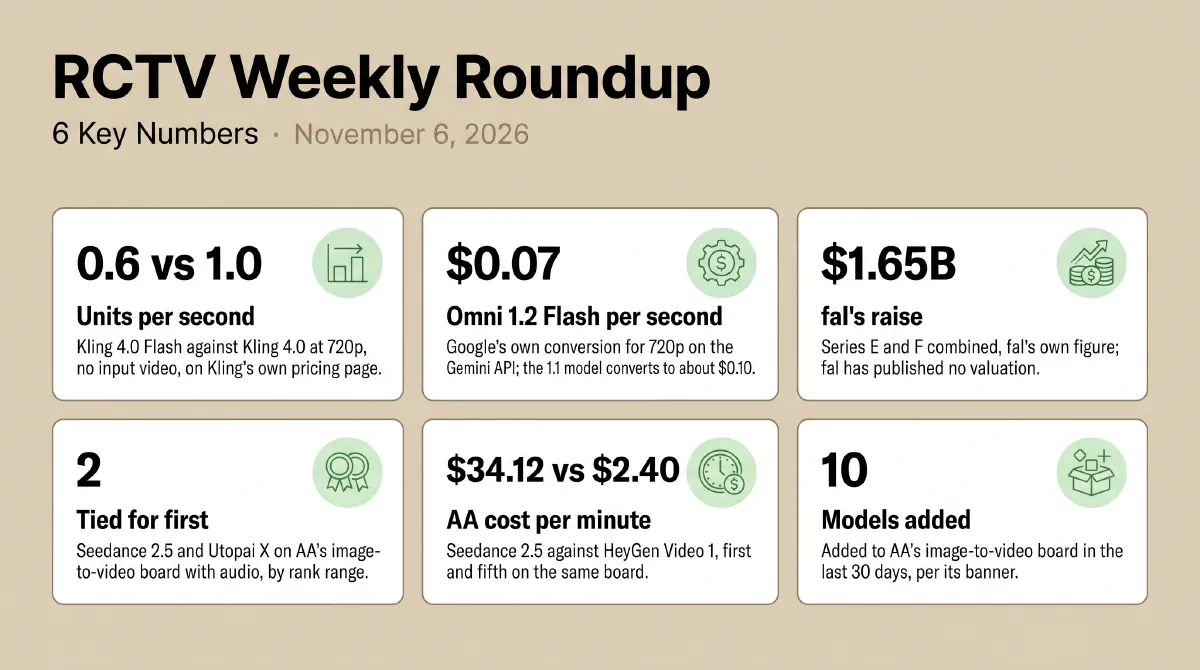
- 0.6 vs 1.0 units a second — Kling 4.0 Flash against Kling 4.0 at 720p with no input video, on Kling’s pricing page. At the smallest package’s list price, Flash is about $0.094 a second, our arithmetic, which matches fal’s listing.
- $0.07 a second — Gemini Omni 1.2 Flash at 720p, by Google’s own conversion on the Gemini API pricing page. The 1.1 model converts to about $0.10.
- $1.65B — fal’s combined Series E and F, its own figure. No valuation published.
- 2 — models tied for first on AA’s image-to-video board with audio: Seedance 2.5 (range 1–2) and Utopai X (1–3), v2.1, Nov 8.
- $34.12 vs $2.40 a minute — AA’s cost for Seedance 2.5 and HeyGen Video 1 on that board.
- 10 — models AA added to that board in the last 30 days, per its banner.
🔮 What to Watch Next Week
- Kling 4.0 Flash: an Artificial Analysis row, and a Kling-authored statement on audio. Kling’s release note already gives the length and resolution; audio is the one spec still resting on resellers.
- Gemini Omni 1.2 Flash: its first Artificial Analysis row. Requests to 1.1 move to 1.2’s rates on Dec 3.
- FLUX 3 Max: fal’s 50% discount ends Nov 21 or Nov 22, depending on which fal page you read, then the $0.17 list returns. Check the rate before building on it.
- EU AI Act, Dec 2: the Article 50(2) marking duty for systems already on the market, and the new Article 5 ban on non-consensual intimate imagery, both under Regulation (EU) 2026/1744, are 23 days out.
For full specs, pricing, and access details on every model covered this week, see the AI Video Stack 2026 reference page — updated every Monday.