Tomorrow is the most consequential day on the AI video calendar this year, and only half of it is about a model. The TAKE IT DOWN Act’s federal compliance deadline lands May 19 — the morning Google opens I/O — and the FTC has already sent warning letters, by name, to fifteen of the largest platforms on the internet. The money side didn’t pause for the regulators: Kuaishou is reportedly courting outside capital for Kling AI at a $20 billion valuation, and the agentic-video pattern we’ve tracked since March stopped being any one company’s bet.
Models covered: Kling · Runway · Higgsfield · HappyHorse
⚖️ TAKE IT DOWN Goes Live Tomorrow — and the FTC Named Names First
Last week we flagged that no platform had published a TAKE IT DOWN compliance page with the deadline eight days out. The FTC answered the silence before the platforms did. On May 13, Chairman Andrew Ferguson sent formal letters to fifteen of the largest user-content platforms — Amazon, Alphabet, Apple, Automattic, Bumble, Discord, Match Group, Meta, Microsoft, Pinterest, Reddit, SmugMug, Snapchat, TikTok, and X — reminding them that full compliance is due “no later than May 19” and closing with a line worth quoting in full: “We stand ready to monitor compliance, investigate violations, and enforce the Take It Down Act.”
The TAKE IT DOWN Act, signed May 19, 2025, gave covered platforms a year to stand up a notice-and-removal process for non-consensual intimate imagery and AI-generated deepfakes; the first federal conviction set the criminal precedent in April. Tomorrow opens the civil-enforcement profile, and the legal bulletins are precise about the stakes: a clear and conspicuous reporting mechanism, removal within 48 hours of a valid request, and civil penalties up to $53,088 per violation, enforced by the FTC. Worth being precise back: the 48-hour notice-and-removal process is the statutory obligation. Hash-based duplicate suppression — the part hardest to engineer to scale in a week — is something Ferguson urged platforms to “consider,” not something the Act mandates. Platforms shipping minimum-viable compliance tomorrow are reading the statute correctly, not cutting a corner.
The conspicuous absence from Ferguson’s mailing list: the AI video generators themselves. Kling, Veo, Runway, Luma, Pika, and the third-party HappyHorse and Seedance endpoints were not named. That is not a safe harbor. The Act’s covered-platform definition reaches anything that hosts user-generated content, which every generator does at the output stage. The reasonable operating assumption is that the FTC’s first list is the largest-surface-area first, not the only one — and a generator that reads its absence from a stakeholder letter as an exemption is making a bet against the agency’s own stated enforcement intent.
Why it matters: This is the first federal AI-content compliance regime to go live with hard civil penalties, and the FTC chose to telegraph enforcement by name before the deadline rather than wait for litigation to map the scope. For AI video platforms the question is no longer whether covered-platform status applies — it’s whether the published procedure exists by tomorrow morning. The labs that have one are treating federal compliance as infrastructure. The labs that don’t are running on the FTC’s tolerance, not a legal defense.
💰 Kuaishou Courts Outside Money for Kling at a Reported $20B
Kuaishou confirmed on May 13 that it is weighing a restructuring that would bring external financing into Kling AI, its generative-video unit. That much is on the record from the company. Everything quantified around it is reporting, not confirmation: Kuaishou explicitly called the plan preliminary, with no definitive agreements signed. With that caveat doing real work, the reported shape is a roughly $2 billion pre-IPO round at a $20 billion target valuation, with Tencent named among potential investors, and Kling’s annualized revenue reportedly around $500 million — roughly double its January run rate, the majority from overseas markets. Kuaishou shares rose nearly 10% on the report.
Hold the numbers at arm’s length and the signal still reads clearly. We argued after the Sora shutdown that consumer AI video subscriptions were structurally broken on cost versus retention, and that the viable path ran through professional infrastructure. A unit reportedly clearing $500 million annualized, mostly overseas and not on a consumer-app treadmill, is the cleanest data point yet for that thesis — and it’s a Chinese company posting it while the US pure-plays stay quieter about revenue than valuation.
Why it matters: Sora’s collapse removed the public comparable for AI video economics, and the field has run two months without one. A Kling raise at $20 billion with Tencent reportedly at the table re-anchors the conversation and sets a revenue-not-narrative bar that Runway, Luma, and the rest will be measured against in their next rounds. The reporting is unconfirmed and the valuation is a target, not a close. The direction of travel is not in doubt.
🤖 The Agentic Layer Stops Being One Company’s Bet
When Luma Agents shipped in March it read as one lab’s interface experiment. Pika Agents in early May made it two. This week made it the industry’s stated direction. Runway launched Runway Agent, a conversational partner that runs ideation, generation, sound, and editing end-to-end through a chat surface. Days later Higgsfield shipped Supercomputer, an agent that orchestrates GPT-5.5, Seedance 2.0, Gemini, and others to plan and produce full campaigns from one conversation, on web and Telegram.
Four platforms in roughly nine weeks — Luma, Pika, Runway, Higgsfield — have converged on the same shape: the model is no longer the product; the orchestration around it is. Two of them (Pika, Higgsfield) are explicitly multi-model, treating the generators as interchangeable engines behind a planning layer. That’s the post-Sora aggregator thesis arriving as product, not commentary — landing the same week Kling’s reported economics show the model layer is still where the revenue is. Both can be true: the money is in the model, the defensibility is moving above it.
Why it matters: When one lab ships an agent it’s a bet. When four ship the same architecture inside a quarter it’s the next interface cycle, and the strategic question flips. The model leaderboard still decides who has the best engine; the agentic layer decides who owns the customer relationship. Labs that win the benchmark but cede the conversational surface risk becoming the commodity inside someone else’s product — the exact position the multi-model agents are engineering for.
🏛️ A Second State Wave — This Time It’s About Provenance
Last week’s roundup covered the state map through the lens of non-consensual-imagery liability — Connecticut’s HB 5312, Vermont, Iowa, Utah. This week’s state movement is a different theory aimed at a different target. Connecticut is back, but with a different bill: SB 5, the omnibus AI Responsibility and Transparency Act, which passed both chambers May 1 and awaits Governor Lamont’s signature. Buried in its 67 pages is the part that reaches the generators directly: providers with more than one million monthly users must embed C2PA-aligned provenance data into any audio, image, or video their systems generate or materially alter, and make it resistant to tampering. The provenance obligation takes effect October 1, 2026; the detectability standard follows October 1, 2027.
Arizona is moving the same idea on a narrower track. SB 1786 — “artificial intelligence; content verification” — would require covered providers to embed tamper-resistant provenance data in AI-generated or materially altered video, image, and audio. It has passed the Arizona Senate and awaits a House vote, with a committee-amended effective date of February 1, 2027 — further along than a committee bill, not yet law, and not the “both chambers” some trackers report. Hawaii’s HB 2137 would extend the disclosure idea to synthetic performers in advertising; it advanced this session amid organized industry opposition, and we’ll confirm its final disposition rather than overstate it here.
Why it matters: Last week’s state laws targeted the people who misuse generated video; this week’s target the systems that make it. A provenance-embedding mandate at platform scale is a build requirement, not a content-moderation policy — it changes what the model ships, not just what the platform removes. Connecticut and Arizona aren’t aligned on effective dates or scope, which is the larger problem: a generator serving all fifty states now faces a patchwork of incompatible provenance regimes with no federal standard to preempt them.
🐎 HappyHorse Open Weights: Week Three of “Coming Soon”
The credibility test we set May 4 hasn’t moved, and now it’s three weeks old. Alibaba’s happyhorse.me/open-source page still reads “fully open-sourced.” The public GitHub still holds an information-collection form instead of weights, inference code, or a license. Hugging Face still reads “coming soon.” No date has been attached to the gap. HappyHorse-1.0 holds its leaderboard position as a commercial-API-only product carrying a public claim that its weights are released.
Why it matters: Two weeks of this was a release-timing question. Three weeks is a credibility posture. The open-weights claim drove the leaderboard story that made HappyHorse a name in April; the longer the artifact stays vapor, the more the operative story becomes a hosted-only API wearing open-source marketing. If weights don’t ship before I/O, “coming soon” is the summer position.
📈 By the Numbers
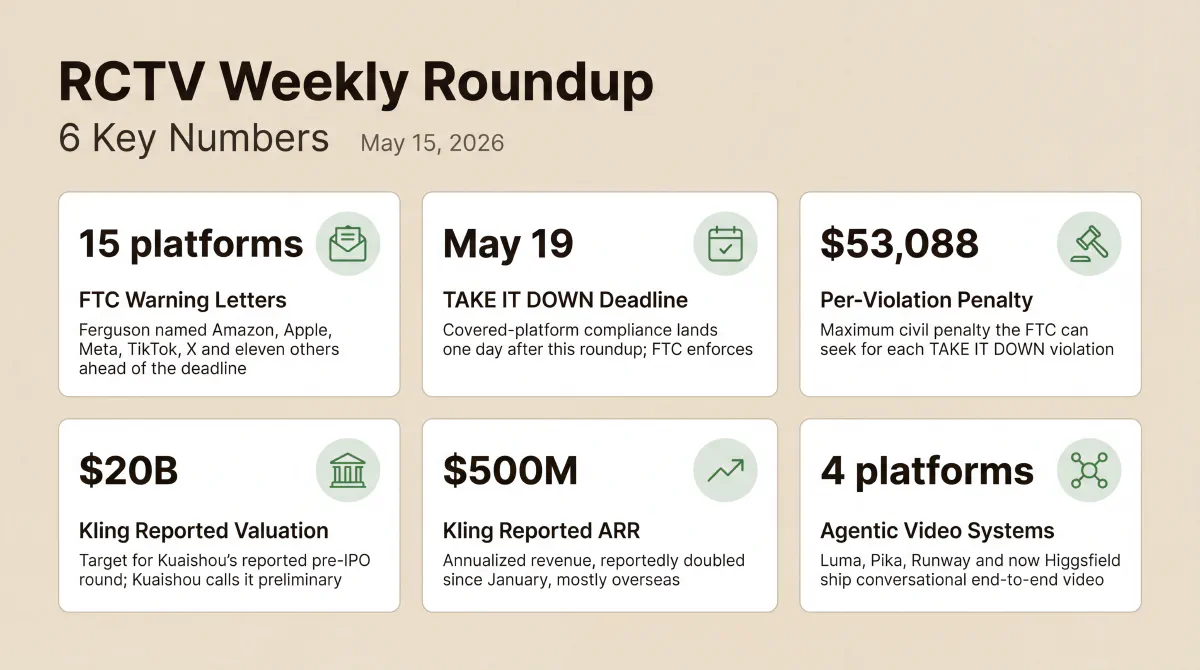
- 15 platforms — named recipients of the FTC’s TAKE IT DOWN warning letters, from Amazon and Apple to TikTok and X
- May 19 — TAKE IT DOWN Act covered-platform compliance deadline, one day after this roundup
- $53,088 — maximum civil penalty per violation the FTC can seek, per legal analysis of the deadline
- $20B — reported target valuation for Kuaishou’s Kling AI external-financing plan; Kuaishou calls the plan preliminary
- $500M — Kling’s reported annualized revenue, reportedly double its January run rate, mostly overseas
- 4 platforms — Luma, Pika, Runway, and Higgsfield have now shipped conversational end-to-end agentic video in roughly nine weeks
🔮 What to Watch Next Week
- Google I/O — May 19. Whether Omni is a Veo rebrand, a parallel model, or a unified image-video system reveals itself on stage; Veo 4 is the other open question. We’re tracking; Wednesday’s pulse logs what Google actually ships and the May 25 roundup carries it.
- TAKE IT DOWN enforcement posture — May 19+. The deadline is the start, not the story. We’re watching which of the fifteen named platforms — and which AI video labs — publish a compliance procedure, and whether the FTC’s first action targets a platform or a generator.
- Kling financing. Reporting is unconfirmed and the round is a target. Watch for a definitive agreement, a named lead investor, or a Kuaishou statement that moves it past “preliminary.”
- HappyHorse weights. Ship before I/O or “coming soon” is the operational posture through summer. No new framing from Alibaba this week.
For full specs, pricing, and access details on every model covered this week, see the AI Video Stack 2026 reference page — updated every Monday.