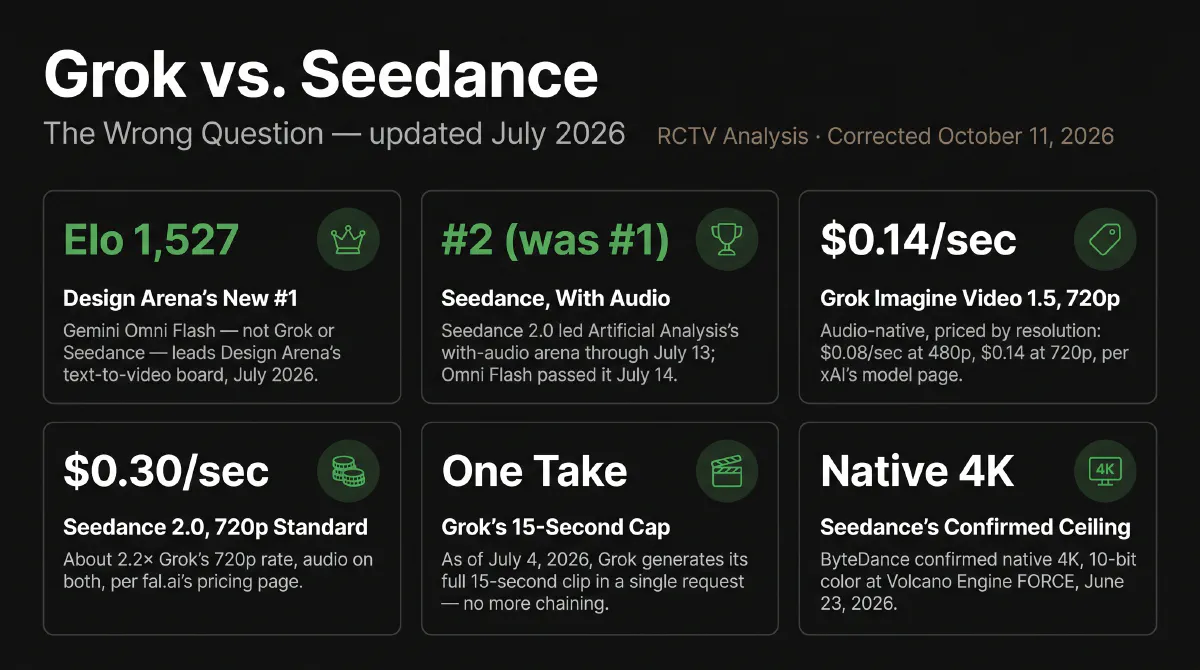
Grok Imagine and Seedance 2.0 are still not fighting for the same job. Pick Grok Imagine Video 1.5 — from $0.08 per second at 480p ($0.14 at 720p), audio-native, and, as of July 4, a full 15-second clip in a single request — if the point is volume distributed inside X. Pick Seedance 2.0 — confirmed native 4K, camera-move replication, US access via CapCut — if the output has to hold up on its own. Neither one leads the quality boards anymore: as of July 14, 2026, Google’s Gemini Omni Flash sits #1 on both of Artificial Analysis’s audio-inclusive arenas, ahead of Seedance on each.
That last sentence is the actual news in this update. The distribution-versus-craft frame from June still holds. But “craft” no longer means “Seedance is winning,” and the honest move is to say so rather than quietly patch the numbers and hope nobody checks the leaderboard.
Grok Imagine vs. Seedance 2.0, at a glance
(current as of July 14, 2026 — full sourcing and dates below)
| Grok Imagine Video 1.5 (xAI) | Seedance 2.0 (ByteDance) | |
|---|---|---|
| Resolution | 720p; 1080p “Pro” tier promised April 2026, still unshipped | Native 4K, 10-bit color — confirmed June 23, 2026 |
| Audio | Native, single generation pass | Native, single generation pass |
| Max clip length | 15 seconds, single request as of July 4, 2026 (previously required chaining shorter clips) | 15 seconds per generation, multi-shot cuts within that window; Seedance 2.5 preview targets 30 seconds uncut |
| Price | $0.08/sec at 480p, $0.14 at 720p — per xAI’s docs | $0.3034/sec at 720p standard — per fal.ai, about 2.2× Grok’s 720p rate |
| Distribution | X app, grok.com, iOS, Android — bundled into SuperGrok | CapCut/Dreamina (US, real-face restricted); also via Higgsfield, Runway, and Pika as of late June |
| Camera control | Extend-from-frame chaining; no dedicated camera API | Reference-video camera-move replication; frame-level character consistency |
| Artificial Analysis, image-to-video with audio — the one board both models actually share | #3, Elo 1,115 | #2, Elo 1,196 |
| Artificial Analysis, text-to-video with audio | Not scored — the audio-native model is image-to-video only | #2, Elo 1,224 (down from #1 as of July 13) |
The framing problem the June version had
Here’s a correction the earlier version of this piece needed and didn’t have: Grok’s audio-native model isn’t a text-to-video model. Grok Imagine Video 1.5 generates from an image, not a text prompt — xAI’s own docs list it under image-to-video. The original, still-cheaper ($0.05/sec) Grok Imagine remains text-to-video and still has no audio. So the one Artificial Analysis board where these two companies’ audio-capable models genuinely compete head-to-head is image-to-video, not text-to-video — and there, Seedance leads, 1,196 to 1,115, for now.
On text-to-video specifically — the product both companies market hardest — Seedance competes in a field that no longer includes a Grok audio tier at all, and it no longer leads that field either. Gemini Omni Flash debuted on Design Arena July 2 and has since landed Artificial Analysis scores too: #1 on text-to-video with audio at Elo 1,240, and #1 on image-to-video with audio at Elo 1,203 — both ahead of Seedance, and both new since RCTV’s July 13 roundup reported Omni Flash’s Artificial Analysis score as still pending. Whatever changed, it changed in the last 48 hours.
A second, separate leaderboard tells a similar story on a different scale. Design Arena runs its own voting pool with its own Elo range — not comparable point-for-point to Artificial Analysis’s. There, as of July 5, 2026 (the board’s most recent stable read), Omni Flash leads at 1,527, Seedance 2.0 sits second at 1,482, Meta’s Muse Video is third at 1,459, and HappyHorse-1.0 is fourth at 1,430. Different scale, different voting pool, same conclusion: Seedance is very good and currently second, on both boards that measure it.
The case for Grok: price and reach, with one fewer asterisk
Grok Imagine’s pitch hasn’t changed since June — it’s built into X, it starts at $0.08 a second with audio included, and reach compounds when the model lives where people already are. What’s new is a real capability gain, not a marketing refresh. On July 4, 2026, a developer testing the app reported that Grok Imagine now generates its full 15-second clip “in one long take,” rather than chaining several shorter generations together — the workaround that had defined the product’s practical ceiling since launch. Elon Musk amplified a follow-up demo three days later.
xAI hasn’t published this as a dated release note or blog post. The company’s release-notes page, checked July 14, 2026, has no entry for it. The record here is a developer’s post and a founder retweet, not a spec sheet — treat the capability as real and the documentation as pending.
Everything else about Grok’s position is unchanged, which is itself worth noting: still 720p, still no confirmed date for the 1080p “Pro” tier Musk promised for April and missed, and still priced by resolution — $0.08/sec at 480p, $0.14 at 720p, per xAI’s model page. The aggregator sites that list tiered pricing had it right. The “$4.20/min” figure that circulates online belongs to the original Grok Imagine’s old $0.07/sec@720p rate — a different, cheaper, silent model — not Video 1.5.
The case for Seedance: still the craft bet, with distribution it didn’t have in June
Seedance 2.0’s argument in June was quality without reach. Reach arrived. ByteDance confirmed native 4K at 10-bit color depth at Volcano Engine FORCE on June 23, and within 24 hours three separate platforms — Higgsfield, Dreamina, and Runway — shipped Seedance 4K to their own users. Pika added the same tier two days later. Higgsfield now sells an “unlimited” Seedance tier through a BytePlus commercial partnership; Runway resells API access to it through Runway Dev. ByteDance still doesn’t operate a mainstream US consumer surface beyond CapCut’s restricted access — but it no longer needs one. Four other companies are distributing the model for it, which is more or less the assembly-layer thesis RCTV laid out July 9 playing out in real time on this exact model.
The specs still justify the craft framing: a Dual-Branch Diffusion Transformer generating audio and video in a single pass, reference-video camera-move replication, frame-level character consistency across shots. What’s newly clear is the price. fal.ai’s live listing puts the standard 720p-with-audio tier at $0.3034/sec — about 2.2 times Grok’s $0.14 at the same resolution — with a faster tier at $0.2419/sec and a stripped-down “mini” tier near $0.02/sec for non-US markets.
The next spec bump is already previewed. ByteDance showed Seedance 2.5 at the same June 23 event — single clips up to 30 seconds with no stitching, up to 50 multimodal reference inputs, post-generation editing that redrafts part of a frame without touching the rest — and opened a public rollout on Dreamina and Jimeng July 3. Every spec there is ByteDance’s own claim; there’s no independent benchmark yet, no confirmed US date, and — checked July 14, 2026 — no listing on fal.ai. The third-party API access ByteDance is reportedly targeting for late July hasn’t shipped.
Distribution bet vs. craft bet — still the right frame, more crowded now
The June thesis was: Grok bets on distribution, Seedance bets on craft, and both are reaching toward the other’s strength. That’s still true. Grok added a genuine craft improvement, however lightly documented. Seedance added reach through four distribution partners it doesn’t own. Neither company abandoned its original bet; both hedged it.
What the June version didn’t anticipate is a third company doing both at once. Gemini Omni Flash launched free inside YouTube Shorts — distribution Grok would recognize — and is now leading the quality boards both Grok and Seedance built their reputations on. Google didn’t pick a side of the distribution-versus-craft stack. It’s early evidence the stack itself might not require picking one, if you’re Google.
Quick verdicts
Use Grok Imagine Video 1.5 if:
- Reach matters more than resolution — you’re distributing inside X
- Price matters at 720p: $0.14/sec with audio, less than half Seedance 2.0’s standard rate
- A single-take 15-second clip covers your use case
- 720p is genuinely fine for where the video ends up
Use Seedance 2.0 if:
- You need native 4K output
- Camera control and character consistency are production requirements
- You have access through CapCut, Higgsfield, Runway Dev, or Pika
- Budget allows roughly twice Grok’s per-second rate at 720p, and more as resolution climbs
Neither, if:
- You just want the model with the highest score on Artificial Analysis’s audio boards. That’s Gemini Omni Flash, for now.
Two things worth watching: whether Seedance 2.5 reaches a US or third-party API before this comparison needs another pass, and whether Gemini Omni Flash’s sudden lead on both Artificial Analysis audio boards holds or reflects an early-vote sample that regresses as more votes land. We’re watching both.
By the Numbers
Elo 1,527. Gemini Omni Flash’s lead on Design Arena’s text-to-video board; Seedance 2.0 sits second at 1,482, as of July 5, 2026, the board’s most recent stable read.
Elo 1,240. Gemini Omni Flash’s new #1 on Artificial Analysis’s text-to-video with-audio arena, as of July 14, 2026 — Seedance 2.0 held #1 there through July 13.
$0.3034/sec. Seedance 2.0’s standard 720p-with-audio rate, per fal.ai — about 2.2× Grok Imagine Video 1.5’s $0.14/sec at the same resolution.
One request. Grok Imagine’s full 15-second clip generation as of July 4, 2026, previously requiring chained shorter generations to reach the same length. xAI hasn’t published a release note for it.
Native 4K, 10-bit. Seedance 2.0’s confirmed resolution ceiling as of June 23, 2026 — the spec three separate platforms built a distribution wave on within 24 hours.
30 seconds, no stitching. ByteDance’s target for Seedance 2.5, which opened public rollout on Dreamina and Jimeng July 3, 2026 — vendor-claimed, no confirmed US or third-party-API date yet.
Correction (October 11, 2026): This piece said Grok Imagine Video 1.5 had a flat rate of $0.08/sec with no resolution tiers. That was wrong. xAI’s model page prices the model by resolution: $0.08/sec at 480p, $0.14 at 720p and $0.25 at 1080p. The $0.08 headline is the 480p rate. Grok was capped at 720p when we last updated this piece, so the like-for-like comparison with Seedance 2.0’s $0.3034/sec at 720p is $0.14 against $0.3034, about 2.2 times, not “nearly 4×”. We also cut the claim that Grok was the cheapest audio-capable API on the market: Google lists Veo 3.1 Fast with audio at $0.10/sec at 720p. The text above is corrected; the infographic is regenerated.