The EU’s Article 50 disclosure rule and California’s AI Transparency Act both took effect Sunday — the deadline we’ve tracked since June, now a day behind this post instead of ahead of it. Meta joined Google as a signatory to the EU’s voluntary Code before the bell rang; the European Commission’s own published signatory list, out Friday, confirms who’s actually on it. None of that slowed the week’s bigger surprises down: ByteDance quietly out-launched its own aggregator partners, and a lab nobody was tracking a week ago walked straight into the top five.
Models covered: Runway · HeyGen · Seedance · MiniMax
⚖️ Article 50 Is Live. Google and Meta Signed. The Chinese Labs Haven’t — Yet.
The EU AI Act’s Article 50 transparency obligation and California’s AI Transparency Act — SB 942, as amended by AB 853, which moved its operative date from January 1 to August 2 — AI-detection-tool requirement both took effect this past Sunday, August 2. Article 50 requires that AI-generated outputs be “marked in a machine-readable format and detectable as artificially generated or manipulated.” Article 50 carries no penalty of its own — violations fall under the AI Act’s general enforcement framework, Article 99, which caps fines for transparency-obligation breaches at €15 million or 3% of global annual turnover, whichever is greater. The California statute requires covered providers with more than 1,000,000 monthly California users to offer a free AI-detection tool to the public; violations draw a $5,000-per-violation civil penalty — each day of violation counts as a separate violation — enforceable by the California attorney general, a city attorney, or county counsel, per the codified text of Business and Professions Code § 22757.4.
Ahead of the deadline, Meta signed the EU’s voluntary Code of Practice on July 28, joining Google (already covered here last week). Meta’s Markus Reinisch framed the move as an attempt to “keep the approach practical, interoperable and genuinely useful,” while warning against “a growing array of different labels and disclosures that end up overwhelming people” — the same hedge Google reached for a week earlier.
The Commission published its own initial signatory rundown on July 31, naming roughly 190 organizations — the overwhelming majority unrelated to AI video. Among the AI-video-relevant providers it names as signatories: Google, Meta, Black Forest Labs, Synthesia and OpenAI. Not named: ByteDance, Kuaishou, Alibaba, or TikTok — nor, checking the same list against this week’s other two stories below, SpaceXAI or the newly-launched MiniMax. The Commission’s own language notes the code “remains open for signature” and the list “will continue to be updated” — absence from a snapshot isn’t a declined invitation, and the labs that dominate several Artificial Analysis leaderboards may simply not have gotten to it yet.
Why it matters: The rule that was six days out last week is now in force, and the split is exactly the one worth watching: the labs with consumer and enterprise exposure in Europe opted into voluntary disclosure before the deadline; the labs that don’t need Brussels’s goodwill haven’t.
🤖 Runway Ships a Second Agent Feature in Twenty Hours
Runway’s Media Router — a system that lets a team define what “best” means once, for cost, quality, or latency, then routes each request to a model automatically — was already covered here last week. About twenty hours later, Runway shipped a second capability on the same layer: “Workflows in Runway Agent,” natural-language authoring, running, and editing of node-based workflows. In Runway’s own words: “Now you can build, run or edit your node-based workflows through natural language.”
Media Router posted July 23 at 17:23 UTC; Workflows posted July 24 at 13:40 UTC. Two distinct agent-layer features, back to back, inside a single day. The aggregator whose “world’s best models, in one place” pivot we first flagged in June now routes automatically and lets teams script that routing in plain language.
Why it matters: An aggregator that only routes is a directory with extra steps. One that lets you author the routing logic conversationally is closer to infrastructure.
🎬 HeyGen’s Six-Entry Week: From Storyboards to Full Color Grading
HeyGen shipped “Companion Mode” for HyperFrames on July 22 — an agent that pitches five creative angles, checks in with a storyboard, sketches frames for review, and only builds once a human approves each step. “The difference between ordering a video and directing one,” in HeyGen’s framing. It landed just outside last week’s coverage window and carries forward here.
Underneath it, the “30 Days of HyperFrames” series shipped six distinct capabilities inside this single coverage week alone: background/alpha-channel removal on July 24 ("every talking-head video is really two videos: the person, and everything behind them"); a pipeline that turns a Claude Design export directly into HyperFrames source material on July 26, because both speak HTML and CSS; HeyGen-managed cloud rendering on July 26, also billed per render with no re-upload for repeat jobs ("one upload, a hundred personalized videos, zero re-zipping"); a Components Catalog of 138 installable video blocks on July 27; typed Variables on July 28 that turn one composition into a batch-rendered template — “one command, one composition, a folder of personalized videos”; and a full DaVinci-Resolve-style color-grading suite on July 29, operable by CLI or plain English ("what you see while you grade is what ships"). Six ships, six calendar days, July 24 through July 29. Luma shipped a close cousin of the first one two days later — “Layers,” which extracts compositable layers from any image inside Luma Agents — the same assembly-not-generation instinct, a different vendor.
This is vendor-authored promotional content — one company’s own account of its shipping pace, not independently verified capability testing. Taken at face value, it’s still the sharpest evidence yet for the July 9 argument that the production loop, not the model, is where capability keeps accruing: a batch-templating feature that turns one build into a folder of videos, and a professional color-grading task now directed in English, are both “production loop, not generation” in the most literal sense.
Why it matters: Six ships in six days from one team, on the exact axis a flagship piece here already named, is a cadence claim worth taking seriously even while discounting the fact that HeyGen is the one making it.
🌊 Seedance 2.5 Actually Ships — Just Not Where Everyone Expected
Runway and Pika both teased hosting ByteDance’s Seedance 2.5 last week — “coming soon,” no date, no price. ByteDance didn’t wait for either of them. On July 31, Dreamina — ByteDance’s own consumer app — pushed the global launch directly: 63 hours after Runway’s tease, about 50 after Pika’s. Native 30-second single-generation clips, an interactive editing mode that reshapes any part of a frame, a Long Video mode holding consistency up to three minutes, Maya and Blender plugins for film pipelines, and up to 50 multimodal references now including 3D white-model and green-screen support. The model ships with invisible watermarking, C2PA content credentials, and AI labels — ByteDance’s own disclosure framing, landing two days before Article 50 made disclosure mandatory for everyone else.
It’s available now across Southeast Asia, the Middle East, Africa, Europe, and South America — not the US, the same Hollywood-copyright-pressure routing pattern we’ve tracked since the 2.0 launch. Reaction was immediate: Higgsfield alone posted more than ten reactive marketing posts within three hours of the launch, the same same-day-adoption pattern this beat has seen all summer. As of this writing, Runway and Pika still haven’t actually shipped Seedance 2.5 on their own platforms — the “coming soon” teases remain unfulfilled while ByteDance’s first-party app got there first.
Why it matters: The aggregator-pivot thesis assumes the model shows up wherever the aggregator points. This week the model’s own maker beat two aggregators to market with it.
🐎 A Lab Nobody Was Tracking Debuts at #2
MiniMax launched H3 — branded Hailuo 3.0 — on July 31: a multimodal model taking text, image, video, and audio references (up to nine images, three videos, three audio clips) and generating 5–15 second native-2K clips at 24fps with native stereo audio and in-place character, scene, dialogue, and voice editing. Pricing starts at $0.13/sec for 2K, with a cheaper 768p tier promised “coming soon.” MiniMax’s own launch copy bills the model as offering “open weights” — no weights are live yet, so treat that as a forward claim, not a fact, until they land.
The number that matters: H3 debuted directly at #2 on Artificial Analysis’s text-to-video leaderboard (Elo 1,242, behind only Gemini Omni Flash) and #3 on image-to-video (Elo 1,184) — and it didn’t stop there. On Artificial Analysis’s video-editing leaderboard, a category the big generation boards don’t measure, H3 debuted outright #1 (Elo 1,130 on over 5,000 blind-preference samples), ahead of Gemini Omni Flash and HappyHorse-1.0. Three boards, three top-three finishes, one of them a win — all confirmed live as of this draft. Runway, Pika, and ComfyUI all announced same-day support — the identical multi-aggregator sprint that played out on Seedance 2.5, above.
A version bump from an established vendor is routine news. A lab with no presence on these boards a week ago landing at immediate top-tier on an independent benchmark is not — it’s the kind of debut that usually gets its own treatment once the open-weights claim resolves one way or the other.
Why it matters: The leaderboard doesn’t care how long a lab has been on RCTV’s radar. Neither, apparently, does the field.
📈 By the Numbers
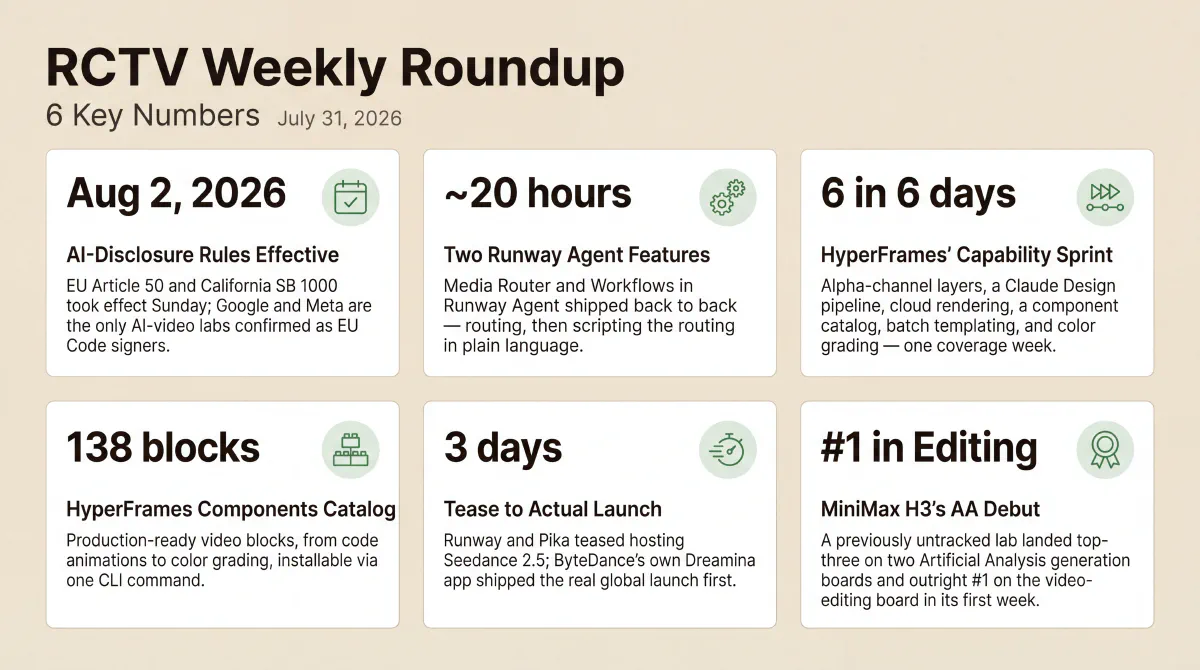
- Aug 2, 2026 — the day EU Article 50 disclosure and California’s AI Transparency Act (SB 942, as amended by AB 853) both took effect; the European Commission’s own list names Google, Meta, Black Forest Labs, Synthesia and OpenAI as signatories, and not ByteDance, Kuaishou, Alibaba or TikTok.
- ~20 hours — the gap between Runway’s Media Router and Workflows in Runway Agent shipping — two distinct agent features back to back.
- 6 in 6 days — “30 Days of HyperFrames” capability ships across this single coverage week (July 24–29): alpha-channel removal, a Claude Design pipeline, cloud rendering, a components catalog, batch templating, and color grading.
- 138 — production-ready video blocks in HyperFrames’ Components Catalog, installable via one CLI command.
- 3 days — from Runway and Pika’s “coming soon” teases to ByteDance’s own Dreamina app actually shipping Seedance 2.5’s global launch.
- #1 — MiniMax H3’s debut ranking on Artificial Analysis’s video-editing leaderboard (Elo 1,130, 5,000+ samples), on top of #2 text-to-video and #3 image-to-video — all in its first week tracked.
🔮 What to Watch Next Week
- Seedance 2.5’s US and Runway/Pika rollout. The model launched everywhere except the US and hasn’t landed on either aggregator that teased it — watch for either to close the gap.
- MiniMax’s open-weights promise. H3’s own launch copy calls it an open-weights model; none are live yet. Worth watching whether that claim ships or quietly fades, the way open-source claims on this beat sometimes do.
- The EU’s signatory list. The Commission says it will keep updating; whether ByteDance, Kuaishou, or Alibaba ever appear on it is a cleaner signal than anything inferred from their silence this week.
For full specs, pricing, and access details on every model covered this week, see the AI Video Stack 2026 reference page — updated every Monday.
Correction (August 11, 2026): This piece originally identified the California law that took effect August 2 as SB 1000. That was wrong. The law is the California AI Transparency Act — SB 942 (2023–2024, Chapter 291), as amended by AB 853, which moved its operative date from January 1 to August 2, 2026.
SB 1000 (2025–2026) is a separate, still-pending bill that shares the same popular name. It passed the state Senate 33–1 with an urgency clause on May 19 and remains on the Assembly Third Reading File; it has not passed the Assembly, been enrolled, or been signed. It is not law and did not take effect on August 2.
The substance of what we reported holds: the obligation (a free public AI-detection tool for covered providers), the penalty ($5,000 per violation, per day), the statutory citation (Business and Professions Code § 22757.4), and the August 2 date are all correct and all belong to SB 942. Only the bill number and name were wrong.
The error entered our coverage in the June 15 roundup and repeated through August 3. Our own June 1 roundup had it right — it stated plainly that “the August 2 date does not wait for SB 1000 to pass” — and we drifted from our own reporting. Every affected piece has been corrected. We’re writing up how this happened, and what the law actually requires, in next week’s roundup.
Correction (October 11, 2026): This piece said Google and Meta were the only AI-video-relevant signatories on the European Commission’s July 31 list of Code of Practice signatories. The Commission’s announcement also names Black Forest Labs and Synthesia, both AI-video makers, among the provider-section signatories, along with OpenAI. ByteDance, Kuaishou, Alibaba and TikTok were, as reported, not on it. The text above is corrected; the infographic’s first card still carries the original wording.