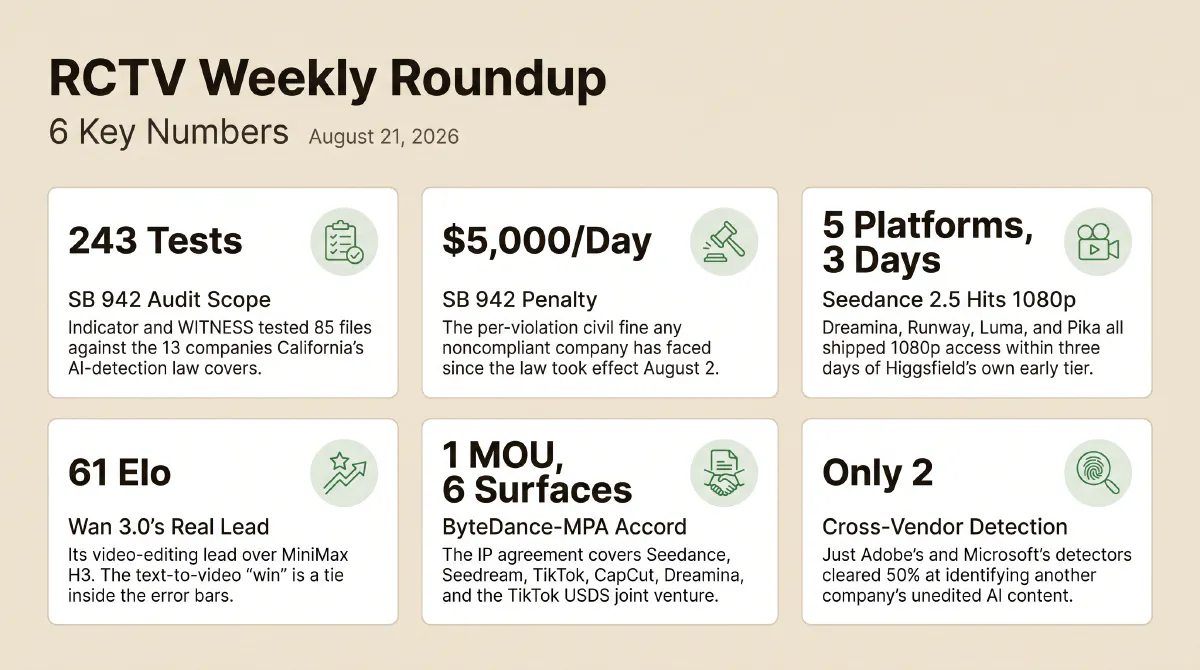
California’s AI-detection law has been in force for three weeks. An independent audit tested the thirteen companies it covers. HeyGen and Grok came back without the detector the statute requires. Read past the audit and it’s a catch-up week: Seedance 2.5’s 1080p tier finishes rolling out across five platforms, Alibaba’s Wan 3.0 debuts atop two leaderboards, and Hollywood signs its first AI-safeguards agreement with a Chinese tech giant.
Models covered: Seedance 2.5 · Wan 3.0 · Gemini · HeyGen
⚖️ An Audit Tested Who’s Actually Following California’s AI-Detection Law
Journalists at Indicator, working with the human-rights nonprofit WITNESS, ran 243 tests across 85 files against the 13 companies covered by California’s SB 942, the AI Transparency Act that took effect August 2. The count of compliant companies is moving, not fixed, so date every version of it: Indicator’s own count, published August 12, put it at 6 of 13 with a dedicated public detector. Transparency Coalition’s August 13 read of the same study put it at 7. KQED’s August 17 check put it at 8, after Suno told the outlet it had shipped a detector “at the beginning of the month,” following its appearance among the noncompliant in Indicator’s original report.
One pair of names holds steady across every version of the count: Transparency Coalition and KQED both independently name HeyGen and Grok — xAI’s product — among the companies without a detector, and neither sits in the disputed slot between the different tallies. Both have been exposed to SB 942’s $5,000-per-violation-per-day penalty since the law’s August 2 effective date. Anthropic was excluded from the audit on stated grounds: per Indicator, the lab “doesn’t generate photorealistic images or videos.”
The nuance that outranks the count: even the companies with detectors mostly can’t read each other’s output. Per KQED’s reporting on the audit, only Google’s and OpenAI’s tools could identify their own content after it had been edited, and only Adobe’s and Microsoft’s could identify another tool’s unedited content more than half of the time. SB 942 mandates detectors. The detectors that exist mostly fail at the one job a detection regime actually needs: telling one company’s synthetic content from another’s.
The same week, Google moved the opposite direction on a related signal. Gemini’s watermark now has a switch: users can toggle visible watermarks on or off for images (Nano Banana), video (Omni), and music (Lyria), Google VP Josh Woodward said August 14, rolling out over the following days. Invisible SynthID watermarks and C2PA metadata will always stay embedded in the background regardless of the toggle, per Gemini’s own account. It’s a strange week to make a provenance signal more optional, the same one an audit just found half the field short of a legal floor on — though the visible mark was always cosmetic; SynthID and C2PA don’t move.
Why it matters: A law built to make AI content traceable has produced detectors that mostly can’t trace each other’s work. The compliance count will keep moving. That won’t.
🎬 The Seedance 2.5 1080p Wave Finishes What Higgsfield Started
Within three days of Higgsfield’s own early-access 1080p tier, four more assembly-layer platforms matched it. ByteDance’s own consumer surface went first: Dreamina shipped 1080p globally ex-US on August 14, “available now across Southeast Asia, the Middle East, Africa, Europe, and South America.” Runway followed the next morning: “Seedance 2.5 in 1080p is now live on Runway. Early access starts today.” Luma and Pika both shipped it the same day, August 17 — Luma promising an upscale path to 4K, Pika bundling it into the Pika API Club at what it calls a steep discount against rival aggregators.
That’s five platforms on 1080p Seedance 2.5 within three days. The base-access wave just over two weeks ago was tighter still on a smaller field: Runway, Higgsfield, and Pika all went live on standard Seedance 2.5 inside two hours of each other on August 7. The pattern isn’t new — the field running it is now wider. None of the five has said when “early access” ends on any tier.
The same week, the self-hosted layer picked up its own agentic entry point: ComfyUI shipped Comfy MCP local and open-source — “the #1 ask after Comfy Cloud MCP shipped in June” — letting an agent see a user’s actual local install, every custom node and model on disk, and run a workflow end to end. It’s the same move HyperFrames made inside Claude Design two weeks ago: the agentic layer keeps finding new places to attach.
Why it matters: Resolution convergence used to take months. Between the base-access wave and the 1080p wave, the whole assembly layer now matches a leading model’s spec within days.
🥇 A Familiar Vendor Tops Two Leaderboards at Once Under a Name Nobody Was Watching
Alibaba’s Wan 3.0 debuted on Artificial Analysis on August 19, entering at the top of two boards at once — though only one of them convincingly. On text-to-video (with audio) it sits at Elo 1,244 ±10 against Gemini Omni Flash’s 1,238 ±6: six points inside a ten-point interval, which is a tie, and Artificial Analysis says so itself by listing Wan 3.0’s rank range as 1–2 rather than 1. The video-editing board is the real result — Elo 1,191 against MiniMax H3’s 1,130, a gap wide enough that no error bar rescues it. It reportedly opened to public beta on August 6 via Alibaba Cloud Model Studio and Qwen Cloud — invite-gated, and corroborated so far only by TechNode Global and a cluster of secondary coverage, not an Alibaba or Qwen primary. The model generates 30-second single-pass clips, accepts documents — spreadsheets, slide decks, PDFs — as creative references up to 100MB, and tops out at 1080p. It’s closed beta, not open weights, distinct from the Wan2.7 line already tracked on these same boards.
Wan 3.0’s debut is the third time this month a company already familiar to readers has shipped a materially new product line that surfaced only once it forced its way onto a public leaderboard, after Black Forest Labs’ FLUX 3 (August 5) and Lightricks’ LTX-2.5 (August 12). No GitHub organization exists yet for Wan 3.0, and Alibaba’s own English-language X presence doesn’t cover the Wan brand at all — the same gap that let the prior two entrants through.
Why it matters: A vendor’s product line can surface as news the moment it clears a leaderboard threshold, whether or not the vendor said anything first. Leaderboards are becoming a discovery mechanism in their own right, not just a scorecard.
🤝 Hollywood and a Chinese Tech Giant Sign Their First AI Safeguards Deal
ByteDance and the Motion Picture Association signed a global memorandum of understanding on AI intellectual-property protections on August 17, covering Seedance, Seedream, TikTok, the TikTok USDS joint venture, CapCut, and Dreamina. MPA Chairman Charles Rivkin: “copyright is a cornerstone of the film and television industry.” ByteDance General Counsel John Rogovin called it proof that “responsible innovation in AI goes hand in hand with meaningful protections” for rightsholders.
MPA’s own release frames the agreement only as a “shared framework.” The “voluntary truce, no payment to studios” characterization comes from press coverage — LA Times, NBC News, Hollywood Reporter, Variety — not from MPA itself. Neither party published enforcement mechanics, detection thresholds, or audit rights alongside the announcement.
Read the release for what it doesn’t say, though, and the shape gets clearer. It describes “strong guardrails” and “safeguards” on what the models put out. It says nothing at all about training data — not one line about what Seedance and Seedream learned from, which was the whole substance of the studios’ original complaint. This MOU governs what the models emit, not what they were built on. Those are different questions, and only one of them just got an agreement.
It closes an arc we’ve tracked since March, when a cease-and-desist over Seedream and Seedance froze ByteDance’s global rollout. Five months later, the freeze ends in a handshake instead of a lawsuit.
Why it matters: A five-month-old cease-and-desist ending in a negotiated framework rather than a courtroom is probably the shape most AI-video copyright disputes take from here — quieter and faster than the litigation model predicted. But nobody should read this as ByteDance’s copyright exposure being settled. The output layer got a handshake. The training question didn’t get mentioned.
📈 By the Numbers
- 243 tests, 85 files — Indicator and WITNESS’s audit methodology against the 13 companies SB 942 covers; the compliant-company count itself moved from 6 (Indicator, Aug 12) to 7 (Transparency Coalition, Aug 13) to 8 (KQED, Aug 17).
- $5,000 per violation, per day — SB 942’s civil penalty, in force since August 2; both HeyGen and Grok (xAI) are named as noncompliant by two independent secondaries.
- 5 platforms, 3 days — Dreamina, Runway, Luma, and Pika all shipped 1080p Seedance 2.5 within three days of Higgsfield’s own early-access tier.
- 1,244 vs 1,238, ±10 — Wan 3.0’s debut over Gemini Omni Flash on Artificial Analysis text-to-video: a statistical tie, and AA lists the rank range as 1–2. Its video-editing lead (1,191 to MiniMax H3’s 1,130) is the one that clears its own error bars.
- 1 MOU, 6 surfaces — ByteDance and the MPA’s global IP agreement covers Seedance, Seedream, TikTok, the TikTok USDS joint venture, CapCut, and Dreamina.
- Only two detectors — Adobe’s and Microsoft’s — could identify another company’s unedited AI content more than half the time. Every other tested detector fell below that bar.
🔮 What to Watch Next Week
- Whether the SB 942 compliance count moves again. It’s changed twice in a week already; a fourth vendor shipping a detector — or a fifth failing to — would be the next data point.
- Whether any of the five 1080p platforms names an early-access end date. None has yet.
- Wan 3.0’s adoption curve. Two Artificial Analysis #1 spots in its first week; whether a third board or a first aggregator integration follows is the next test of how real the debut is.
For full specs, pricing, and access details on every model covered this week, see the AI Video Stack 2026 reference page — updated every Monday.