Two more layers absorbed agentic video production this week — a design tool and a local-inference stack now both go straight from prompt to finished, scored, sound-designed video with no human touching the assembly step. Read past that, and we owe you something less celebratory: a correction on the bill number behind California’s AI-transparency law, wrong in our own coverage for ten weeks running.
Models covered: HyperFrames · ComfyUI · LTX · FLUX 3 · Higgsfield
🤖 The Assembly Layer Just Absorbed a Design Tool and a Local Render Stack
HyperFrames — the HeyGen-built, open-sourced production layer we’ve tracked since June — shipped an MCP server inside Anthropic’s Claude Design on August 7. Animate a design, hit share, and a HyperFrames agent scores the result, adds sound effects, tightens the motion, and renders a finished MP4: “Just send it to HyperFrames. We’ll take it from there,” in the vendor’s own words. No human touches the step between “design” and “shippable video.”
The same window, ComfyUI shipped native Seedance 2.5 partner-node support: “30 seconds. One pass. No stitching, no seams to hide” — up to 50 reference assets per run (30 images, 10 videos, 10 audio), second-level shot control via timeline prompting, and native dialogue and lip sync in 10+ languages. The same convergence we tracked last week on hosted platforms — Runway, Higgsfield, Pika — now reaches the self-hosted, local-inference layer too.
Same week, same pattern elsewhere: Luma Agents added MiniMax H3 (already covered here last time), and Runway extended its own agent with Figma, Dropbox, and Notion connectors — three more file tools an agent can now reach into directly, on top of the models it already routes to.
Why it matters: A design surface and a local render stack doing what only hosted aggregator platforms did a week ago is the cleanest evidence yet for the argument we made in June and July: the moat isn’t the model, and increasingly it isn’t even the platform. It’s whichever agent owns the assembly step.
⚖️ We Cited the Wrong Statute for Ten Weeks. Here’s the One That’s Actually Law.
For ten weeks and eight roundups, we told you California’s AI Transparency Act was Senate Bill 1000. It isn’t. As of this writing, SB 1000 is still sitting on the Assembly Third Reading File — never enrolled, never signed, not law. The actual statute is SB 942 (2023–24, Chapter 291), as amended by AB 853, which moved its operative date to August 2, 2026 — fifteen days before this post. A third bill, AB 2713, also carries “California AI Transparency Act” in its title and sits pending in the Senate. Three bills, one popular name, and a compliance-tracking pipeline that read legislative motion as enactment.
What we got right the entire time: the obligation (a free, public AI-detection tool for any covered provider with more than 1,000,000 monthly California users; visible manifest and embedded latent disclosure on AI-generated content), the $5,000-per-violation-per-day penalty, and the statutory citation — Business and Professions Code § 22757.4. All of it belongs to SB 942. Only the bill number was wrong.
Our own June 1 roundup had it right: “the August 2 date does not wait for SB 1000 to pass.” The error entered with the June 15 roundup and repeated seven times before we caught it. Every affected piece carries a correction. If you’re running compliance against our coverage, here’s what actually binds you: SB 942 is the law, it’s been in force for two weeks, and the fine is per violation, per day.
Why it matters: A wrong bill number doesn’t change what the law requires — but it changes what you’d search for if you were trying to verify it yourself. That’s the whole job.
🎞️ A Vendor With a Wikipedia Page and 22 Million Downloads Just Shipped to Four Surfaces at Once
LTX — the open-weights video-model line that spun out of Lightricks as an independent company on July 8 — shipped LTX-2.5 on August 11, and had it live on four surfaces within about ten hours: the vendor’s own primary (“Introducing LTX-2.5”), open weights on Hugging Face, Day-0 native support in ComfyUI, and a same-window Runway integration: “LTX-2.5 is now on Runway. Available today.”
LTX’s own blog describes Diffusion Fidelity Rendering, native multishot generation that holds continuity across cuts, a custom Gemma 4 text-encoder backbone, and full HDR ACES support. Asteria, a production studio LTX has partnered with, is customer enough to quote: “Features like the ACES workflow are what excite us about LTX and its models,” per co-founder Paul Trillo. The model is free for organizations under $10 million in annual revenue, measured across the whole entity; a paid license applies above that.
By LTX’s own account, the open-weights line has drawn more than 22 million downloads on Hugging Face since the base LTX-2 architecture launched in January — enough, the company says, to make it “the top open world model” on the platform. That’s not a new entrant. It’s a vendor with a dedicated Wikipedia page and at least two prior major versions — LTX-2 and LTX-2.3 — that shipped without much of the industry noticing.
Why it matters: An open-weights line with 22 million downloads, Day-0 ComfyUI support, and a same-day Runway integration has the distribution the hosted platforms spent this year buying — without running a platform at all. The aggregators integrate LTX for the same reason they integrated Seedance and FLUX: the demand is already there. Scale on the open-weights side is easy to miss precisely because it accumulates on Hugging Face instead of in launch coverage.
🎯 Black Forest Labs Just Picked Up Its Third Aggregator in Eight Days
Luma integrated FLUX 3 Video on August 12 — “FLUX 3 is now live in Luma… video with native audio, available today” — following Runway (August 4) and Pika (August 5), both covered here two weeks ago. Three aggregators, eight days.
That number matters beyond the pickup itself. Two aggregators picking up a model is a pickup; three inside eight days is the platforms agreeing on something. FLUX 3 Video is now a default option on Runway, Pika, and Luma — for a lab that had never shipped video before this month.
The leaderboard caught up too. Design Arena’s text-to-video board puts FLUX 3 Video at #2, Elo 1,496 — still marked preliminary — sixteen points behind Gemini Omni Flash’s 1,512. A fast climb for a lab that was image-only two months ago.
Why it matters: Three integrations and a top-two leaderboard debut in the same eight-day stretch is a lot of momentum for a “watch item.” We’re watching.
📈 By the Numbers
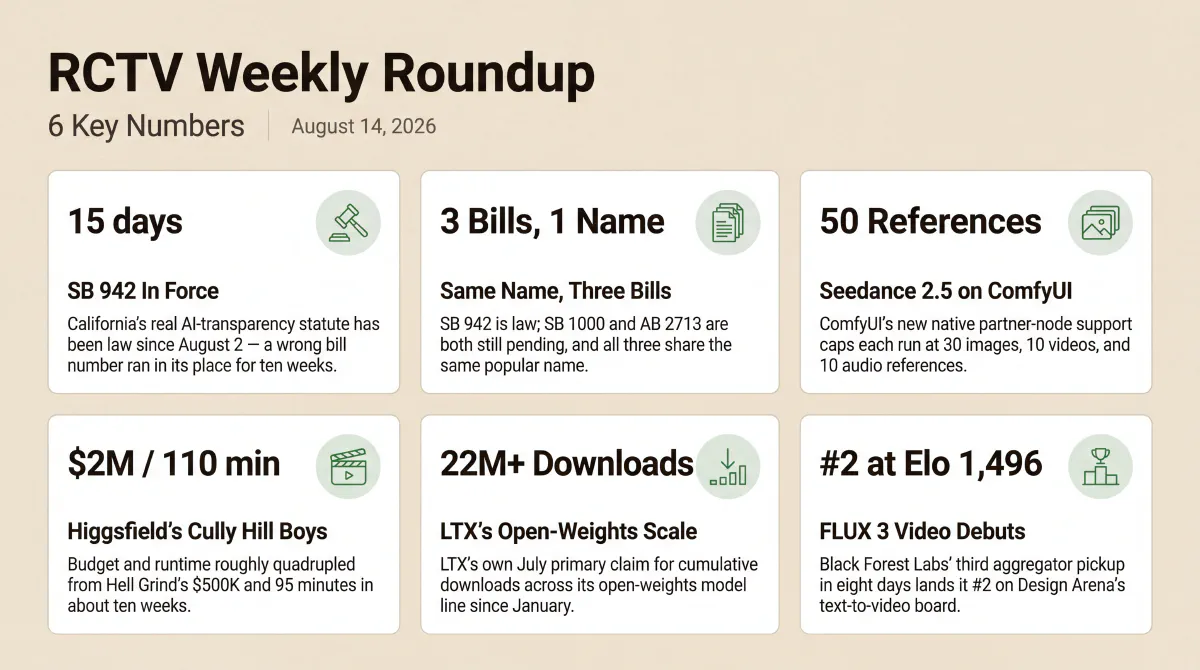
- 15 days — how long SB 942, the real statute behind California’s AI Transparency Act, has been in force as of this post; a wrong bill number ran in its place for ten weeks across eight roundups.
- 3 bills, 1 name — SB 942 (law), SB 1000 (still pending, Assembly Third Reading), and AB 2713 (still pending, Senate Third Reading) all carry “California AI Transparency Act” in their titles.
- 50 references — Seedance 2.5’s per-run reference cap (30 images, 10 videos, 10 audio) on ComfyUI’s new Day-0 native partner-node support. Higgsfield put a number on the same model’s ceiling three days later, opening free 1080p generation as a “limited time” early-access tier — a resolution the August 7 go-live announcements never specified.
- $2,000,000 / 110 minutes — Higgsfield’s “The Cully Hill Boys” budget and runtime, up from Hell Grind’s $500,000 and 95 minutes roughly ten weeks earlier; the festival judging it has now booked a third A-list director in three weeks — Alex Proyas, after Paul W.S. Anderson and Pixar’s Edwin Catmull.
- 22M+ downloads — LTX’s own July 8 claim for cumulative downloads across its open-weights model line.
- #2 at Elo 1,496 — Black Forest Labs’ FLUX 3 Video, fresh Design Arena text-to-video ranking, sixteen points behind Gemini Omni Flash.
🔮 What to Watch Next Week
- Whether a fourth platform takes FLUX 3 Video. Three aggregators in eight days is a pattern; a fourth would make Black Forest Labs a default across the entire hosted layer, two months after it shipped its first video model.
- LTX’s release cadence. Three major versions since January, the last one live on four surfaces in ten hours. Whether that pace holds is the test of whether the open-weights line is a real competitor to the hosted platforms or a fast-moving niche.
- AB 2713’s Senate progress. Currently on the Third Reading File; if it advances, that’s a fourth regulatory data point on a beat this roundup already covers in depth.
For full specs, pricing, and access details on every model covered this week, see the AI Video Stack 2026 reference page — updated every Monday.