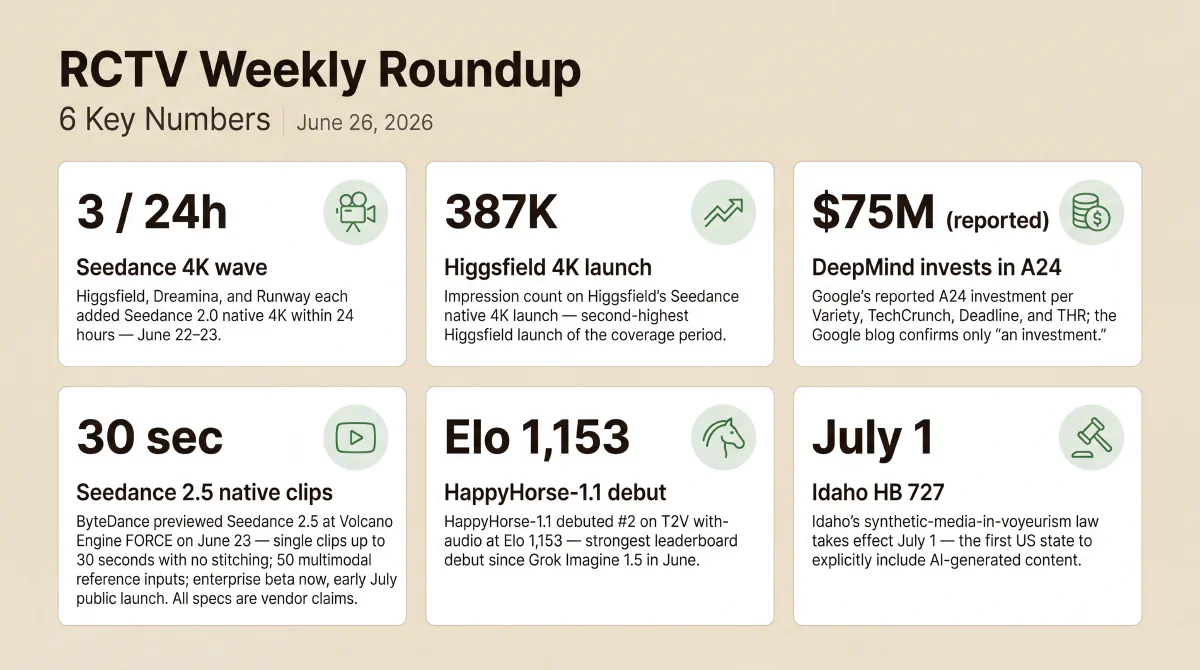
Three platforms added Seedance 2.0 native 4K in a single 24-hour window. Runway — the last major pure-play still differentiating on its own models — explicitly adopted the aggregator frame: “The world’s best models, in one place.” Google DeepMind put money into A24. The convergence that the June 11 agentic flagship marked as the trajectory landed, this week, as news.
Models covered: Seedance · HappyHorse · Kling
🔄 Seedance 4K is Everywhere Now. Runway Just Said It Out Loud.
Higgsfield went first on June 22: Seedance 2.0 in native 4K, with video-to-video upscaling that takes existing 720p or 1080p footage and outputs native 4K via generation. Dreamina followed the next morning at 3840×2160 UHD — available in Southeast Asia, the Middle East, Africa, Europe, and South America, with the US again absent. Runway finished the trio on June 23 evening: Seedance 4K, Seedance Mini, and Kling 3.0 Turbo, all in a single post. The caption: “The world’s best models, in one place.”
The underlying capability is ByteDance’s. At Volcano Engine FORCE on June 23 — the same day as the distribution wave — ByteDance confirmed that Seedance 2.0 now supports native 4K with 10-bit color depth, the technical fact the three-platform wave runs on. At the same event, ByteDance previewed Seedance 2.5: single clips up to 30 seconds with no post-stitching, up to 50 multimodal reference inputs, and post-generation editing that redrafts part of a frame without touching the rest. Global enterprise beta is open now; public launch is targeted for early July. Every capability claim is ByteDance’s own, made at a developer conference — no independent benchmarks exist yet. But 30-second native generation from the model already holding #1 on the leaderboard is the number every competitor is measuring itself against.
That last line is the actual story. Runway built its reputation on Gen-4 and Aleph 2.0 — its own models. Adding Seedance (ByteDance) and Kling (Kuaishou) to the same platform isn’t expanding a model menu. It’s a strategy statement: the company that differentiated on output quality is now differentiating on curation and distribution. Pika went this route last year when it relaunched as a multi-model orchestrator over Kling, Veo, MiniMax, Seedance, and Sora. Now Runway is doing it explicitly — and Runway has more to lose by making the move, because Runway had more to protect.
Dreamina’s geography exclusion is worth reading carefully. This is the third consecutive Dreamina product expansion that omits the US. The pattern tracks to the Hollywood copyright pressure that froze ByteDance’s US rollout in March. It is not coincidence.
Two days later, on June 25, Runway launched Agent 2.0: a shift from AI video tool toward full-stack marketing creative system, with campaign analytics, multi-platform scaling, and ad localization in a single pipeline. “Go from a simple prompt to fully realized marketing briefs and campaign assets right inside of Runway Agent,” per the launch post. The post also states Runway Agent “is being built to become the most capable autonomous agent for real-world work” — which is a large claim for a marketing-workflow product and worth watching against the artifact. But the direction is coherent: Runway is moving up the creative stack while adding competitor models at the generation layer simultaneously.
Why it matters: When Runway curates your competitor’s model alongside yours, the model stopped being the differentiator. Resolution is becoming table-stakes. The contest has moved to aggregation, curation, and who owns the professional workflow — and the company that had the clearest reason to resist that shift made the move explicitly this week.
🎬 Google Buys Into A24. The Investment Tells You More Than the Partnership.
Google DeepMind and A24 announced a “first-of-its-kind research partnership” on June 22 — collaboration across “multiple projects over time” to “help artists develop new workflows and techniques.” Beyond the partnership language, the Google blog confirms simply: “Google has made an investment in A24.”
The dollar figure — $75M, per Variety, TechCrunch, Deadline, and The Hollywood Reporter — is reported uniformly but does not appear in Google’s own statement. The “first equity stake in a film studio” framing is trade-press characterization, not primary language. Both figures are attributed here as reported; Google and A24 have not confirmed either.
What the investment does confirm, regardless of size: Google is no longer just tooling around filmmakers. A24 is the studio behind Hereditary, Midsommar, Everything Everywhere All at Once, and Past Lives — the studio that defined prestige indie cinema for a generation. Buying a stake is different from signing a partnership. It gives DeepMind a seat inside productions, not just adjacent to them.
Two Hollywood-AI alignment moments landed in one coverage window: this one and the Scorsese-BFL arc from June 5. The contrast is instructive. Scorsese is using FLUX for storyboarding on a film that hasn’t started shooting. DeepMind is putting capital into a studio in active production. “The tools of the future are shaped by the creators who use them” is the partnership’s explicit frame — and A24 is a credible voice for what professional filmmakers actually want from those tools.
Why it matters: An equity stake gives DeepMind access to production friction that no partnership agreement can replicate. What A24 complains about at the table becomes a roadmap priority. That’s a different kind of influence than press-release alignment.
📋 The Compliance Staircase Gets Steeper
Three items, in order of urgency.
Idaho HB 727 takes effect July 1 — two days from this roundup. The state’s synthetic-media law is the first in the US to explicitly include AI-generated content within video-voyeurism definitions. Signed March 25, the bill amends existing voyeurism and explicit synthetic-media disclosure statutes. You don’t need a federal framework to face real enforcement risk; Idaho just moved first.
California’s AB 2713 (California AI Transparency Act) is one Senate floor vote from the governor’s desk. The bill requires covered platforms to disclose whether provenance data or digital signatures are embedded in published content — a C2PA-aligned transparency mandate that applies to AI-generated video platforms operating in California. It cleared Senate committee and has already passed the Assembly 74-0. At those margins, it goes through.
EU Art. 50 disclosure obligations hit August 2. The staircase: August 2 (disclosure requirement, Article 50); December 2 (technical watermarking requirement, Article 50(2) after the Omnibus grace-period extension). The disclosure requirement and the watermarking requirement are distinct — the August deadline is about labeling content as AI-generated, not about embedding machine-readable marks. AI video platforms operating in Europe have 34 days.
The voluntary transparency code’s initial signatory list is already public. Roughly two dozen providers signed before the July 22 form deadline — Google, OpenAI, Microsoft, Anthropic, Amazon, Black Forest Labs among others. Meta did not sign. The AI video labs most directly affected by the August 2 disclosure requirement — ByteDance, Kuaishou, Alibaba/ATH — are absent from the initial list, as is xAI. The final list publishes before August 2.
Why it matters: Idaho → California → EU in 2026 is a global provenance-disclosure wave, and none of these are proposed legislation anymore. One is 48 hours away. Two compliance scorecards — one for the EU, one for the US state stack — are in progress.
🐴 HappyHorse-1.1 Debuts at #2. The Leaderboard Doesn’t Lie.
HappyHorse-1.1 launched June 23 on the HappyHorse platform, Alibaba Cloud Bailian, and Qwen Cloud — five improvement axes over 1.0 across motion dynamics, subject consistency, prompt adherence, visual quality, and audio generation. The most technically specific claim, per TechNode, is 9 simultaneous reference images — versus the single-image limit on most competitors. Alibaba is running a global filmmaking competition alongside the launch, with prizes up to RMB 1 million (~$147K).
The leaderboard story is more reliable than any marketing claim: HappyHorse-1.1 debuted #2 on both the T2V with-audio arena (Elo 1,153, 2,367 samples) and I2V with-audio (Elo 1,120, 2,387 samples), per Artificial Analysis leaderboards read Friday. That is the strongest debut since Grok Imagine 1.5 in June, and it pushed grok-imagine-video-1.5-preview from #2 to #3 on I2V. On T2V with-audio, the top five now runs: Seedance 2.0 #1 (Elo 1,219), HappyHorse-1.1 #2 (Elo 1,153), HappyHorse-1.0 #3 (Elo 1,123), Kling 3.0 Pro #4 (Elo 1,104), SkyReels V4 #5 (Elo 1,104).
One caveat worth tracking: fal.ai’s API partnership covers HappyHorse-1.0 only. The 1.1 model is not yet on fal; access routes through Alibaba’s own platforms.
The May 6 analysis documented the gap between HappyHorse-1.0’s “fully open-sourced” marketing and what was actually available. The leaderboard position is objectively verifiable in a way that open-source claims are not — it is real, it is primary-sourced, and it reflects the model’s competitive standing today. The open-source question and the 9-reference-image claim are still in the verify-before-building category.
Why it matters: Alibaba now runs two competitive video models — HappyHorse and Wan — while the leaderboard top five consolidates. When the same company’s 1.0 model sits at #3 and its 1.1 sits at #2, the cadence of iteration is as significant as any single launch.
📈 By the Numbers
- 3 platforms, 24 hours — Higgsfield (June 22), Dreamina (June 23), and Runway (June 23) each added Seedance 2.0 native 4K in a coordinated distribution wave. Pika MCP added the same tiers June 24–25, completing the sweep.
- 387K impressions on Higgsfield’s Seedance 4K launch post — second-highest Higgsfield launch of the coverage period, behind the Minecraft Mod in June.
- $75M (reported) — Google’s investment in A24, per Variety, TechCrunch, Deadline, and THR. Not confirmed in Google’s own blog, which states only “Google has made an investment in A24.”
- 30 seconds, no stitching — Seedance 2.5, previewed at Volcano Engine FORCE on June 23: single native clips, 50 multimodal reference inputs, post-generation editing. Enterprise beta now; early July public launch. All specs are vendor claims — no independent benchmarks yet. The underlying Seedance 2.0, meanwhile, holds #1 on T2V with-audio at Elo 1,219.
- Elo 1,153 — HappyHorse-1.1 debuted at T2V with-audio #2 on Friday — the strongest debut since Grok Imagine 1.5. All leaderboard data is with-audio; the without-audio arenas tell a different story.
- July 1 — Idaho HB 727 effective date. Two days from this roundup. The first US state to explicitly include AI-generated synthetic media in video-voyeurism statute definitions.
🔮 What to Watch Next Week
- Idaho HB 727 goes live July 1 — two days out. Synthetic-media-in-voyeurism enforcement begins. First enforcement actions and adjacent state responses are what to watch.
- California’s content-provenance disclosure bill — one Senate floor vote from the governor’s desk. If it clears, it’s the most sweeping US platform-level AI content provenance mandate to date.
- EU Art. 50 disclosure deadline, August 2 — 34 days. AI video platforms in Europe are on the clock for labeling requirements.
- Kuaishou/Kling financing — still no company-confirmed round from Caixin or SCMP tier. The press-attributed $500M ARR / $20B valuation from May is a standing-watch item. On primary confirmation, it arms the Kling business piece.
For full specs, pricing, and access details on every model covered this week, see the AI Video Stack 2026 reference page — updated every Monday.