No frontier model launched this week — but three institutions on the sidelines showed up with a verdict anyway. Netflix put a number on how much of its 2026 slate touched generative AI. Cannes Lions ran its first awards category for AI-assisted craft, and gave the top prize to Google, not the vendor whose fans were loudest about it. A benchmark board handed Gemini Omni Flash a clean sweep it’s been missing since launch. The vendors didn’t wait to be graded, either: ByteDance opened its newest model to any developer with an API key, and a second Chinese video startup closed a nine-figure round with Alibaba’s money in it.
Models covered: Netflix · Kling · Gemini · Seedance · PixVerse
🎬 Netflix Says Generative AI Touched ~300 Titles This Year — Mostly in the Edit Bay
Netflix’s Q2 2026 shareholder letter, published July 16, put a hard number on something the industry has mostly discussed in anecdotes: “In 2026, GenAI workflows have been used in roughly 300 of our titles, with the largest concentration of work in post-production.” The letter frames the usage as spanning “the production lifecycle, from concept and pre-visualization through post and delivery” — not one tool bolted onto editing, but something touching several stages at once.
Three named productions anchor the disclosure: the Indian sports thriller Glory, the Brazilian soccer miniseries Brasil 70: A Saga do Tri, and the American Revolution docuseries The American Experiment all “utilized GenAI tools to create highly complex sequences,” per the letter. Co-CEO Ted Sarandos added specifics on the earnings call: AI enhanced crowd scenes, world-building, opening shots, and historical battle sequences, and 17 minutes of The American Experiment’s AI-assisted footage came together “twice as fast and at half the cost,” per Fortune’s writeup of the call.
The letter’s own framing goes past cost-cutting: Netflix says the tools deliver “higher quality output more quickly and at a lower cost than traditional methods,” and, more pointedly, that “in some cases, productions would have had to leave out key shots and sequences in the absence of GenAI technology.” That’s sharper than “AI made it cheaper.” It’s “AI made some of this possible at all.”
This is the first hard, named-production disclosure of generative-AI-in-production scale from a major streamer — not a vendor demo, not a solo operator’s field report. The July 9 flagship argued the production loop, not the model, is where AI video’s moat lives now, citing two independent solo builders (Sara Nambiar, Anthropic’s Thariq Shihipar). Netflix is the enterprise catching up at blockbuster-tier budgets, because the loop is cheaper and lets them keep shots they’d otherwise cut. One caveat: “~300 titles used AI somewhere” is deliberately broad — a single AI-touched shot in post-production counts. Read it as “AI touched 300 productions somewhere in the pipeline,” not “Netflix released 300 AI-generated films.”
Why it matters: This is the buyer-side proof point the July 9 flagship’s thesis was missing — an enterprise at scale putting generative AI into production, with named titles and its own numbers behind it, not another vendor claiming the future has arrived.
🏆 Cannes Gave AI Craft Its Own Category. The Grand Prix Didn’t Go to Kling.
Cannes Lions ran its first dedicated “AI Craft” award lane this year, spread across Film Craft, Digital Craft, and Industry Craft. The AI Craft Grand Prix — the marquee prize — went to Google, for Project Genie, a tool built on DeepMind’s Genie 3 that turns text, images, or drawings into explorable interactive worlds. The other finalists were Microsoft, Sphere Studios, The RealReal, and Movistar Prosegur Alarmas. Kling wasn’t among them.
Kling-made advertising still won real Lions this week — just not the headline one. “L’Ultimo Uomo Reale” (“The Last Real Man”), a short film for The RealReal produced largely with Kling, won a Silver Lion in Film – Consumer Goods and a Bronze in the Film Craft – AI Craft lane, per Kling’s own announcement, corroborated by 36kr. A second Kling-made piece, “Lorem Ipsum” — an entirely AI-generated short from Argentine studio Purga Films whose only dialogue is the words “lorem ipsum” — won Bronze in Film, confirmed independently by La Nación, Argentina’s leading daily.
Read the two facts together and the honest headline isn’t “Kling won at Cannes” — it’s that AI-assisted work took real metal across multiple categories, and the loudest vendor didn’t win the category built for it. Last week’s coverage of Kling’s record round called it “the entire Chinese tech establishment pricing one company’s AI-video business at $18 billion.” Craft-jury approval turned out to be a different currency than a funding round — Kling cashed only one of them at the top tier.
Kling’s business kept scaling in parallel. Kuaishou disclosed that Kling AI’s annualized revenue run rate reached roughly $500 million in March 2026 — up from $240 million in December 2025 and from just over $100 million ten months after Kling’s 2025 launch, both prior Kuaishou-disclosed checkpoints; that’s roughly a 108% jump in the Dec-to-March quarter alone. Kuaishou’s own Q1 2026 revenue for Kling ran above ¥650 million (about $96 million), up more than 300% year over year — the figure both Kuaishou and SCMP’s headline reference. A separate “nearly 400%” figure from 36kr measures something different — ARR one year apart, not quarterly revenue — so treat the two as separate readings, not one number restated twice. Kling’s user base has also crossed 100 million across 224 countries, with roughly 70-75% of revenue now coming from outside China, per 36kr.
The capital kept flowing beyond Kling, too. PixVerse, a Singapore startup founded in 2023 by ex-ByteDance vision lead Wang Changhu and Jaden Xie, closed a $439 million Series C extension July 13, pushing its valuation past $2 billion. Alibaba is among the new backers — alongside Lollapalooza, Ivy, Grand Mount, Eastern Bell, Mirae, BlueFocus, and CloudAlpha — and already deploys PixVerse’s tech. PixVerse claims 150 million-plus users across 177 countries; the money funds its R1 real-time world model and a push into interactive entertainment. Alibaba now touches nearly every layer of Chinese AI video: Kling, PixVerse, open-source Wan, and HappyHorse via ATH.
Why it matters: Three legitimacy tracks converged on Kling and its peers this month — capital, scale, and craft — but the sharpest fact is the marquee prize went to the company that didn’t need the other two.
📊 The Benchmark Finally Agrees: Gemini Omni Flash Sweeps All Four Boards
Gemini Omni Flash isn’t just #1 on Artificial Analysis’s two with-audio boards — it’s #1 on all four boards the site runs. Text-to-video: #1 with audio (Elo 1,240, Seedance 2.0 720p #2 at 1,226) and #1 without (Elo 1,327, HappyHorse-1.0 #2 at 1,288). Image-to-video: #1 with audio (Elo 1,204, Seedance #2 at 1,197) and #1 without (Elo 1,374, Seedance #2 at 1,346). Kling 3.0 1080p Pro, in the with-audio top five two weeks ago, is gone from it now — it resurfaces at #5 on the no-audio side.
It’s the first hard number attached to Omni Flash since general availability on July 1, and it directly answers a gap RCTV flagged in May: DeepMind called Omni “a first step toward a world model” at I/O without publishing a single benchmark. Two months and one GA later, there are four numbers, and all four say #1.
One honest caveat: Omni Flash’s sample count trails the model it dethroned — roughly 3,500 votes on the with-audio text-to-video board versus Seedance 2.0’s 10,430. Artificial Analysis is also one voting pool with its own quirks; Omni Flash separately leads Design Arena, a different pool, so the signal isn’t resting on one judge panel. A four-board sweep five weeks after GA is a strong early read, not a settled throne — this year’s pattern has been early spikes followed by weeks of broader voting settling where a model actually lands.
Why it matters: It closes the loop the May flagship opened — Google now has four numbers, not just a claim, for the model it called a step toward a world model.
🎥 While Everyone Was Getting Graded, ByteDance Shipped an API
The three stories above are about outsiders grading AI video’s homework. ByteDance spent the same week shipping more of it. Seedance 2.5’s API went live on BytePlus ModelArk July 16 — for the first time, any developer with a BytePlus account can make one call and get back a continuous, unstitched 30-second clip with co-generated audio. Up to 50 reference images, video, or audio clips steer the output; region-level editing re-renders a single bounding box instead of the whole frame. we flagged this as a thing to watch last week, targeting “late July” for API access — it landed early.
What’s still missing is a price — the API is live and metered, with no published rate card to route or budget against. It also ships into the same legal weather as its predecessor: every major studio’s February cease-and-desist letter to ByteDance remains unanswered, with no court ruling on any of them.
Why it matters: The rest of this roundup is institutions catching up to what AI video can already do. This is a reminder the vendors aren’t waiting for the grade.
📈 By the Numbers
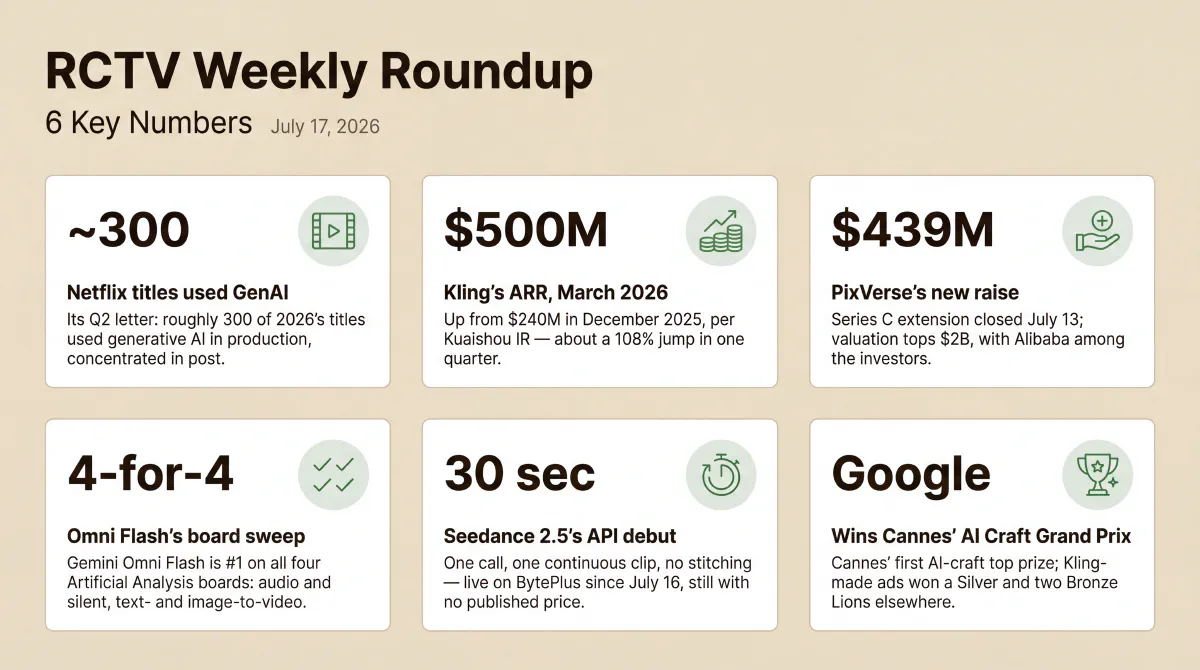
- ~300 — Netflix titles that used generative AI somewhere in 2026 production, concentrated in post-production — a scope-elastic number, not a count of AI-generated films.
- $500M — Kling’s annualized revenue run rate as of March 2026, up from $240M in December 2025 — about a 108% jump in one quarter.
- $439M — PixVerse’s Series C extension, closed July 13, valuation past $2B — Alibaba is among the investors and already deploying PixVerse’s tech.
- 4-for-4 — Gemini Omni Flash is #1 on all four Artificial Analysis video boards: text-to-video with audio (1,240) and without (1,327), image-to-video with audio (1,204) and without (1,374).
- 30 sec — Seedance 2.5’s API went live July 16 with a single-pass, unstitched clip length — and still no published price.
- Google — winner of Cannes’ first AI Craft Grand Prix, for Project Genie; Kling-made ads still won a Silver and two Bronze Lions at the same show.
🔮 What to Watch Next Week
- EU AI Act Article 50 disclosure and California’s AI Transparency Act (SB 942, as amended by AB 853) — both due August 2, about 13 days out.
- Whether Cannes’ AI Craft category becomes a template other festivals follow, or stays a five-finalist first pass.
- Kling’s Hong Kong IPO filing — last week’s $18B round reads as pre-IPO positioning.
- Whether Omni Flash’s four-board sweep holds as more votes land, and whether Seedance 2.5 gets a price.
For full specs, pricing, and access details on every model covered this week, see the AI Video Stack 2026 reference page — updated every Monday.