Kuaishou closed the biggest funding round a video-generation company has ever raised this week — nearly $3 billion, at an $18 billion valuation, with Tencent, Alibaba, and Baidu all writing checks into the same company. Five vendors shipped assembly-layer products in the same seven days, the week after RCTV argued that’s where the moat lives now. And Meta, which spent years licensing other labs’ models, previewed its own video model and landed in the top three on a leaderboard before it had a launch date.
Models covered: Kling · Runway · Meta · Grok Imagine
💰 Kling Closes the Biggest Funding Round in AI-Video History
Kuaishou disclosed July 2 that its Kling AI subsidiary has closed a funding round of nearly $3 billion at a post-money valuation of about $18 billion — what the South China Morning Post calls “the largest in the world by an AI video model firm.” The round was led by CPE Yuanfeng, Guofang Venture Capital, Tencent, Zhongguancun Science City Fund, and CITIC Securities, per TechNode, with Alibaba Cloud and Baidu among 38-plus participating investors. Kuaishou keeps control: its stake dilutes from 100% to 68.33%, split between outside investors and an employee ownership plan.
That investor list is the story before the number is. Tencent, Alibaba, and Baidu don’t normally write checks into the same company — they compete for the same AI-video customers, and Tencent runs its own rival model, Hunyuan. All three backed Kling anyway. SCMP reports the round is widely read as pre-positioning for a Hong Kong IPO Kuaishou expects to start within 12 months, with proceeds earmarked for compute and data-center buildout.
The revenue underneath it is real, not story-mode. Kling’s Q1 2026 revenue topped 650 million yuan (about $96 million), up more than 300% year over year, with an annualized run rate near $500 million — quadruple where it stood a year ago. That’s the inverse of what we’ve tracked since Sora’s shutdown in March: Sora burned cash with no durable business model behind it; Kling is closing a record round on real, compounding revenue. The valuation also lands below where the rumor mill had it when RCTV first covered the courtship in May — press reports then floated a $20 billion target; this round priced at $18 billion instead.
Why it matters: This isn’t three rivals making a symbolic gesture — it’s the entire Chinese tech establishment pricing one company’s AI-video business at $18 billion on real, quadrupling revenue, the exact inverse of Sora’s collapse in March. Whether the round changes how Kling competes abroad is worth its own piece; for now, the capital event is the news.
🧩 Five Vendors, One Pattern: the Assembly Layer Keeps Shipping
Thursday’s flagship argued the production loop around a model — not the model itself — is where the moat sits now. The week that followed delivered the evidence without being asked: five vendors shipped assembly-layer products, each attacking the same problem from a different angle.
Pika went furthest into the edit itself. Its new Director’s Suite is an experimental AI timeline editor built for agent-driven video — storyboarding, clip generation, and chat-guided editing in one interface — alongside a VFX Skill and a Seedance-4K-powered “4K-VFX” Skill that edits an existing clip from a single prompt while preserving faces, gestures, audio, and camera moves. It shipped the day after the flagship published.
Runway went for the business model. Runway Dev, launched July 8, is a dedicated developer and enterprise platform: one API over Runway’s own frontier models — Gen-4.5, Aleph 2.0, Act-Two — plus third-party models including Seedance, GPT Image 2, and ElevenLabs. “Recipes” package prompting and workflow expertise into single API calls; “Workflows” let teams chain multiple models into custom pipelines. Runway says the platform already runs production for Adobe, ElevenLabs, Shutterstock, Figma Weave, Gamma, and Silverside, with SOC 2 Type II compliance and IP indemnification — company-stated claims, not independently audited by us. It’s the aggregator bet RCTV has tracked since June acquiring an actual monetization shape.
HyperFrames — HeyGen’s video-rendering framework — made the flagship’s own argument in public a day before the flagship ran. In an X-Article published July 8, HyperFrames product engineer James Russo laid out why the tool renders agent-authored video from plain HTML instead of a proprietary timeline format, with real usage behind it: 1.3 million videos rendered for 267,000 creators in 90 days, 32,000 GitHub stars, open source, running inside Claude Code, Codex, and Cursor. It’s a stronger primary than the build we cited Thursday — worth the correction here.
Kling closed the one remaining gap in the group RCTV named in June as the agentic-orchestration five. Kling MCP and CLI went live July 8 — “your favorite model, now in your favorite agent” — joining Luma, Adobe, Pika, Runway, and Higgsfield in the agent-callable tier.
And Higgsfield pushed furthest into the professional edit suite: its new plugins bring Gemini Omni Flash and Seed Audio 1.0 directly into Adobe Premiere Pro and DaVinci Resolve Studio timelines, for background cleanup, multi-shot generation, and 18-language dubbing without leaving the NLE.
“Skills” is now a term four separate vendors have landed on for portable agent workflows — Pika, Luma, Runway, and now HyperFrames all use the word for the same idea, unprompted by each other.
Why it matters: None of this is one company’s roadmap. It’s five vendors independently converging on the same bet — that the model is table stakes and the workflow around it is what customers pay for — in the same week RCTV said so in print. The pattern closes a loop the June agentic-orchestration piece opened: the tooling layer isn’t emerging anymore. It’s here.
🎬 Meta Finally Enters AI Video — and Lands Top Three Before It Ships
Meta Superintelligence Labs previewed Muse Video on July 7, alongside Muse Image — Meta’s first in-house image and video models after years of licensing Midjourney and Black Forest Labs. Muse Video is built on the same pretraining base as Muse Image, generates with native audio, and Meta claims “competitive performance in prompt adherence, visual fidelity, and temporal consistency.”
It’s also, by Meta’s own account, not a product yet. There’s no published resolution, clip length, or pricing — the blog’s language is “coming soon to creators and in Meta AI.” Meta names its own gaps directly, citing “audio-video synchronization and physically accurate fast motion” as areas still being worked on.
None of that stopped it from landing at #3 on Design Arena’s text-to-video leaderboard within days of preview — Elo 1,459 as of July 5, per Meta’s own citation of the board, which we independently confirmed on Arena’s live leaderboard. Gemini Omni Flash still holds #1 there at Elo 1,527 — the model whose Design Arena debut we covered July 2 — with Dreamina’s Seedance 2.0 720p at #2 (Elo 1,482) ahead of Muse Video, and HappyHorse-1.0 close behind at #4 (Elo 1,430).
That’s a different #1 than Artificial Analysis shows. On that board, HappyHorse-1.0 leads text-to-video without audio and Seedance 2.0 leads with audio — Gemini Omni Flash and Muse Video don’t appear near the top at all there. Design Arena measures blind human preference; Artificial Analysis runs its own separate voting pool. Two credible boards, two different leaders, and which one you trust says more about what you’re optimizing for than either model does.
Why it matters: Meta sat out generative video for years while it licensed other labs’ models. It’s now building in-house, and the first preview is already top-three on a human-preference board — before Meta has published a single spec you could build a workflow around. Top-three on a leaderboard is not a product you can use yet. Both things are true at once.
⏱️ Grok Imagine Collapses Its 15-Second Cap Into One Take
While five vendors spent the window shipping workflow tools, xAI quietly tightened the model itself. Grok Imagine users reported July 4 that the app now generates its full 15-second clip in a single request — an early tester called it “one long take,” rather than chaining shorter generations together to reach that length, the prior workaround — plus a new option to extend a clip further after it’s generated. Musk amplified the update three days later. xAI hasn’t published this as a dated release note or blog post, so the record here is user reports and a founder retweet, not a spec sheet. The rest hasn’t moved: still 720p, still priced from $0.08/sec at 480p ($0.14 at 720p), and the 1080p Pro tier promised in April remains unshipped.
Why it matters: It’s the week’s tell. The sharpest change to a frontier video model was a smoother path to the same 15 seconds — while five separate vendors shipped workflow products around the models. The model layer is where the week went quiet.
📈 By the Numbers
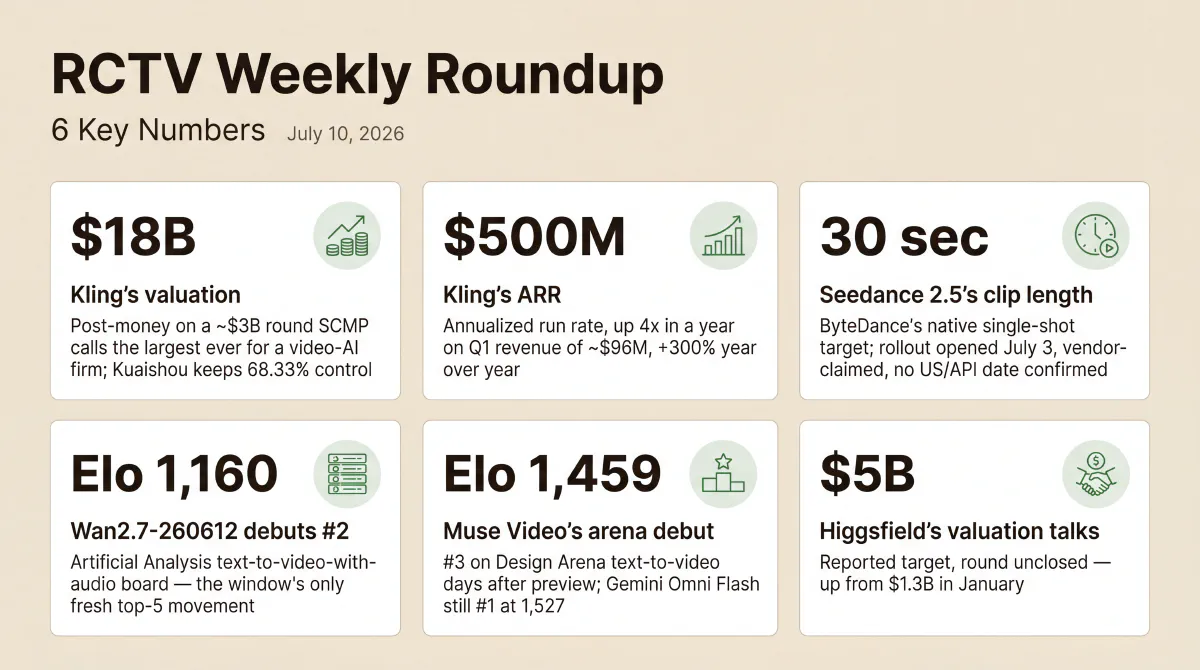
- $18B — Kling’s post-money valuation on a ~$3 billion round SCMP calls the largest ever for a video-generation company; Kuaishou keeps 68.33% control.
- $500M — Kling’s annualized revenue run rate, up 4x in a year on Q1 2026 revenue of more than 650 million yuan (~$96 million), +300% year over year.
- 30 seconds — the native single-shot clip ByteDance is targeting for Seedance 2.5’s public rollout, which opened July 3 on Dreamina and Jimeng — vendor-claimed, no confirmed US or third-party-API date yet.
- Elo 1,160 — Wan2.7-260612’s debut at #2 on Artificial Analysis’s text-to-video-with-audio board, the window’s only fresh top-5 leaderboard movement.
- Elo 1,459 — Muse Video’s Design Arena debut, #3 on text-to-video days after preview, while Gemini Omni Flash holds #1 at 1,527.
- $5B — the valuation Higgsfield is reportedly in talks to raise at, up from $1.3 billion in January — the round hasn’t closed.
🔮 What to Watch Next Week
- EU AI Act Article 50 disclosure + California’s AI Transparency Act (SB 942, as amended by AB 853) detection-tool deadline — both August 2, about three weeks out.
- Seedance 2.5’s US and third-party-API rollout. ByteDance is targeting CapCut for mid-July and API access for late July; watch the shipped spec against the announcement, and the copyright questions trade press has already raised.
- Kling’s Hong Kong IPO filing. The round is read as pre-IPO positioning; watch for the actual listing filing inside the 12-month window Kuaishou named.
- “Skills” as a converging standard. Pika, Luma, Runway, and now HyperFrames all use the term for portable agent workflows — watch for a fifth vendor, or an interop claim between them.
For full specs, pricing, and access details on every model covered this week, see the AI Video Stack 2026 reference page — updated every Monday.
Correction (October 11, 2026): This piece gave Grok Imagine Video 1.5’s price as $0.08/sec. That is its 480p rate; xAI’s model page prices it by resolution, $0.14 at 720p. The text above is corrected.