OpenAI is leaving the video-generation infrastructure business. The Sora API goes dark September 24, three days after this publishes, with no replacement named. In the same week, Runway, Higgsfield and Pika all doubled down on selling other labs’ models alongside, or instead of, their own. One lab exits the model-rental business from the top; three storefronts keep building the marketplace underneath.
Models covered: Sora · Runway · Higgsfield · Pika
🎬 OpenAI Shuts the Door on Sora for Good
The Sora Videos API — sora-2, sora-2-pro, and every dated snapshot in between — shuts down September 24, per OpenAI’s own deprecations page, which says developers were notified March 24 of their “removal from the API on September 24, 2026.” The recommended-replacement column for every Sora row is a dash.
That’s the second half of a shutdown that started in April, when Sora’s consumer web and app went dark. This closes the other half: OpenAI isn’t just retiring a consumer product anymore, it’s exiting the video-generation infrastructure layer entirely. It also cuts against what we argued in April, that professional infrastructure, not consumer subscriptions, was the viable path for video-generation economics. OpenAI just walked away from the infrastructure layer too. The April argument now has a counterexample from the company that prompted it.
OpenAI’s Sora sunset FAQ points developers to an export tool, refund routing, and data deletion after the export window, and nothing else. No alternative model, no migration path. There’s no OpenAI blog post announcing any of it, either. The date reached the public through a developer’s account, not the company’s: ComfyUI cofounder Robin Huang posted the countdown on September 15, framing it as a case for portable, node-based pipelines over single-vendor lock-in. “Models are rentals. Workflows are property.” He has a workflow product to sell, and the fact stands either way.
Why it matters: A frontier lab is walking away from the video API business entirely, not just trimming a consumer product, three days after this publishes. The loudest notice came from a competitor’s cofounder, not from OpenAI.
🔀 Runway, Higgsfield and Pika All Sell Everyone Else’s Models
The same week OpenAI heads for the exit, three platforms that sell other labs’ models alongside, or instead of, their own all doubled down on selling everyone’s.
Runway’s “Fall 2026 collection”, posted September 16, calls itself “our biggest model drop yet.” Every one of its five new additions is another lab’s work: MiniMax H3 Max for video, Fish Audio S2.1 Pro and Cartesia Sonic 3.6 for audio, and a Flux Video upscaler and editor from Black Forest Labs. Zero Runway models in Runway’s biggest drop. The same week, Runway also shipped a model of its own, Enhance Frame Rate, which interpolates footage to 25, 30, 48, 60 or 120 fps plus the NTSC 59.94 standard at one credit per two seconds of video, and separately overhauled its pricing into a single credit pool spanning the web app and Runway Dev. New enterprise sign-ups before December 31 get 10% more credits; existing enterprises that refer another get 5,000 credits and a day with an Applied AI Architect. Runway, which also licenses its own weights to enterprises for fine-tuning and self-hosting, is now on both sides of the counter.
Higgsfield’s new API, announced the same day and live the next, pitches “50+ frontier models in one API, at lower prices than a subscription,” with up to 50% off a user’s top picks. Higgsfield’s own console catalog lists 22 models today, 14 of them video: Kling 3.0 at 50% off, Seedance 2.5 at 30% off, MiniMax H3 at 45% off, alongside Wan 3.0, Grok Imagine, LTX-2.5 and Higgsfield’s own Soul and Genjutsu. Its documentation site, which would settle what Higgsfield counts as a model, still covers only the Soul family, with no September changelog. The gap between the pitch and the catalog is the story here, not the discount.
Pika relaunched the next day as “an AI creative platform made for and by Creatives.” Pika’s own site now lists Seedance 2.5 and GPT Image 2.5 in its model menu alongside Pika 2.5, and beyond them Grok Imagine 1.5, Gemini 1.1 Omni Flash, Nano Banana 2 and MiniMax H3. Every paid tier, from the $10 Starter plan up, includes “All models,” at “60 credits per $1 on every plan.” Pika’s own blog hadn’t caught up to the relaunch as of this week; its newest post is still August’s Pika Soundtrack.
None of this is a new argument. Adobe built a 30-model hub in April; Runway called itself an aggregator in June and opened Runway Dev the month after; two weeks ago Adobe and Runway shipped rival integrations into the same two editing apps on the same day. What’s new is the timing: three platforms making the same bet within about a day of each other, in the week a frontier lab’s exit from renting video models by the API call went from a developer notice to public knowledge. Robin Huang put words to the split a day before Runway’s drop, while arguing for his own product: models are rentals, workflows are property. Runway, Higgsfield and Pika are all betting the rental market is worth owning even when you don’t own the apartment.
Why it matters: The lab exiting the video-model-rental business and the three platforms racing deeper into it are the same story from opposite sides of the ledger. Nobody who builds a frontier video model wants to be the utility underneath somebody else’s storefront, and three storefronts just bet that’s exactly where the money is.
🛡️ Runway Ships the Safety Layer for Its Own Real-Time Push
Runway published “Moderation in Real Time” on September 16: a synchronous content-moderation system that screens generations before they render, built on Zentropi’s CoPE-B, a LoRA adapter over Google’s Gemma-4-26B-A4B-it. Runway’s own claim: “the safety review currently takes an average of less than 0.5 seconds.” An average, not a ceiling.
Runway says it wants the moderation layer in place before the more powerful real-time models it plans to release in the coming months. Read against Solaris (August 31, real-time interface generation) and GWM Worlds 2 (September 3, real-time video-generating world model), this is Runway laying safety infrastructure under a real-time push it’s already three weeks into. The review layer arrives before the models it’s meant to gate.
Why it matters: Real-time generation removes the gap between a prompt and a rendered frame that human moderation used to fill. Runway built the gate before finishing the models it’s meant to hold back.
⚖️ One of California’s Two AI-Disclosure Bills Is Now Law
SB 1050 was signed by Governor Newsom and chaptered September 16 as Chapter 246, Statutes of 2026. It makes it an unlawful advertising practice to run an ad that prominently features a synthetic performer without a clear disclosure, and the statute defines a synthetic performer as a generative-AI figure that reads as a human performance while being “not recognizable as any identifiable natural person.” Deepfakes of real people are a different law’s problem; this one covers the invented cast. Ads for expressive works, films, games and the like, are exempt when the synthetic performer is used the way it is in the work. The bill carries no urgency clause, so it takes effect January 1, 2027 on California’s standard schedule.
SB 1000, the broader AI Transparency Act rewrite, remains on the Governor’s desk, enrolled since September 2 with no chaptered entry. Under Article IV, Section 10(b)(2) of the state constitution, a bill in that position becomes law automatically if Newsom neither signs nor vetoes it by September 30, nine days from this roundup’s publish date.
Why it matters: The two bills arrived on the Governor’s desk a week apart and are leaving it on different schedules. One is already statute; the other has nine days left before the constitution decides for him.
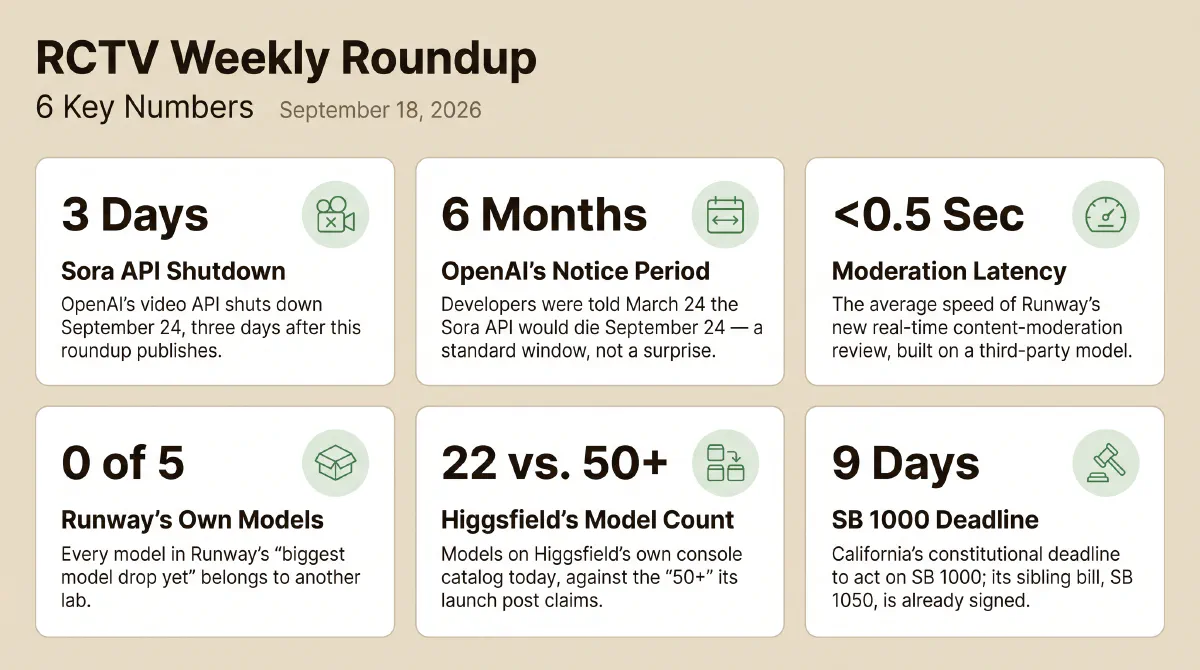
📈 By the Numbers
- 3 days — from this roundup’s publish date to the Sora API’s shutdown on September 24.
- 6 months — the notice period OpenAI gave developers before killing the Sora API, from its March 24 notification to the September 24 removal.
- <0.5 seconds — the average review time of Runway’s new real-time moderation system, built on Zentropi’s CoPE-B adapter over Google’s
Gemma-4-26B-A4B-it. - 0 of 5 — Runway models in Runway’s “biggest model drop yet”; every addition belongs to another lab.
- 22 vs. “50+” — models on Higgsfield’s own console catalog today against the count its launch post claims.
- 9 days — from publish to California’s constitutional deadline for SB 1000; its sibling bill, SB 1050, is already signed.
🔮 What to Watch Next Week
- September 24 — the Sora API actually goes dark, three days after this publishes.
- Whether Governor Newsom signs, vetoes, or lets SB 1000 lapse into law by California’s September 30 deadline.
- Whether one of the more powerful real-time models Runway says are coming ships. The moderation layer was built ahead of them, not after.
- Who Video Rebirth is. Its Bach 1.0 Pro sits #3 on Artificial Analysis’s no-audio image-to-video board at Elo 1,359, behind only Gemini Omni Flash and Wan 3.0, and the Singapore company’s own site names no Pro tier at all.
For full specs, pricing, and access details on every model covered this week, see the AI Video Stack 2026 reference page — updated every Monday.