Adobe and Runway both shipped generative AI tools directly into Premiere Pro and After Effects this week — on the same day, with different lists of partner models. Neither company explains the gap. California’s two AI-disclosure bills, meanwhile, picked up an actual deadline: under the state’s own constitution, both become law automatically on September 30 if Governor Newsom neither signs nor vetoes them.
Models covered: Adobe Firefly · Google Veo · Kling · Runway · Luma
🎬 Adobe and Runway Shipped Into the Same Two Apps. Their Model Lists Don’t Match.
Adobe shipped a native Generative Media Tool inside Premiere Pro and After Effects on September 8, per its own blog post. Editors pick a model and generate video or sound effects directly in the timeline, filling gaps using reference frames sampled from the project — no export, no round trip. Adobe names its own Firefly plus, in its own words, “partner models including Google Veo, Kling, Runway and Luma.” Four of the vendors this beat tracks, named by Adobe itself, landing inside the industry’s dominant professional editor.
Runway shipped something different the same day: a free-standing plugin, installed separately (Window → Extensions → Runway) and billed against a user’s own Runway plan rather than Adobe’s. Its video roster: Gen-4.5, Seedance 2.5, Kling 3.0 Pro and Veo 3.1, plus Aleph 2.0 for re-rendering an existing clip and Ruby for HDR conversion, neither of which generates from scratch. “No exports, no round trips,” Runway’s own plugin page says. “Your timeline stays your timeline.”
Line the two rosters up and they don’t match. Adobe names Luma; Runway’s own plugin doesn’t carry it. Runway’s plugin carries ByteDance’s Seedance 2.5; Adobe’s four partners don’t include it. Google’s Veo and Kuaishou’s Kling are the only outside models on both lists. Runway is on both too, in different guises: an outside partner in Adobe’s post, its own Gen-4.5 in its own plugin. Neither company explains the discrepancy. We don’t know why ByteDance is in one list and not the other, and neither primary says.
None of this is new strategy, just a new venue for it. Adobe Firefly became a 30-model aggregation hub back in April; Runway pivoted explicitly to aggregation in June, pitching itself as “the world’s best models, in one place.” What shipped this week is that strategy reaching the actual edit timeline, via two vendors racing each other into the same two apps on the same day. It also extends an argument made here in July: the moat was never the model, it’s the production loop around it. Adobe and Runway are both betting that the loop — the timeline itself — is worth more than any single model choice inside it, which is exactly why both companies can ship rival integrations into the same two apps without either one needing to win the underlying model fight.
Neither company says how the meter runs on someone else’s model. Adobe’s post covers capability, not billing — it doesn’t specify whether generating with Veo, Kling, Runway or Luma inside its panel draws on a user’s existing subscription to that vendor, on Adobe credits, or on some blended arrangement. Runway’s terms are explicit by contrast: its plugin runs entirely on the credits already on a user’s Runway plan, whether the request goes to Runway’s own Gen-4.5 or to a competitor’s Kling.
For an editor choosing between the two, the practical difference is where the model list lives and who’s billing for it. Adobe’s four partners sit inside Premiere’s own generative panel, presumably settled through some arrangement between Adobe and each partner that neither side has detailed. Runway’s four sit inside a separate extension, billed against Runway’s own plan no matter which of the four models actually renders the frame. Neither structure is obviously better for the person doing the editing — they’re just different products wearing the same “generate on your timeline” pitch.
Why it matters: Two aggregation strategies converged on the same real estate and produced two different vendor lists, and the mismatch is the whole story — nobody has settled who gets to be a “partner model” inside professional editing software, or on what basis. Adobe’s version runs through its own generative panel on terms Adobe hasn’t published; Runway’s runs through Runway’s plan and Runway’s credits. The editor gets more model choice either way. Just not the same choice, depending on which company’s panel they open.
⚖️ California’s Two AI-Disclosure Bills Just Got a Deadline
California’s AI Transparency Act rewrite, SB 1000, has sat on Governor Newsom’s desk since September 2 — confirmed directly against the bill’s own status page, not a tracker. Twelve days, as of this roundup’s publish date, still neither signed nor vetoed.
As passed, SB 1000 would remove the covered-provider user-count threshold from the state’s AI Transparency Act, rename “AI detection tool” to “disclosure verification tool,” and require latent disclosure stating that content is AI-generated or modified. Its urgency clause means those changes take effect the moment Newsom signs — not on the usual January 1 clock most statutes wait for.
SB 1050 joined SB 1000 on the Governor’s desk a week later: enrolled September 4, presented September 9. It adds a new article to the state’s false-advertising law requiring disclosure whenever an advertisement uses a synthetic performer — AI-generated output standing in for a real person or endorser. Both bills passed the Legislature before September 1 and reached the Governor’s desk on or after that date, which puts both under the same constitutional clock. Under Article IV, Section 10(b)(2) of the California Constitution, a bill in that position becomes law automatically if the Governor neither signs nor vetoes it by September 30 — a harder deadline than the ordinary 12-day clock most bills get, and not a tracker’s estimate. It’s the text that sets it.
Why it matters: September 30 is now a real date, not a guess, and it doesn’t force a single outcome for both bills. Newsom could sign one and veto the other, veto both, sign both, or let either lapse into law without his signature at all — the two bills could plausibly reach two different fates by the same date. Whichever way it breaks, California ends the month with more AI-disclosure law on the books than it had in August.
📈 By the Numbers
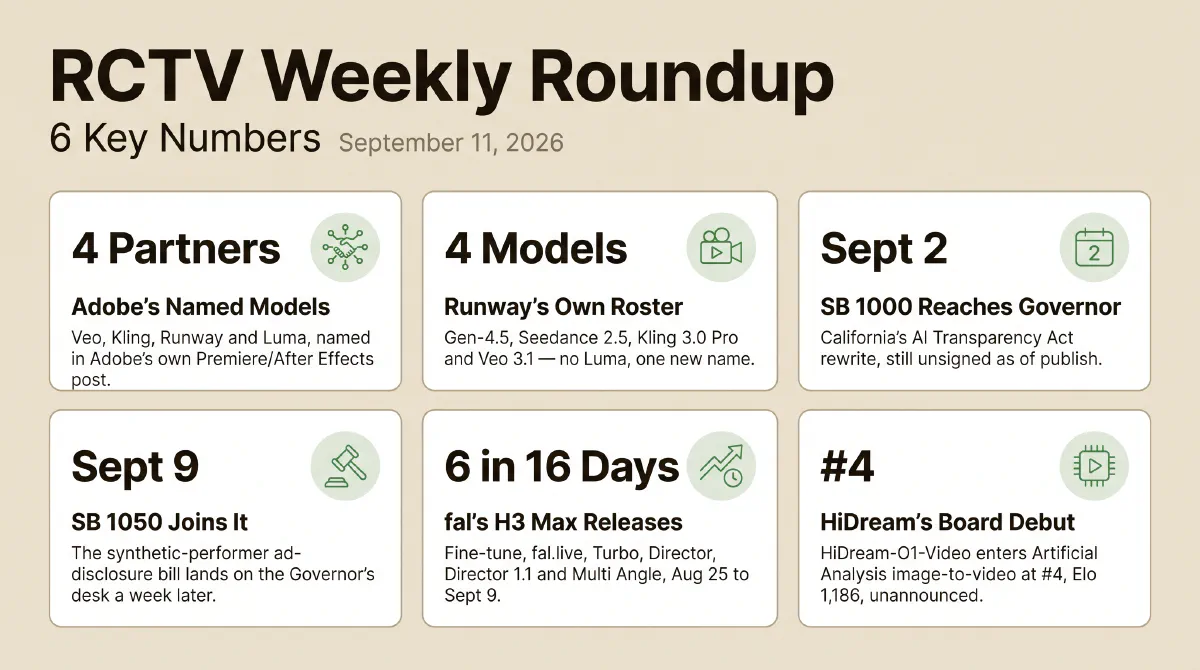
- 4 partners — Adobe names Google Veo, Kling, Runway and Luma as the models behind its new Premiere/After Effects Generative Media Tool.
- 4 models — Runway’s own, separately-shipped plugin carries Gen-4.5, Seedance 2.5, Kling 3.0 Pro and Veo 3.1 — a roster that swaps Luma for ByteDance’s Seedance.
- September 2 — the date SB 1000 reached the Governor’s desk; still unsigned.
- September 9 — the date SB 1050 joined it.
- 6 in 16 days — fal’s H3 Max releases from the August 25 fine-tune to Multi Angle on September 9: the fine-tune, fal.live, Turbo, Director, Director 1.1 and Multi Angle — with Reference-to-Video reaching general availability in the same stretch as a feature rather than a release.
- 1 new top-five entrant — HiDream-O1-Video debuted at #4 on Artificial Analysis’s image-to-video board (Elo 1,186) from a Beijing lab with no launch announcement anywhere we could find; the other two boards moved within noise.
🔮 What to Watch Next Week
- Whether Governor Newsom signs, vetoes, or lets either California bill lapse into law by September 30 — the state constitution’s own deadline, not an estimate.
- Whether Adobe or Runway adds a vendor to either roster, or ever explains the gap between the two.
- Whether HiDream.ai ever announces the model that Artificial Analysis already ranks fourth on image-to-video.
For full specs, pricing, and access details on every model covered this week, see the AI Video Stack 2026 reference page — updated every Monday.