Vidu shipped a new flagship with a leaderboard result and a price, and only one of them holds up against the primary sources. A Russian lab released an open audio-video model under plain MIT. Kling 4.0 now has a full spec table and still no price.
Models covered: Vidu Q4 · Kandinsky 6.0 · Kling 4.0 · SynthID
🏁 Vidu Q4 Preview Ties for Third on Image-to-Video. The $0.014 Headline Isn’t on Its Price Table.
On October 7, Vidu released Q4 Preview, its “next-gen flagship” video model. Artificial Analysis placed it third on its image-to-video board.
Read the board before the headline. On AA-Video-I2V v1.0, with audio, as we read it October 11: H3 Max 1195, H3 1181, Vidu Q4 Preview 1179 (±10), Gemini Omni Flash 1178, Seedance 2.0 at 720p 1176, HiDream-O1-Video 1175. Ranks three through six sit within four points, and every interval is ±7 to ±10. That is a tie for third, not a podium. The row also carries AA’s “Provisional result” label. This is the default view, which includes derived models. AA announced October 8 that derived models now show their base model’s logo and can be hidden; it lists H3 Max as built on H3, so the top of this list changes if you hide them.
The jump is the real story. Vidu Q3 Pro scored 1056 on the same board, 19th by AA’s count, so Q4 Preview adds about 123 points. Vidu’s page lists up to 15 reference images, three voice references, clips of 3 to 16 seconds and output to 4K. Q4 does image-to-video and reference-to-video only. It has no text-to-video mode, so the text-to-video boards have nothing to say about it. “Preview” is literal: the API model ID is viduq4-preview, and AA says the full release is still ahead. Nobody has given a date.
Now the price. Vidu’s launch post says “from $0.014/sec.” A reply the same afternoon calls that launch promotional pricing, with terms varying by plan and region. The API price table doesn’t contain it. Q4 Preview costs 9 credits a second at 540p, 19 at 720p, 24 at 1080p, 38 at 2K and 78 at 4K, with a credit listed at RMB 0.03125. AA converts the 1080p rate to $7.20 a minute, which is $0.005 a credit and puts 540p at $0.045 a second. fal, which hosts Q4, lists the same $0.045 for 540p after November 30, and $0.0315 under a 30% promotion until then. Neither is $0.014.
At 1080p the comparison does hold. Q4 Preview costs 24 credits a second, the same as Q3 Pro, so AA’s “better quality at the same price” checks out against Vidu’s table.
Why it matters: A lab that went from 19th to a tie for third in one version is a credible top-tier option on image-to-video. What a buyer pays is 9 to 78 credits a second, not the number in the launch video, and the rank is a provisional tie.
🔓 Kandinsky 6.0 Video Is Open Audio-Video Under Plain MIT. The 71% Is Sber’s.
Sber’s Kandinsky Lab open-sourced Kandinsky 6.0 Video on October 6, two days after posting the technical report. It is a joint audio-video family in two sizes, Lite at 3B parameters and Pro at 29B. Both make five-second clips with synchronized 44 kHz audio and lip-sync, from text or from an image. The repo supports Diffusers, ComfyUI, vLLM-Omni, SGLang and FastVideo.
The license file is the standard MIT text, copyright Kandinsky Lab, with no territory or use restriction. Set that against MiniMax H3’s license, which excludes the EU, the UK, South Korea and the United States, the clause behind our October 5 lead. One wrinkle: the main Pro checkpoint on Hugging Face carries the MIT tag and sits behind a form asking for contact information. The distilled Pro and the Lite repos don’t, and the README’s quick start uses the distilled one.
The quality claims are Sber’s. Its press service told T-J that Pro beats Kandinsky 5.0 “in 71% of cases,” beats the open LTX-2.5, and in image animation beats Veo 3.1 Fast. The paper’s abstract reports no such figure. It says Pro outperforms 5.0 and “remains competitive with leading audio-video generation models, particularly in speech quality,” in the lab’s own side-by-side human evaluation. Artificial Analysis’s image-to-video board doesn’t list it, and we found no independent test. T-J adds that Sber offers the model free in its GigaChat assistant, and quotes Sber calling it the first Russian model with synchronized sound.
Open weights still cost something to run. The README’s timings for a five-second clip on an RTX 4090: 936 seconds for Pro at standard definition, 1,247 at Full HD; Lite takes 437 at standard definition. On an 80 GB card, Pro needs CPU offload.
Why it matters: A license and a leaderboard answer different questions. MIT settles what the license lets you do with the weights. Nothing independent yet says how good they are, and the open-weights tracker exists because “open” has meant a lot of things this year.
🎬 Kling 4.0: A Full Spec Table, Its Own “Coming Soon” Caveats, and No Price
Kling’s release note now carries the full 4.0 table: 3 to 30 seconds, 720p to 4K, 21:9, stereo audio, up to 10 keyframes, up to 15 reference items. Read to the end and the page walks some of it back. 10-bit HDR output at 1080p and 4K is “coming soon,” as is video extension to two minutes. The Flash tier, in limited early access since September 28, tops out at 20 seconds, 720p and 8-bit SDR. The note says the full model launches in October.
The API pricing page says its plans “currently don’t support Kling 4.0” and lists no 4.0 or Flash row, so no 4.0 price exists anywhere. The homepage leads with “All-New Kling 4.0” and a Create Now button. Kling’s October 9 event post refers to “the launch of Kling 4.0” ahead of an October 14 panel in Santa Monica. Kling’s own release note and price page say it hasn’t happened. As of October 11, we can’t call it launched.
Why it matters: A flagship with a spec table and no price can’t be compared with anything. The tell on launch day is whether HDR and extension are live or still on the promise list.
🔍 SynthID Detector Goes Public. California’s Tool Rule Reads Differently.
On October 7, Google DeepMind said SynthID Detector is “available to everyone.” It checks content made with Google’s tools or with partners’: OpenAI, NVIDIA and Kakao, with Apple listed as coming. The portal takes images, audio and video, and says it is not a general AI detector; it recognizes only watermarks from companies that have adopted SynthID. Its terms bar bypassing the interface to “programmatically submit requests” or using the front end as an API for bulk checks.
California’s rewrite of its AI Transparency Act, SB 1000, signed September 30 as Chapter 861, asks each covered provider for a free, publicly accessible disclosure verification tool. It must accept uploads or URLs, output any system provenance data it finds, and support an API a user can invoke “without visiting the covered provider’s internet website.” The same section lets providers limit access when needed for security or to prevent misuse, and lets them satisfy the rule by pointing users to a third-party tool that complies itself. The penalty is $5,000 per violation, each day a separate one. It amends SB 942, the original Act, which we laid out in August.
The two texts differ. Neither Google’s post nor the portal mentions California. Whether the limitations clause reconciles them, and whether SynthID Detector is the tool the statute means, nothing we read says.
Why it matters: A verification tool software can’t call is hard to build a compliance workflow around, and the statute asks for one that can be called. The third-party route requires the other tool to comply too, API included, so the terms on any widely used detector become a compliance question.
🔎 Also Moving
Black Forest Labs says FLUX 3 is first on Physics-IQ. The third-party Anates board ranks FLUX 3 [large] first on net improvement, +12.27 points to Odyssey-3 Pro’s +11.15. BFL’s post says the base model leads and a version paired with a physics verification layer scores higher. The board marks both of the top two entries as using an LLM with a custom prompt source, so it is ranking pipelines, not bare models. On the board’s normalized cost, FLUX’s entry runs $0.868 a video and Odyssey-3 Pro’s $0.267.
Anthropic put Claude Motion in beta on October 8 for Team and Enterprise plans. It turns a prompt into a short animated explainer, built as code from your own text, charts and images, and exports an MP4. Anthropic says it uses no video generation model, so “no generated footage and no AI-generated people.” The generative part is a handoff: Anthropic lists Adobe, Descript, HeyGen, Higgsfield, invideo, Luma AI and Runway as places to take the file next, and Runway’s launch-partner page pitches exactly that, adding generated footage around the animation.
📈 By the Numbers
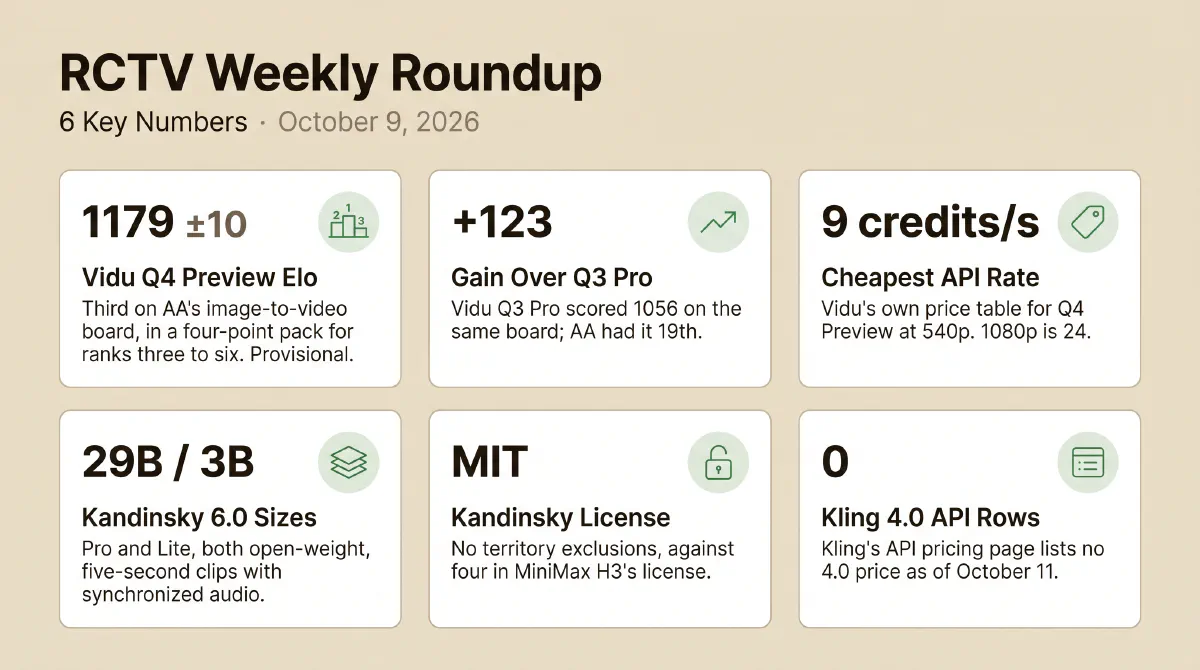
- 1179 (±10) — Vidu Q4 Preview’s Elo on Artificial Analysis’s image-to-video board, with audio, as read October 11: third, inside a four-point pack. Provisional.
- +123 — its gain over Vidu Q3 Pro (1056) on the same board.
- 9 credits/s — the cheapest Q4 Preview rate on Vidu’s API table, at 540p. 1080p is 24.
- 29B / 3B — parameters in Kandinsky 6.0 Video Pro and Lite, per the paper.
- MIT — Kandinsky 6.0’s license, with no territory exclusion.
- 0 — Kling 4.0 rows on Kling’s API pricing page as of October 11.
🔮 What to Watch Next Week
- Kling 4.0’s full launch. Busan’s ACFM runs through October 13 and the Santa Monica panel is October 14. Price and the two “coming soon” features are the open points.
- Vidu Q4 past Preview. A full-release date, and whether AA’s provisional row holds.
- An independent test of Kandinsky 6.0. Until one exists, the 71% is Sber’s figure alone.
For full specs, pricing, and access details on every model covered this week, see the AI Video Stack 2026 reference page — updated every Monday.