MiniMax’s open-weight H3 is turning into the base layer other companies build on, and this week three of them shipped models on it inside a day. The license they inherit excludes the United States. Whether anyone asked MiniMax’s permission is not on the record.
Models covered: MiniMax H3 · HeyGen · Utopai X · Kling · Runway
🧱 Three Companies Build on MiniMax H3 in a Day. Its License Excludes the US.
On September 30, HeyGen, Utopai Studios and Creatify Labs each announced a video model post-trained on H3. HeyGen’s catalog page for HeyGen Video 1.0 says it is “Built on MiniMax H3 and post-trained by HeyGen.” The price is $0.01 per second through October, via HeyGen’s API, OpenRouter, Runware and ComfyUI. Its quality numbers come from HeyGen’s own eval on Artificial Analysis Arena prompts; HeyGen is on neither AA board, so they are not a ranking.
Utopai X is the one with a ranking. Artificial Analysis’s debut post describes it as post-trained on MiniMax H3, running inside Utopai’s PAI platform with no public API. Utopai’s own launch post calls Utopai X proprietary and says only that it builds on an unnamed existing foundation model, so the H3 attribution is Artificial Analysis’s, not Utopai’s. Creatify’s Boreal-H3 is post-trained “specifically for advertising,” with vendor numbers (85.3% reference fidelity, brief success up from 28% to 50%) and no stated baselines. It is not the earlier Creatify “Boreal” already on the leaderboard.
The H3 license, dated August 2, defines Excluded Territories as the EU, the UK, South Korea and the United States. The grant applies “solely within the Applicable Territory,” which is everywhere else, and it follows where the model is used, not where the licensee is based: Section V.4 bars using, modifying or displaying the model or its Outputs outside that territory. Derivatives, distillations included, inherit the terms with no added conditions, and Outputs may not be used to improve other models. Section II invites anyone in an excluded territory to ask MiniMax for a license, and any user above $20 million in annual revenue needs written authorization regardless.
Now the mismatch. HeyGen is a Los Angeles company that describes itself as “a domestic corporation established in the United States.” Utopai is headquartered in Mountain View, California, and its launch post bills Utopai X as the “highest-ranked model from a U.S.-based company.” On the license’s plain text, a product that runs or displays H3-derived output in the United States sits outside the grant unless MiniMax licensed it separately. None of this week’s announcements mentions such a license, and we can’t tell whether either company has one.
The question has been open since August. fal, a San Francisco company, has offered its own H3 post-train, H3 Max, since then (the fourth H3 Max product came in early September), and on October 1 it added Recast, a one-click character swap built on H3 Max. Viggle-Animate inherited the terms without saying so. What changed this week is the layer: fal made H3 infrastructure for other hosts, and these three make it products.
MiniMax, meanwhile, keeps applauding. On fal’s launch blog in August, MiniMax’s H3 team called fal “a natural partner for H3 Max.” This week its X account quote-posted HeyGen’s launch, “proud to provide the foundation,” and did the same for Creatify’s. That reads like a partner, not a licensor with a problem. Either MiniMax is licensing US use privately, or its territory clause binds less than it reads. A MiniMax statement on licensees in excluded territories would settle which. None exists.
Artificial Analysis rebuilt its text-to-video board the same day. AA-Video-T2V v2.0 judges every model at 1080p, with more than 68,000 votes over 1,000 prompts. On the with-audio board as we read it October 4, Wan 3.0 leads at 1156, Utopai X is second at 1148, Seedance 2.5 third at 1142, and H3 at 768p fourth at 1138, with fal’s H3 Max fifth at 1134. The top four sit within 18 points on error bars of roughly ±9 to ±10, so it is a pack, not a podium. Three of the top five are H3 or built on it. On the companion no-audio board, which launched the same day, Wan 3.0 leads at 1129, and H3 at 768p and H3 Max take second and third. Kling 3.0 at 1080p (Pro) is the fixed anchor at 1000. The scale is new, so none of this compares with any earlier Elo.
Why it matters: An open-weight license is a distribution channel only for the territories it covers. Three products built on H3 launched this week where it doesn’t, and the lab welcomed them. Until MiniMax says which rule applies, every US company building on H3 is relying on a permission nobody has published.
🎬 Kling 4.0 Arrives as a Spec Sheet, a Yearly-Subscriber Tier and a Month, Not a Date
Kuaishou’s @Kling_ai account announced Kling 4.0 on September 28. The claims: up to 4K, 10-bit HDR, 15 multimodal references, 10 keyframes, native 30-second generation, stereo audio. The release date: “Kling 4.0 is coming this October.” The only thing shipping now is Kling 4.0 Flash, live for Ultra Yearly subscribers.
kling.ai carries an “All-New Kling 4.0” banner and no price, date, resolution or HDR text, and no mention of October. Kling 4.0 is on no Artificial Analysis board; the newest Kling entry is 3.0. A creator post that disclosed Kling paid for it says launch output is 1080p and cheaper than Seedance, which conflicts with the “up to 4K” headline. Nobody has resolved that. fal says 4.0 is coming soon to fal with Flash in limited early access, which fits Kling’s own account.
An October 2 article by a Kling creative partner, shared by Kling’s account, calls the current access a closed beta, with the official launch still ahead.
So: one headline spec, one gated tier, the product weeks away. As of October 4 it has not launched.
Why it matters: Kling’s last flagship set the anchor on the new Artificial Analysis scale. The next one is being priced into expectations before anyone outside Kuaishou has run it.
⚖️ California Signs SB 1000, Chapter 861, and Two Companion Bills
Governor Newsom approved SB 1000 on September 30. The bill history records it as Chapter 861, Statutes of 2026. It carries an urgency clause: the text says it takes effect immediately, so the effective date is signature, not January.
It amends the California AI Transparency Act, which was already operative on August 2. SB 1000 does not start that clock; it changes a live law. The covered-provider definition loses its 1,000,000-monthly-user threshold. The “AI detection tool” becomes a “disclosure verification tool.” Systems whose primary function is assistive technology are exempt until January 1, 2029, with a $50,000-per-violation penalty for falsely claiming the exemption. The general penalty stays at $5,000.
SB 1000 is the amending bill our August correction separated from the Act itself. As of September 30 it is law too, and it widens who the Act binds.
Two companions were signed the same day, per the Governor’s release. AB 2713 (Wicks), Chapter 856, bars large online platforms, meaning those with more than 2,000,000 unique monthly users, from knowingly stripping system provenance data or digital signatures where technically feasible, starting January 1, 2027. The release summarizes it as “prohibiting the deletion of a digital watermark,” which is looser than the statute. SB 1111 (Ashby), Chapter 862, makes a “digital replica” part of a person’s voice or likeness under California’s likeness-rights civil action, and makes using one to impersonate someone a form of false impersonation under a new Penal Code section 540. SB 1159, on AI transparency and governance, was also signed; we have not read it.
Why it matters: The detection-tool and threshold changes pull smaller generative-video vendors into a regime that used to cover only the biggest. For a video company the date to watch is January 1, 2027, when platform-side provenance becomes the other half of the same system.
🛒 Runway Joins the OpenAI Marketplace and Launches Ads. Economics Undisclosed on Both.
Runway says it is joining the OpenAI Marketplace as a “launch partner,” so enterprise customers can apply part of their OpenAI commitment to Runway purchases. Listed: Gen-4.5, Seedance 2.5, GPT Image 2.5 and ElevenLabs V4. Runway resells other labs’ models next to its own. The “launch partner” language is Runway’s alone. OpenAI’s directory lists Runway without it, and its FAQ says customers “contract with and pay the partner directly.” No pricing or revenue share appears anywhere. A day later Runway’s changelog added a second OpenAI surface: Runway inside OpenAI’s Dots.
Runway Ads, announced September 30, is “piloting” with select enterprise partners. Runway’s own figures: weekly ad volume up from 77 to roughly 900, conversion up roughly 34%, cost per subscriber down 41%. They describe Runway’s own pilot, with no outside check. A “$100M ARR” figure appears in Runway’s X post and not on the page, so we leave it out.
It extends a pattern we’ve tracked since summer, from Runway’s own Media Router to the September week when Higgsfield, Pika and Runway all leaned into selling other labs’ models. This time the storefront belongs to OpenAI.
Why it matters: The lab with the most to lose from aggregation is now selling through it. The numbers that would say whether that works, price and split, are the ones nobody printed.
🔎 Also Moving
Higgsfield called its native-1080p Seedance 2.5 “the only US-based” one at its highest quality. Runway’s API changelog lists Seedance 2.5 1080p from August 15, so we skip the superlative. Vidu announced Vidu S2 on September 28, a model family for voice-controlled characters, outfit changes and digital humans; it is vendor-only and unchecked. HiDream-O1-Video sits fifth on Artificial Analysis’s image-to-video board, on the older v1.0 scale.
📈 By the Numbers
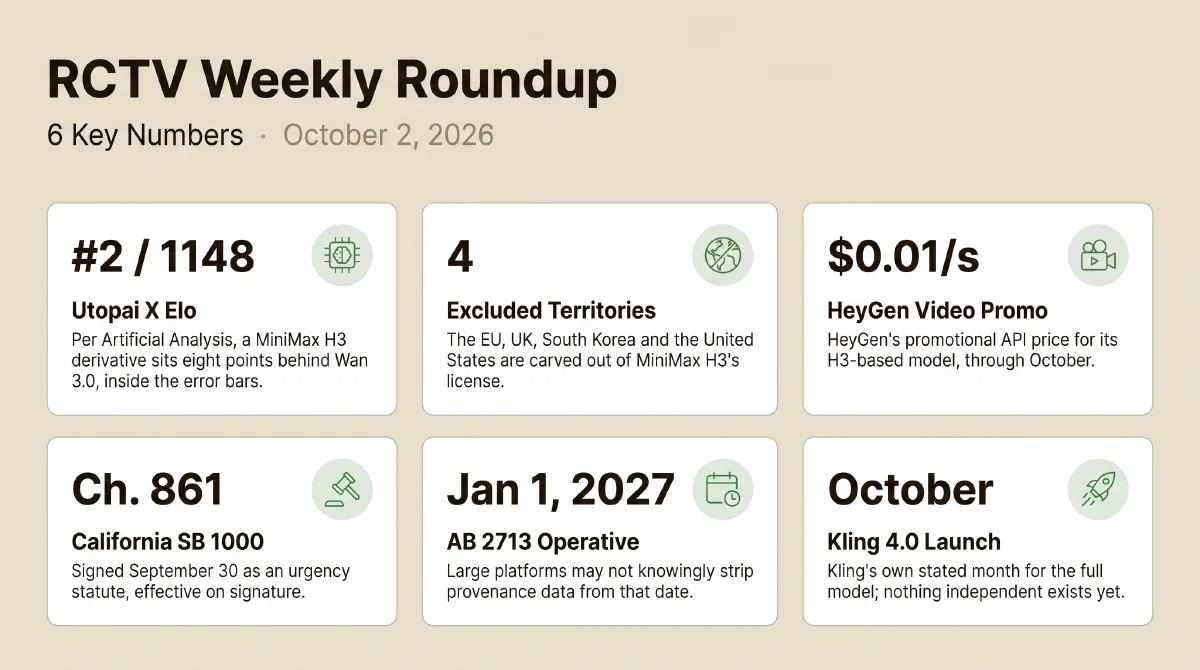
- #2 / 1148 — Utopai X’s Elo on Artificial Analysis’s rebuilt text-to-video board, eight points behind Wan 3.0 as read October 4, with overlapping intervals.
- 4 — territories excluded by the H3 license, United States included.
- $0.01/s — HeyGen Video 1.0’s promotional price through October.
- Chapter 861 — California SB 1000, signed September 30, effective on signature.
- Jan 1, 2027 — when AB 2713’s platform provenance duty starts.
- October — the month Kling says 4.0 launches in full.
🔮 What to Watch Next Week
- Kling 4.0’s full launch. Price and resolution are where the sources already disagree.
- A MiniMax statement on licensees in excluded territories. None exists yet.
- Artificial Analysis’s image-to-video board on the v2.0 scale. AA says it is coming; every Elo moves again when it does.
- SB 1000’s implementation and AB 2713’s January 1, 2027 start.
For full specs, pricing, and access details on every model covered this week, see the AI Video Stack 2026 reference page — updated every Monday.