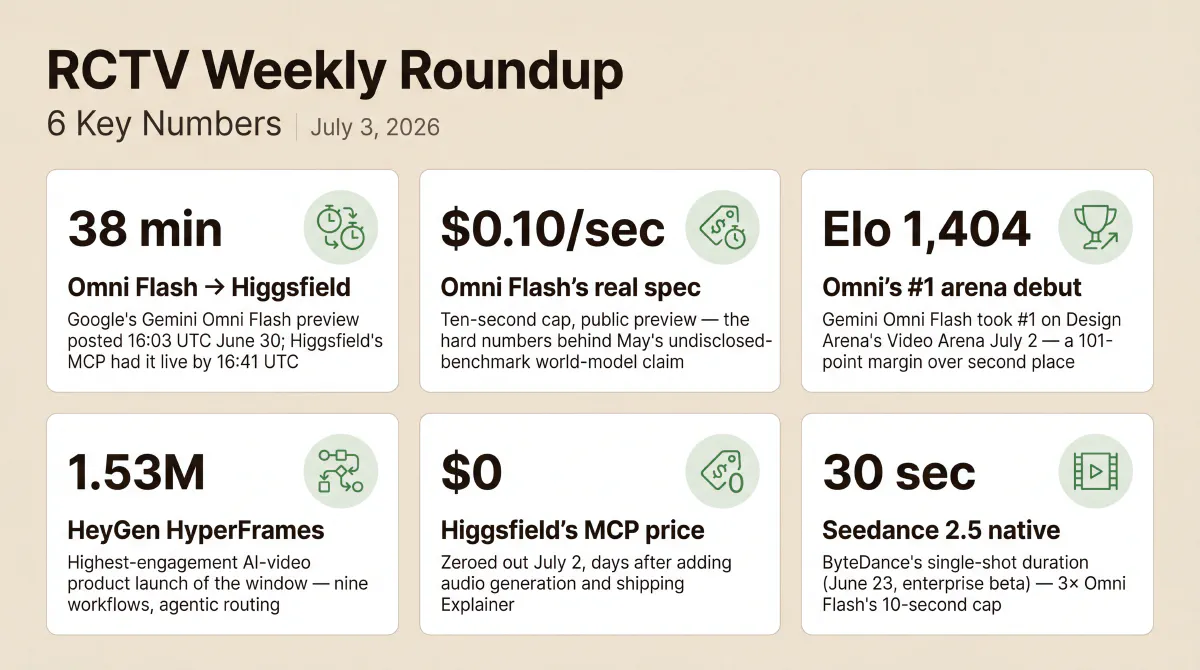
Google shipped the most-hyped new model of the week into public preview on June 30. Higgsfield had it live inside its MCP 38 minutes later. Everything else that moved this window — HeyGen’s agentic workflow routing, Higgsfield’s audio pipeline and price cut, Runway’s conglomerate deal and Skills layer — happened one level up, at the workflow wrapped around the model. The leaderboards, meanwhile, barely twitched.
Models covered: Gemini · HeyGen · HappyHorse
🤝 Gemini Omni Flash Landed in Preview. Higgsfield Had It Live in 38 Minutes.
Google DeepMind put Gemini Omni Flash into public preview on June 30 — not the general availability that circulated in coverage this week. Google’s own post is specific: “Gemini Omni is available in public preview starting today in Google AI Studio and the Gemini API.” Alongside it, Nano Banana 2 Lite — a 4-second text-to-image model at $0.034 per image — shipped as a full release, live today across AI Studio, the Gemini API, and the Enterprise Agent Platform, and rolling out to Google’s consumer surfaces: Search’s AI Mode, the Gemini app, NotebookLM, Google Photos, and Flow.
Omni Flash’s own spec: $0.10 per second, capped at 10-second generations “currently, with longer durations coming soon,” prompted in natural language, editable in conversation. This is the answer to the question the May 21 flagship asked and Google didn’t answer at the time: what does “a first step toward a world model” actually ship as? A price. A limit. And an admission, in Google’s own words, that “character consistency when changing scenes or panning movements has some limitations.”
Higgsfield didn’t wait around for Google to fix that. Google’s announcement went out at 16:03 UTC. Higgsfield’s post landed 38 minutes later, at 16:41 UTC: “This is the Nano Banana moment for AI video!” It’s the highest-engagement post of the entire coverage window — 2,053,097 impressions, more than Google’s own announcement drew. Runway added the model at 19:24 UTC the same day, then Nano Banana 2 Lite the following morning, extending the aggregator identity it stated outright on June 23: “the world’s best models, in one place.” (Luma also added Seedance 2.0 Mini the same day — a different model, part of the Seedance wave we covered last week, not this race.)
Two days later, the first independent scoreboard landed. Omni Flash debuted #1 on Design Arena’s Video Arena at Elo 1,404 (July 2) — a 101-point margin over second place, one of the board’s largest gaps on record. Keep the caveats attached: Design Arena isn’t Artificial Analysis, the board we’ve tracked all year, and Omni’s score there is still pending; on Design Arena’s own image-to-video board, Seedance 2.0 still ranks ahead of it. A record margin on one arena and a 10-second preview cap are both true at once.
Why it matters: Two weeks ago we said the game had moved to aggregation. This week Google handed the aggregators a brand-new model, in preview, and they had it live before most people finished reading the blog post. The June 11 agentic flagship called this trajectory; absorption speed just became the metric that proves it.
🛠️ Nobody Won This Week With a Better Model
Three vendors, one pattern: the contest moved to the workflow wrapped around the model, not the model itself.
HeyGen shipped HyperFrames “Next Generation Skills” June 26 — nine production workflows (launch videos, music videos, captions and overlays on video, six more) with agentic routing: “it knows which one you mean from context and routes there on its own.” No manual workflow picker required. At 1,525,794 impressions, it’s the highest-engagement AI-video product launch of the entire June coverage period — the June 11 agentic-orchestration thesis shipped as a feature, not argued as a prediction.
Higgsfield spent the window completing its own pipeline, then removing the price floor entirely. On June 27, audio generation landed in the Higgsfield MCP — voiceovers, voice cloning, and dubbing across 50-plus languages, powered by Seed Audio 1.0 and ElevenLabs v3, so a creator can generate video and voiceover in one session. On July 2, Higgsfield shipped Explainer: faceless documentaries up to 10 minutes, auto-researched and narrated, built on Claude Fable 5 — the first pulse sighting of Anthropic’s newest model inside a vendor’s production pipeline — plus Gemini Omni Flash. The same day, Higgsfield made its MCP free: 100 credits and a 3-day full-access trial for new users. Two days after the Omni Flash story above, Higgsfield had shipped a net-new product on top of it and zeroed the price of admission to the pipeline underneath it.
Runway went the other direction — up-market. On July 1, Runway announced a partnership with Bertelsmann, integrating its models “across Bertelsmann’s global portfolio of businesses” — RTL Group, BMG, and Bertelsmann Marketing Services. RTL’s Fremantle is already running Runway through its in-house AI studio, Imaginae; BMG is using it for artist marketing visuals. “Content businesses across Bertelsmann are adopting AI at scale,” said Bertelsmann Chief Data Officer Rhys Nölke, “and we are empowering creatives multimodally.” That’s a genuine enterprise-adoption story, not a pilot — a traditional media conglomerate running a generative-video vendor across broadcast, music, and marketing simultaneously. A day later, Runway shipped Agent Skills: a slash-command layer on top of Runway Agent for building ad campaigns, commercials, and localized ads on demand. Runway is now the third vendor, after Pika and Luma, to converge on “Skills” as the name for a portable agent workflow.
Why it matters: Nobody won this week by shipping a better model. HeyGen, Higgsfield, and Runway all bet on owning more of the workflow around models they don’t have to build. The Bertelsmann deal alone could headline its own roundup on a slower week — it’s flagged here rather than split out because the workflow-layer pattern, not any one deal, is the fact of this window.
⚖️ Idaho’s Law Goes Live. Arizona Vetoes — Just Not the Bill We Were Tracking.
Idaho HB 727 took effect July 1, per the Idaho legislature: the first US state law to explicitly bring AI-generated synthetic media inside its video-voyeurism statute, with new penalties for disclosing explicit synthetic media of a real person. Covered platforms and individuals face criminal liability in Idaho now, not on some future compliance date.
Arizona moved the other way — mostly. Gov. Katie Hobbs vetoed a wave of AI bills June 19, including HB 2133, which would have required sites hosting sexual imagery — AI-generated included — to verify the depicted person’s age and consent. Her veto message said the bill “has a chilling effect on free speech and would violate First Amendment rights”; the sponsor countered that the bill’s exemptions for news, parody, and artistic expression already addressed that. The same day’s sweep also killed an AI-agency-rulemaking bill (HB 2592), an AI-chatbot-and-minors bill (HB 2311), and an AI-in-schools mandate (HB 4005).
One bill isn’t on that list, and the reason is the story: SB 1786 — the AI content-provenance mandate RCTV has tracked since April — was never vetoed, because it never reached Hobbs’s desk. After clearing both chambers, it was recalled to the Senate for “reconsideration” on April 27 and stalled there; legislative trackers list it dead as of early May, two months before the June 19 veto sweep. The bill didn’t get vetoed. It quietly died first, and got folded into “Hobbs vetoed everything” reporting anyway.
Why it matters: Idaho live, one Arizona bill vetoed on First Amendment grounds, and another dead of natural causes months earlier — three different outcomes in the same coverage window describe the actual patchwork. That fragmentation is what the compliance scorecard is built to map; this roundup just reports the pieces.
📈 By the Numbers
- 38 minutes — Google’s Gemini Omni Flash preview went live at 16:03 UTC June 30; Higgsfield’s absorption post landed at 16:41 UTC. Runway added the model at 19:24 UTC the same day.
- 2,053,097 impressions — Higgsfield’s Omni Flash post, the highest-engagement post of the coverage window, on a model Google’s own blog admits still struggles with character consistency across scene changes.
- $0.10/sec, 10-second cap — Gemini Omni Flash’s actual public-preview spec, replacing the undisclosed-benchmark “world model” language from May’s I/O launch.
- 30 seconds — the native single-shot duration ByteDance announced for Seedance 2.5 at its Volcano Engine FORCE conference June 23 (enterprise beta; public launch targeted early July). Three times Omni Flash’s cap — the leaderboard leader is still pushing raw capability even as the commodity tier gets absorbed in minutes. The absorption race is at the distribution tier, not the frontier.
- 1,525,794 impressions — HeyGen’s HyperFrames agentic-routing launch, the highest-engagement AI-video product launch of the entire coverage window.
- $0 — Higgsfield zeroed its MCP price July 2, days after adding audio generation and shipping Explainer.
- Elo 1,151 / 1,116 — HappyHorse-1.1 held #2 on both Artificial Analysis with-audio boards (T2V and I2V) as of July 3; Seedance 2.0 stayed #1 on both, unmoved since its June 23 debut.
🔮 What to Watch Next Week
- EU transparency Code of Practice — July 22 signatory deadline. The AI Office’s marking-and-labelling Code (published June 10) opens for signatures; watch which video labs sign before the list locks, ahead of the binding Article 50 date.
- EU AI Act Article 50 disclosure obligation — August 2, 27 days out at publish. AI video platforms operating in Europe are on the clock for labeling requirements.
- California’s AI Transparency Act (SB 942, as amended by AB 853) — free AI-detection-tool deadline also August 2.
- Seedance 2.5 public launch — early July. ByteDance’s #1-ranked model moves from enterprise beta to public: native 30-second single-shot, up to 50 reference materials, joint audio-video generation. Watch the shipped spec against the announcement — and the licensing questions trade press has started raising.
- “Skills” as a naming convergence — Pika, Luma, and now Runway have all landed on the term for portable agent workflows. Watch for a fourth vendor, or an interop claim between them.
- Kuaishou/Kling financing — still a press-attributed round, not a company-confirmed one. Arms the Kling business piece on Caixin/SCMP-tier confirmation.
For full specs, pricing, and access details on every model covered this week, see the AI Video Stack 2026 reference page — updated every Monday.