Meta spent this week claiming its new real-time avatar system beats the two leading commercial rivals on nearly everything it measured. Two days earlier, one of those rivals, HeyGen, had put out a benchmark arguing that nobody has solved the hard part — including whoever happens to be winning. Both can be true. Read together, they’re the week.
Models covered: Meta · HeyGen · Runway · Higgsfield
🎭 Meta Claims Muse Beats Runway and HeyGen at Live Avatars — With One Tie It Admits Itself
Meta published “Bringing Your Muse to Life” on September 23, introducing Muse Realtime Avatar: a system that takes Meta’s existing Muse Realtime Voice model and renders it as a live, responsive on-screen character — a portrait that reacts with subtle expressions, an illustration that gestures as it talks, an object or animal that stays recognizably itself while it moves. Meta announced it the next day on X, in a thread tied to a MetaConnect keynote.
The Muse name first turned up in July, when Meta Superintelligence Labs previewed Muse Video at #3 on Design Arena — preview, not product. Realtime Avatar is a different model in the same family, and this one arrives with named competitors.
The technical claim: Meta’s post names two techniques stacked together, self-forcing and distribution matching distillation, which cut inference from 120 neural function evaluations per chunk down to 2, a 60x reduction, while training the system to resist the drift that live, unbounded generation tends to accumulate. The result streams 448×768 video at 25 frames per second with roughly 870 milliseconds of latency from the end of a user’s turn to the first byte of response, on Meta’s own custom real-time inference stack.
The competitive claim is the one that matters here: Meta compared Muse Realtime Avatar directly against Runway Characters and HeyGen LiveAvatar, using each product’s own live-call experience, and reports that raters preferred Muse Realtime Avatar “overall and across every evaluated dimension.” Meta flags one exception itself: against Runway Characters, the mannerism comparison came out a statistical tie. That’s the whole caveat Meta offers, and it’s worth adding the one it doesn’t: this is Meta’s study, on dimensions Meta chose, with no outside replication yet.
Why it matters: A frontier lab just benchmarked itself against two named commercial products and reported winning nearly everything. That’s a confident public claim, and it lands two days after one of those two rivals published research saying the hard part is still unsolved.
🪞 HeyGen’s Own Benchmark Says the Field Hasn’t Solved Craft — Including Whoever’s Winning
HeyGen’s HyperFrames team put its Code2Video benchmark in front of the field on September 21, built with Google DeepMind and Kaggle; the report itself is dated September 18. It’s a different kind of benchmark than Meta’s: Code2Video scores 168 curated motion-graphics briefs, rendered as code (HTML/React, not diffusion video) through HyperFrames, and judged across five axes — Engagement, Prompt-Intent, Composition, Temporal, and Craft — by a purpose-built “Judge” model trained on human preference data rather than a general vision-language model.
The headline finding, in the report’s own words: “following the brief is nearly solved; craft is not.” The top four models on the leaderboard sit within 12 Elo points of each other with overlapping confidence intervals — the newest OpenAI model in the field didn’t pull ahead of its own predecessor. Open-weight models land within 50 Elo of the leader. Models cluster closest on following instructions and spread furthest apart on composition and craft — the parts of the job a human designer still owns.
HeyGen built a dedicated model for the judging job rather than repurposing a general-purpose one, and discloses why: general vision-language models agree with human raters only about 75% of the time on which of two videos is better, against 82% for HeyGen’s own Judge model — and the more confident the Judge is on a given call, the more often it’s right, up to 98.8% agreement on its highest-confidence verdicts. That’s a smaller detail than the headline finding, but it’s the load-bearing one: a “craft is not solved” conclusion is only as trustworthy as whatever concluded it, and HeyGen is disclosing a real but modest accuracy edge over a general model, not claiming to have solved evaluation either.
Two days later, Meta named HeyGen as one of the products it beat. Both can be true at once. The two studies don’t even measure the same kind of system — Code2Video scores language models writing motion graphics, Meta scored live avatars — but they point at the same gap: getting a model to do what was asked is the easy part now, and making the result look finished isn’t. That’s the line July’s production-is-the-moat piece drew, with HyperFrames as one of its two case studies: scenes came easy, finishing didn’t. It also backs the model-commodification argument in June’s agentic-orchestration piece. Four models within 12 Elo of each other is what a commodity looks like.
Why it matters: On Code2Video, following the brief no longer separates the models; finish does, and nobody has it locked. Meta’s avatar win is a claim about one product in Meta’s own study. HeyGen’s finding is a claim about the whole field.
💰 Higgsfield Says It Crossed $1B in Annualized Revenue — By Its Own Count
Higgsfield posted the milestone on September 24: “18 months after launch, our annualized revenue crossed $1 billion,” per its own account. Bloomberg’s headline on the same news is more careful — Higgsfield “Eyes $1 Billion in 12-Month Sales”. Neither version is audited, and Higgsfield hasn’t said how it counts.
The curve underneath is better documented. Roughly $200M at the end of 2025, a reported ~$500M in July, then $700M annualized, per the company’s own release, when its $400M Series B closed at a $5.4B valuation on August 17. If the new number holds, the run rate added about $300M in five weeks.
It’s also a storefront’s revenue. Higgsfield sells other labs’ models beside its own — this week it added a cheap preview tier for ByteDance’s Seedance 2.5 — which makes this the clearest number yet on whether renting out other people’s models pays. That’s the bet three storefronts doubled down on last week as OpenAI walked away from it. The API Higgsfield opened September 17 can’t take much credit; most of the climb came before it existed. For now it’s something Higgsfield pays people to try: five hours after the revenue post, it promised 100% cashback on API spend across every model, up to $100,000 per business from a $20 million pool; later posts raise the cap to $200,000 and pay it out as API credits.
Why it matters: If reselling other labs’ models is a business, this is what it looks like at scale: a claimed $1B run rate, reported by the reseller. The trajectory is on record. The top line is Higgsfield’s word.
The Sora API shutdown last week’s roundup counted down happened on schedule September 24. OpenAI’s deprecations page still lists no replacement for any of the retired models.
📈 By the Numbers
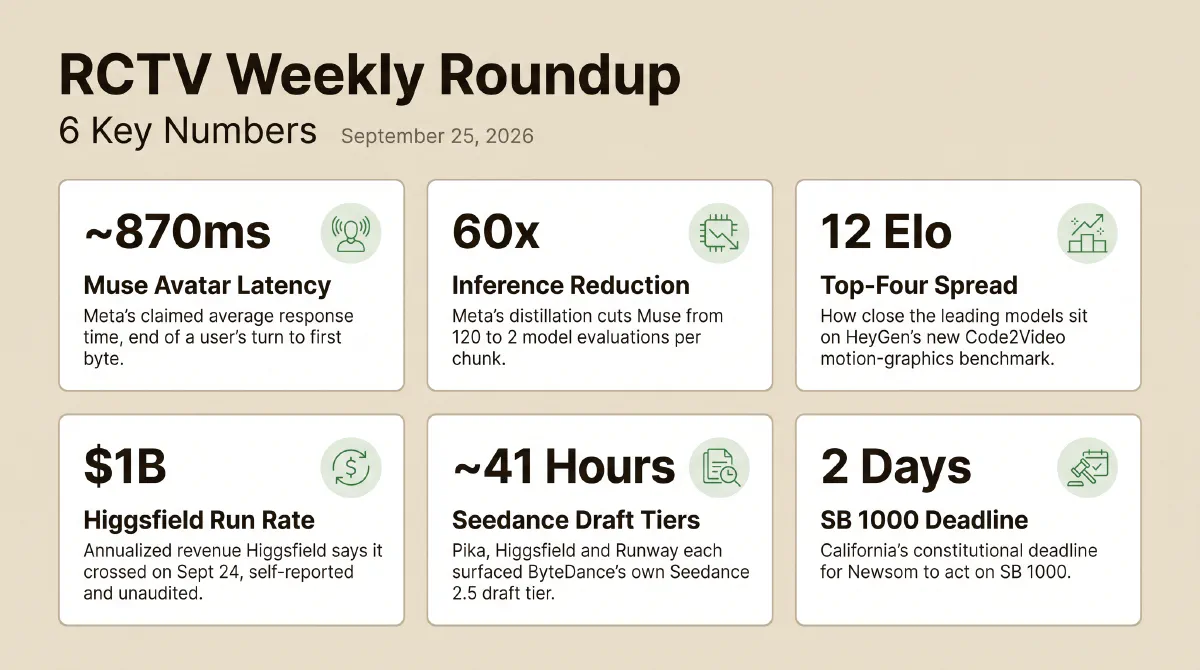
- ~870ms — Meta’s claimed average latency for Muse Realtime Avatar’s live response, from the end of a user’s turn to the first byte.
- 60x — the inference-step reduction (120 → 2 neural function evaluations per chunk) Meta’s distillation technique claims for Muse.
- 12 Elo — the margin separating the top four models on HeyGen, Google DeepMind and Kaggle’s new Code2Video benchmark, with overlapping confidence intervals. No clear winner.
- $1B — the annualized revenue Higgsfield says it crossed on September 24, self-reported and unaudited; $700M at its August Series B close.
- ~41 hours — the span in which Pika, Higgsfield and Runway each surfaced ByteDance’s own Seedance 2.5 draft tier.
- 2 days — from this roundup’s publish date to California’s constitutional deadline for Governor Newsom to act on SB 1000.
🔮 What to Watch Next Week
- September 30 — California’s constitutional deadline for Governor Newsom to act on SB 1000, the broader AI Transparency Act rewrite. With no signature or veto as of publish, the bill becomes law automatically under Article IV, Section 10(b)(2) if the Governor still hasn’t acted by then.
- Andersen v. Stability AI: the artist plaintiffs moved to modify the case schedule on September 21, with the requested changes redacted, and Stability AI opposed on September 25. Judge Orrick’s ruling sets the calendar for the training-data case that matters most to video models; until then, any trial date in circulation is a guess.
- Runway keeps shipping itself into other people’s tools: Brand Kits on its MCP server (Sept 22), a DaVinci Resolve plugin and Runway MCP on Cursor (both Sept 23), then Runway MCP in Claude (Sept 25) — four adds in four days. Watch whether it adds up to more than changelog lines.
- One ByteDance feature, three launch posts. ByteDance documents its own two-step Draft mode for Seedance 2.5 — a cheap draft billed as 480p, full price only on the final take — and it surfaced as Pika’s Draft Mode and Higgsfield’s Preview Mode (both September 23), then Runway’s Draft mode (September 24). Watch whether the storefronts ship anything on Seedance that ByteDance didn’t build first.
- Whether the next model release moves Code2Video’s craft axis, or “brief-following solved, craft not” holds through another benchmark cycle.
For full specs, pricing, and access details on every model covered this week, see the AI Video Stack 2026 reference page — updated every Monday.